/*! This file is auto-generated */ .wp-block-button__link{color:#fff;background-color:#32373c;border-radius:9999px;box-shadow:none;text-decoration:none;padding:calc(.667em + 2px) calc(1.333em + 2px);font-size:1.125em}.wp-block-file__button{background:#32373c;color:#fff;text-decoration:none} Q80E Consider the system of component... [FREE SOLUTION] | ÷ÈÓ°Ö±²¥

÷ÈÓ°Ö±²¥

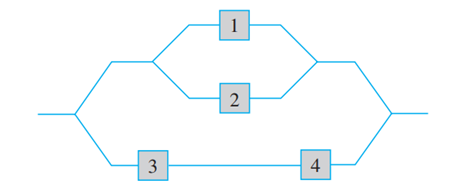
Consider the system of components connected as in the accompanying picture. Components \({\rm{1}}\) and \({\rm{2}}\) are connected in parallel, so that subsystem works iff either 1 or 2 works; since \({\rm{3}}\)and\({\rm{4}}\) are connected in series, that subsystem works iff both\({\rm{3}}\)and\({\rm{4}}\)work. If components work independently of one another and P(component i works) \({\rm{ = }}{\rm{.9}}\)for \({\rm{i = }}{\rm{.1,2}}\)and \({\rm{ = }}{\rm{.8}}\)for \({\rm{i = 3,4}}\),calculate P(system works).
Short Answer

Expert verified

The system works is \(\begin{array}{c}{\rm{P( system works ) = 0}}{\rm{.9964}}\\{\rm{ = 99}}{\rm{.64\% }}\end{array}\)

Step by step solution

01

Definition of Independence

Independence If the probability of one event is unaffected by the occurrence or non-occurrence of the other, two events are said to be independent in probability. Consider the following example for a better understanding of this definition.

02

Given parameters

Given: Five valves

\(\begin{array}{l}{\rm{P( component 1 works ) = 0}}{\rm{.9}}\\{\rm{P( component 2 works ) = 0}}{\rm{.9}}\\{\rm{P( component 3 works ) = 0}}{\rm{.8}}\\{\rm{P( component 4 works ) = 0}}{\rm{.8}}\end{array}\)

The components are self-contained.

03

Finding the system works

For independent events, use the following multiplication rule:

\({\rm{P(A and B) = P(A)*P(B)}}\)

For any two events, the following is the general addition rule:

\({\rm{P(A or B) = P(A) + P(B) - P(A and B)}}\)

Use the multiplication rule for independent events:

\({\rm{P( component 1 and 2 work ) = P( component 1 works )*P( component 2 works )}}\)\({\rm{ = 0}}{\rm{.9*0}}{\rm{.9 = 0}}{\rm{.81}}\)

If component \({\rm{1}}\)or component \({\rm{2}}\)work, the top subsystem will also work. For any two occurrences, apply the general addition rule:

\({\rm{P}}\left( {{\rm{top sub system works }}} \right){\rm{ = P( component\;works ) + P( component\;works ) - P(component\;andwork )}}\)\({\rm{ = 0}}{\rm{.9 + 0}}{\rm{.9 - 0}}{\rm{.81 = 0}}{\rm{.99}}\)

If both components \({\rm{3}}\) and \({\rm{4}}\)are operational, the bottom subsystem will function. For independent events, use the multiplication rule:

04

Explanation of the solution

\({\rm{P}}\left( {{\rm{bottom subsystem works }}} \right){\rm{ = P( component\;works )*P( component\;works)}}\)\({\rm{ = 0}}{\rm{.8*0}}{\rm{.8 = 0}}{\rm{.64}}\)

The two subsystems are independent, because each component is independent. Use the multiplication rule for independent events:

\({\rm{P}}\left( {{\rm{both subsystems work}}} \right){\rm{ = P}}\left( {{\rm{top subsystem works}}} \right){\rm{* P}}\left( {{\rm{bottom subsystem works}}} \right)\)\({\rm{ = 0}}{\rm{.99*0}}{\rm{.64 = 0}}{\rm{.6336}}\)

The system will then work if either the top subsystem works or the bottom subsystem works. Use the general addition rule for any two events:

\({\rm{P}}\left( {{\rm{system works}}} \right){\rm{ = P}}\left( {{\rm{top subsystem works}}} \right){\rm{ + P}}\left( {{\rm{bottom subsystem works}}} \right)\)

\(\begin{array}{c}{\rm{ = 0}}{\rm{.99 + 0}}{\rm{.64 - 0}}{\rm{.6336}}\\{\rm{ = 0}}{\rm{.9964 = 99}}{\rm{.64\% }}\end{array}\)

Therefore,The system works is \(\begin{array}{c}{\rm{P( system works ) = 0}}{\rm{.9964}}\\{\rm{ = 99}}{\rm{.64\% }}\end{array}\)

Unlock Step-by-Step Solutions & Ace Your Exams!

  • Full Textbook Solutions

    Get detailed explanations and key concepts

  • Unlimited Al creation

    Al flashcards, explanations, exams and more...

  • Ads-free access

    To over 500 millions flashcards

  • Money-back guarantee

    We refund you if you fail your exam.

Over 30 million students worldwide already upgrade their learning with ÷ÈÓ°Ö±²¥!

One App. One Place for Learning.

All the tools & learning materials you need for study success - in one app.

Get started for free

Most popular questions from this chapter

A sonnet is a \({\rm{14}}\)-line poem in which certain rhyming patterns are followed. The writer Raymond Queneau published a book containing just \({\rm{10}}\) sonnets, each on a different page. However, these were structured such that other sonnets could be created as follows: the first line of a sonnet could come from the first line on any of the \({\rm{10}}\) pages, the second line could come from the second line on any of the \({\rm{10}}\) pages, and so on (successive lines were perforated for this purpose).

a. How many sonnets can be created from the \({\rm{10}}\) in the book?

b. If one of the sonnets counted in part (a) is selected at random, what is the probability that none of its lines came from either the first or the last sonnet in the book?

A college library has five copies of a certain text onreserve. Two copies (1 and 2) are first printings, and the other three (3, 4, and 5) are second printings. A student examines these books in random order, stopping only when a second printing has been selected. One possible outcome is 5, and another is 213.

a. List the outcomes in S.

b. Let Adenote the event that exactly one book must be examined. What outcomes are in A?

c. Let Bbe the event that book 5 is the one selected. What outcomes are in B?

d. Let Cbe the event that book 1 is not examined. What outcomes are in C?

Each of a sample of four home mortgages is classified as fixed rate (F) or variable rate (V).

a. What are the 16 outcomes in S?

b. Which outcomes are in the event that exactly three of the selected mortgages are fixed rate?

c. Which outcomes are in the event that all four mortgages are of the same type?

d. Which outcomes are in the event that at most one of the four is a variable-rate mortgage?

e. What is the union of the events in parts (c) and (d), and what is the intersection of these two events?

f. What are the union and intersection of the two events in parts (b) and (c)?

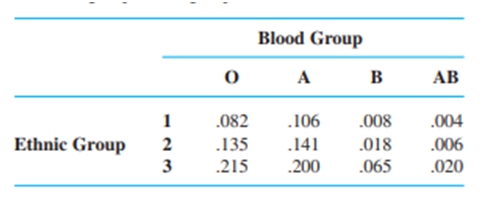
The population of a particular country consists of three ethnic groups. Each individual belongs to one of the four major blood groups. The accompanying joint probability table gives the proportions of individuals in the various ethnic group-blood group combinations.

Suppose that an individual is randomly selected from the population, and define events by \({\rm{A = }}\)\{type A selected), \({\rm{B = }}\) (type B selected), and \({\rm{C = }}\) (ethnic group \({\rm{3}}\) selected).

a. Calculate\({\rm{P(A),P(C)}}\), and \({\rm{P(A{C}C)}}\).

b. Calculate both \({\rm{P(A}}\mid {\rm{C)}}\)and \({\rm{P(C}}\mid {\rm{A)}}\), and explain in context what each of these probabilities represents.

c. If the selected individual does not have type B blood, what is the probability that he or she is from ethnic group\({\rm{1}}\)?

A certain shop repairs both audio and video components. Let A denote the event that the next component brought in for repair is an audio component, and let B be the event that the next component is a compact disc player (so the event B is contained in A). Suppose that \(P\left( A \right) = 0.6\)and\(P\left( B \right) = 0.05\). What is\(P\left( {B|A} \right)\)?

See all solutions

Recommended explanations on Math Textbooks

View all explanations

What do you think about this solution?

We value your feedback to improve our textbook solutions.

Study anywhere. Anytime. Across all devices.