/*! This file is auto-generated */ .wp-block-button__link{color:#fff;background-color:#32373c;border-radius:9999px;box-shadow:none;text-decoration:none;padding:calc(.667em + 2px) calc(1.333em + 2px);font-size:1.125em}.wp-block-file__button{background:#32373c;color:#fff;text-decoration:none} Q6E A college library has five copie... [FREE SOLUTION] | ÷ÈÓ°Ö±²¥

÷ÈÓ°Ö±²¥

A college library has five copies of a certain text onreserve. Two copies (1 and 2) are first printings, and the other three (3, 4, and 5) are second printings. A student examines these books in random order, stopping only when a second printing has been selected. One possible outcome is 5, and another is 213.

a. List the outcomes in S.

b. Let Adenote the event that exactly one book must be examined. What outcomes are in A?

c. Let Bbe the event that book 5 is the one selected. What outcomes are in B?

d. Let Cbe the event that book 1 is not examined. What outcomes are in C?

Short Answer

Expert verified

a. The possible outcomes are,

\(S = \left\{ {\left( 3 \right),\left( 4 \right),\left( 5 \right),\left( {13} \right),\left( {14} \right),\left( {15} \right),\left( {23} \right),\left( {24} \right),\left( {25} \right),\left( {123} \right),\left( {124} \right),\left( {125} \right),\left( {213} \right),\left( {214} \right),\left( {215} \right)} \right\}\)

b. The possible number of outcomes in event A are,

\(A = \left\{ {3,4,5} \right\}\)

c. The possible outcomes in event B are,

\(B = \left\{ {5,15,25,125,215} \right\}\)

d. The possible outcomes in event C are,

\(C = \left\{ {3,4,5,23,25} \right\}\)

Step by step solution

01

Given information

There are 5 copies of a certain text on reserve.

The first printing is two copies (1 and 2) and the second printing are other three copies (3, 4, and 5).

A possible outcome is 5 and another is 213.

02

List of the possible outcomes in S

a.

Let S represents the sample space.

For the provided scenario, the possible number of outcomes is,

\(S = \left\{ {\left( 3 \right),\left( 4 \right),\left( 5 \right),\left( {13} \right),\left( {14} \right),\left( {15} \right),\left( {23} \right),\left( {24} \right),\left( {25} \right),\left( {123} \right),\left( {124} \right),\left( {125} \right),\left( {213} \right),\left( {214} \right),\left( {215} \right)} \right\}\)

Here, the outcome 123 represents that the 1st copy of 1st printing, 2nd copy of first printing, and 3rd copy of second printing are examined and then the student stops.

03

List of the possible outcomes in A

b.

A represents the event that exactly one book must be examined.

The possible number of outcomes in A are,

\(A = \left\{ {3,4,5} \right\}\)

04

List of the possible outcomes in event B

c.

B represents the event that book 5 is the one selected.

Event B will include all the events where book 5 is selected.

The possible outcomes are,

\(B = \left\{ {5,15,25,125,215} \right\}\)

05

List of the possible outcomes in event C

d.

C represents the event that book 1 is not examined.

The possible outcomes included in the C are,

\(C = \left\{ {3,4,5,23,25} \right\}\)

Unlock Step-by-Step Solutions & Ace Your Exams!

  • Full Textbook Solutions

    Get detailed explanations and key concepts

  • Unlimited Al creation

    Al flashcards, explanations, exams and more...

  • Ads-free access

    To over 500 millions flashcards

  • Money-back guarantee

    We refund you if you fail your exam.

Over 30 million students worldwide already upgrade their learning with ÷ÈÓ°Ö±²¥!

One App. One Place for Learning.

All the tools & learning materials you need for study success - in one app.

Get started for free

Most popular questions from this chapter

A friend who lives in Los Angeles makes frequent consulting trips to Washington, D.C.; \({\rm{50\% }}\)of the time she travels on airline\({\rm{\# 1}}\), \({\rm{30\% }}\) of the time on airline \({\rm{\# 2}}\), and the remaining \({\rm{20\% }}\) of the time on airline #3. For airline \({\rm{\# 1}}\), flights are late into D.C. \({\rm{30\% }}\) of the time and late into L.A. \({\rm{10\% }}\) of the time. For airline\({\rm{\# 3}}\), these percentages are \({\rm{25\% }}\) and \({\rm{20\% }}\), whereas for airline #3 the percentages are \({\rm{40\% }}\) and \({\rm{25\% }}\). If we learn that on a particular trip she arrived late at exactly one of the two destinations, what are the posterior probabilities of having flown on airlines \({\rm{\# 1}}\), \({\rm{\# 2}}\), and \({\rm{\# 3}}\)? Assume that the chance of a late arrival in L.A. is unaffected by what happens on the flight to D.C. (Hint: From the tip of each first-generation branch on a tree diagram, draw three second-generation branches labeled, respectively, \({\rm{2}}\) late, \({\rm{2}}\) late, and \({\rm{2}}\) late.)

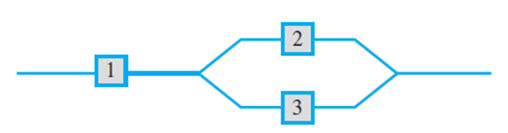
Three components are connected to form a system as shown in the accompanying diagram. Because the components in the 2–3 subsystem are connected in parallel, that subsystem will function if at least one of the two individual components functions. For the entire system to function, component 1 must function and so must the 2–3 subsystem.

The experiment consists of determining the condition of each component (S(success) for a functioning componentand F (failure) for a non-functioning component).

a. Which outcomes are contained in the event Athat exactly two out of the three components function?

b. Which outcomes are contained in the event Bthat at least two of the components function?

c. Which outcomes are contained in the event Cthat the system functions?

d. List outcomes in C’, A \( \cup \)C, A \( \cap \)C, B \( \cup \)C, and B \( \cap \)C.

Computer keyboard failures can be attributed to electrical defects or mechanical defects. A repair facility currently has \({\rm{25}}\) failed keyboards, \({\rm{6}}\) of which have electrical defects and 19 of which have mechanical defects.

a. How many ways are there to randomly select \({\rm{5}}\) of these keyboards for a thorough inspection (without regard to order)?

b. In how many ways can a sample of\({\rm{5}}\) keyboards be selected so that exactly two have an electrical defect?

c. If a sample of \({\rm{5}}\) keyboards is randomly selected, what is the probability that at least \({\rm{4}}\) of these will have a mechanical defect

An ATM personal identification number (PIN) consists of four digits, each a\({\rm{0, 1, 2, \ldots 8, or 9}}\), in succession.

a. How many different possible PINs are there if there are no restrictions on the choice of digits?

b. According to a representative at the author’s local branch of Chase Bank, there are in fact restrictions on the choice of digits. The following choices are prohibited: (i) all four digits identical (ii) sequences of consecutive ascending or descending digits, such as \({\rm{6543}}\) (iii) any sequence starting with \({\rm{19}}\) (birth years are too easy to guess). So, if one of the PINs in (a) is randomly selected, what is the probability that it will be a legitimate PIN (that is, not be one of the prohibited sequences)?

c. Someone has stolen an ATM card and knows that the first and last digits of the PIN are \({\rm{8}}\) and\({\rm{1}}\), respectively. He has three tries before the card is retained by the ATM (but does not realize that). So, he randomly selects the \({\rm{2nd and 3rd}}\) digits for the first try, then randomly selects a different pair of digits for the second try, and yet another randomly selected pair of digits for the third try (the individual knows about the restrictions described in (b) so selects only from the legitimate possibilities). What is the probability that the individual gains access to the account?

d. Recalculate the probability in (c) if the first and last digits are \({\rm{1}}\) and \({\rm{1}}\), respectively.

A production facility employs 10 workers on the day shift, \({\rm{8}}\) workers on the swing shift, and 6 workers on the graveyard shift. A quality control consultant is to select \({\rm{5}}\) of these workers for in-depth interviews. Suppose the selection is made in such a way that any particular group of \({\rm{5}}\) workers has the same chance of being selected as does any other group (drawing \({\rm{5}}\) slips without replacement from among \({\rm{24}}\)).

a. How many selections result in all \({\rm{5}}\) workers coming from the day shift? What is the probability that all 5selected workers will be from the day shift?

b. What is the probability that all \({\rm{5}}\) selected workers will be from the same shift?

c. What is the probability that at least two different shifts will be represented among the selected workers?

d. What is the probability that at least one of the shifts will be unrepresented in the sample of workers?

See all solutions

Recommended explanations on Math Textbooks

View all explanations

What do you think about this solution?

We value your feedback to improve our textbook solutions.

Study anywhere. Anytime. Across all devices.