Chapter 1: Q15. (page 30)
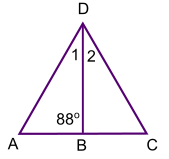
What kind of angle is ?
Short Answer
The angle represents itself as an obtuse angle.
/*! This file is auto-generated */ .wp-block-button__link{color:#fff;background-color:#32373c;border-radius:9999px;box-shadow:none;text-decoration:none;padding:calc(.667em + 2px) calc(1.333em + 2px);font-size:1.125em}.wp-block-file__button{background:#32373c;color:#fff;text-decoration:none}
Learning Materials
Features
Discover
Chapter 1: Q15. (page 30)
What kind of angle is ?

The angle represents itself as an obtuse angle.
All the tools & learning materials you need for study success - in one app.
Get started for free
Reword Theorem 1-3 as two statements, one describing the existence and the other describing uniqueness.
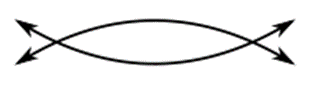
Theorem 1-1 states that two lines intersect at exactly one point. The diagram suggests what would happen if you tried to show two 鈥渓ines鈥 drawn through two points. State the postulate that makes this situation impossible.

Classify each statement as true or false.
It is possible for two intersecting lines to be non-coplanar.
Draw two points P, Q on a sheet of paper. Fold the paper so that fold line f contain both P, Q. Unfold the paper. Now fold so that P falls on Q. Call the second fold g. Lay the paper flat and label the intersection of f and g as X. How are points P, Q and X? Explain.
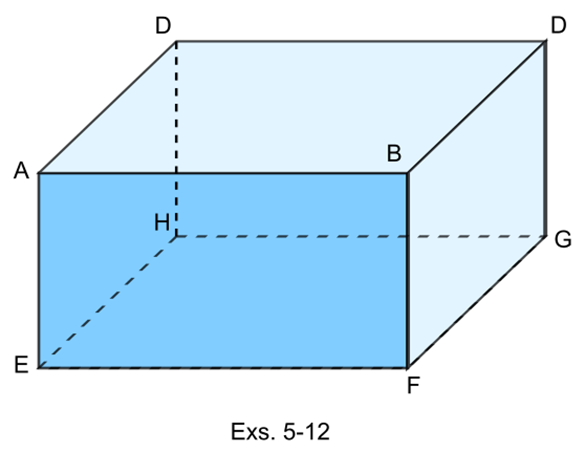
In Exercises 5-11 you will have to visualize certain lines and planes not shown in the diagram of the box. When you name a plane, name it by using four points, no three of which are collinear.

Write the postulate that assures you that exists.
What do you think about this solution?
We value your feedback to improve our textbook solutions.