Explanations
  Textbooks
  Flashcards
  魅影直播 AI
  Notes
Notes  Study Plans
  Study Sets
  Find a degree
  Magazine
 Chapter 1: Points, Lines, Planes and Angles
Q1
Name the vertex and sides of .
Q1
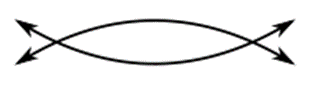
Theorem 1-1 states that two lines intersect at exactly one point. The diagram suggests what would happen if you tried to show two 鈥渓ines鈥� drawn through two points. State the postulate that makes this situation impossible.
Q1
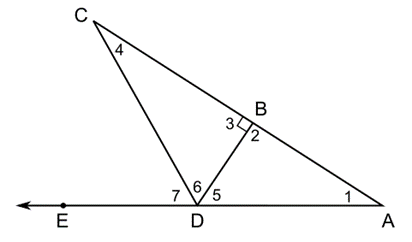
For the following figure, name the vertex and sides of the angle .
Q1
Copy and complete the table. Refer to the diagram on pages 1 and 2.
Distance between | Diagram distance | Ground distance |
X and P | 5 cm | 10 cm |
X and F | 7 cm | ? cm |
X and T | ? cm | ? cm |
Y and F | ? cm | 19 cm |
F and T | 12 cm | ? cm |
Q1.
For the following symbols, find the symbols that represent a line, segment, ray, or length.
a.
b.
c.
d.
Q1.
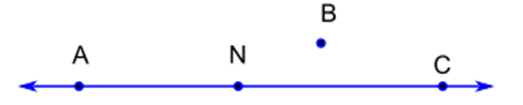
Write three names for the line pictured.
Q10
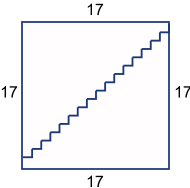
A path between opposite vertices of the square is made up of hundreds of horizontal and vertical segments. (The diagram shows a simplified version.) What is the best approximation to the length of the path-24, 34, 44, or more than 44?
Q10
Can a given line be in two planes? In ten planes?
Q10
Classify each statement as true or false.
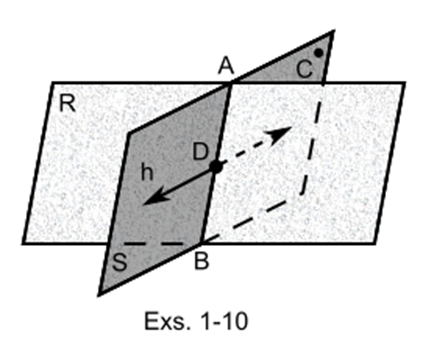
A, B, C, and D are coplanar.
Q11
State whether the angle appears to be acute, right, obtuse, or straight. Then estimate its measure.