Explanations
  Textbooks
  Flashcards
  魅影直播 AI
  Notes
Notes  Study Plans
  Study Sets
  Find a degree
  Magazine
 Chapter 1: Q14WE. (page 25)
State whether it is possible for the figure described to exist. Write yes or no.
Three points all lie in each of the two planes.
Short Answer
Yes, it is possible that three points all lie in each of the two planes.
Step by step solution
Step 1. Write the concept involved.
The concept involved is that if there are three collinear points then through these points infinite planes can pass but if there are three noncollinear points then through these points only one plane can pass.
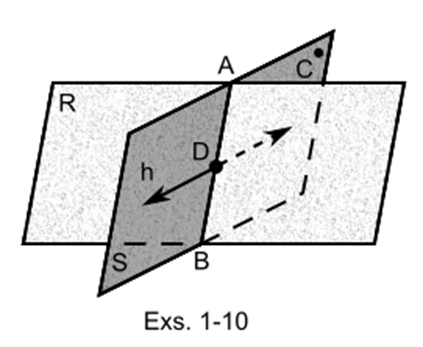
Step 2. Draw the diagram of two planes passing through three points A, B, and C.
The figure represents two planes passing through three points , and is:

Step 3. State whether it is possible that three points all lie in each of two planes by considering the concept and above diagram.
From the diagram and concept, it can be noticed that if three points are collinear then all three points can lie in each of the two planes. Therefore, it is possible that any three points can simultaneously lie on two different planes.
Therefore, it is possible that three points all lie in each of the two planes.

Over 30 million students worldwide already upgrade their learning with 魅影直播!