/*! This file is auto-generated */ .wp-block-button__link{color:#fff;background-color:#32373c;border-radius:9999px;box-shadow:none;text-decoration:none;padding:calc(.667em + 2px) calc(1.333em + 2px);font-size:1.125em}.wp-block-file__button{background:#32373c;color:#fff;text-decoration:none} Q18-13TYU. Prostrate cells usually require ... [FREE SOLUTION] | ÷ÈÓ°Ö±²¥

÷ÈÓ°Ö±²¥

Prostrate cells usually require testosterone and other androgens to survive. But some prostate cancer cells thrive despite treatments that eliminate androgens. One hypothesis is that estrogen, often considered a female hormone, may be activating genes normally controlled by androgen in these cancer cells. Describe one or more experiments to test this hypothesis. (See Figure 11.9 to review the action of these steroid hormones).

Short Answer

Expert verified

The hypothesis stating the activation of prostate cancer cells is to check the interaction of estrogen hormones with receptors present within the nucleus. This interaction can activate the transcription of genes present in these cancer cells.

Step by step solution

01

Prostate cancer and its treatment 

Prostate cancer is male cancer that occurs in the prostate gland. The growth of this cancer takes place with the help of hormones such as testosterone.

The treatment for prostate cancer blocks testosterone. But in some cases, even the blockage of androgenic hormones makes the progress of cancer. This condition is due to the presence of estrogen hormones, a female hormone that helps the survival of the cancer cells.

02

Role of androgen and estrogen in prostate cancer 

The group of male hormones secreted in the body is known as androgen. Overproduction of androgen can result in prostate cancer. The other stimulant for the activation of prostate cancer is estrogen.

Estrogen is the female hormone with a similar role compared to the androgens in the activation of cancer cells.

03

Experiment to test the hypothesis that supports the survival of cancer cells.

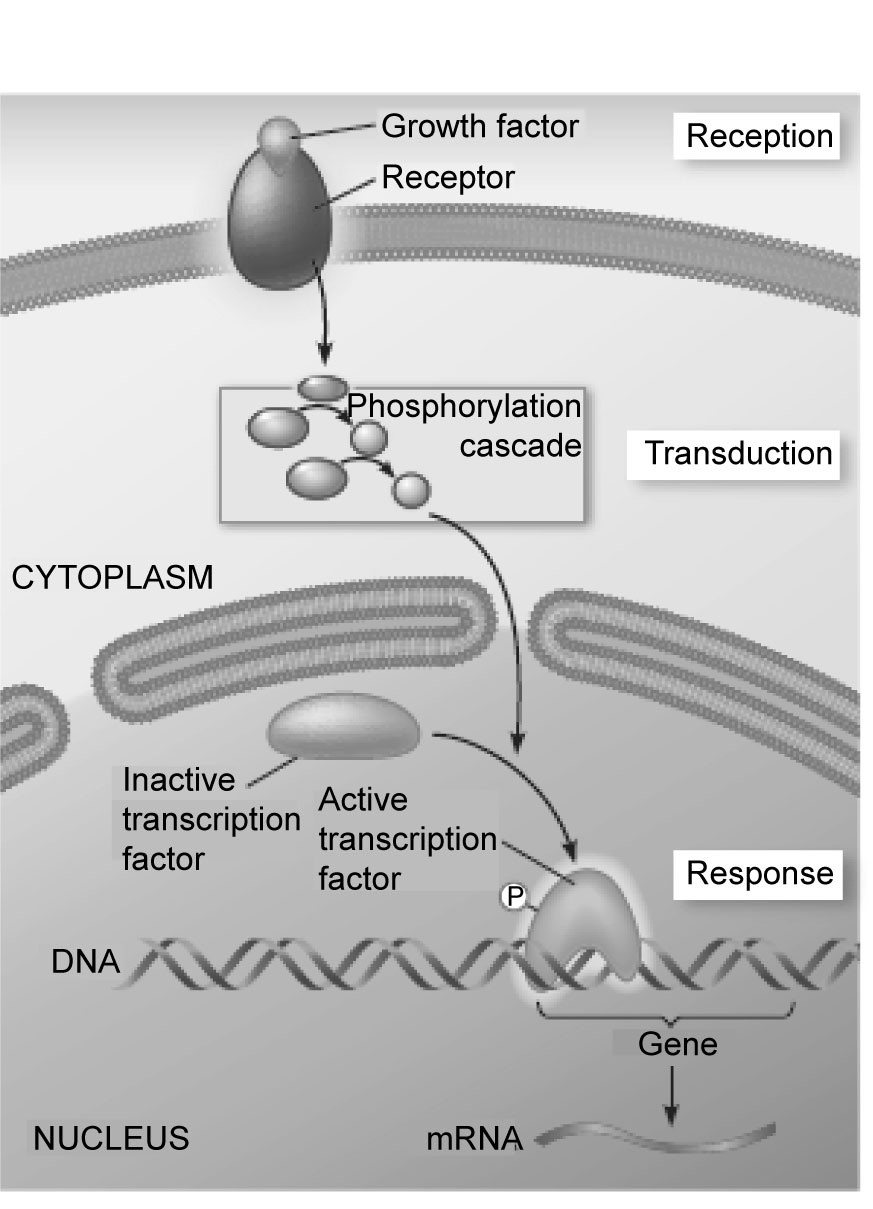
The estrogen hormones present in the body interact with the receptor, leading to the formation of receptor hormone complex within the cell.

The hormone complex acts as a transcription factor that enters the nucleus and activates the gene present in the cancer cells. The transcription of a gene present in cancer helps in the survival of the prostate cancer cells.

The experiment can be framed to design an inhibitor that can bind to the cancer cell receptor. The inhibitor or ligand designed can block the transcription of the genes present in the cancer cells.

Thus, blocking the transcription process initiated by the receptor hormone complex can prove the hypothesis that estrogen can activate the genes present in cancer cells.

Unlock Step-by-Step Solutions & Ace Your Exams!

  • Full Textbook Solutions

    Get detailed explanations and key concepts

  • Unlimited Al creation

    Al flashcards, explanations, exams and more...

  • Ads-free access

    To over 500 millions flashcards

  • Money-back guarantee

    We refund you if you fail your exam.

Over 30 million students worldwide already upgrade their learning with ÷ÈÓ°Ö±²¥!

One App. One Place for Learning.

All the tools & learning materials you need for study success - in one app.

Get started for free

Most popular questions from this chapter

In a short essay (100-150words), discuss how the processes shown in Figure 18.2 are examples of feedback mechanisms regulating biological systems in bacterial cells.


Explain how the signaling molecules released by an embryonic cell can induce changes in a neighboring cell without entering the cell. (See Figures 11.15 and 11.16.)

The p53 protein can activate genes involved in apoptosis. Review Concept 11.5, and discuss how mutations in genes coding for proteins that function in apoptosis could contribute to cancer.

Inactivation of one of the X chromosomes in female mammals involves IncRNA called XIST RNA, mentioned in this section and in Concept 15.2. Describe transcription and binding of XIST RNA, then suggest a model for how it initiates Barr body formation.

The diagram below five genes, including their enhancers, from the genome of a certain species. Imagine that pink, blue, green, black, grey and dark blue activator proteins exist that can bind to the approximately colour-coded control elements in the enhancers of these genes.

(a) Draw an X above enhancer elements (of all the genes) that would have activators bound in a cell where only gene five is transcribed. Identify which coloured activators would be present.

(b) Draw a dot above all enhancer elements that would have activators bound in a cell where the green, blue, and yellow activators are present. Identify which gene(s) would be transcribed.

(c) Imagine that genes 1, 2, and 4 codes for nerve-specific proteins, and genes 3 and 5 are skin-specific. Identify which activators would have to be present in each cell type to ensure transcription of the appropriate genes.

See all solutions

Recommended explanations on Biology Textbooks

View all explanations

What do you think about this solution?

We value your feedback to improve our textbook solutions.

Study anywhere. Anytime. Across all devices.