
 Explanations
  Textbooks
  Flashcards
  魅影直播 AI
  Notes
Notes  Study Plans
  Study Sets
  Find a degree
  Magazine
 Chapter 42: Circulation and Gas Exchange
Q42.3-1ITD.
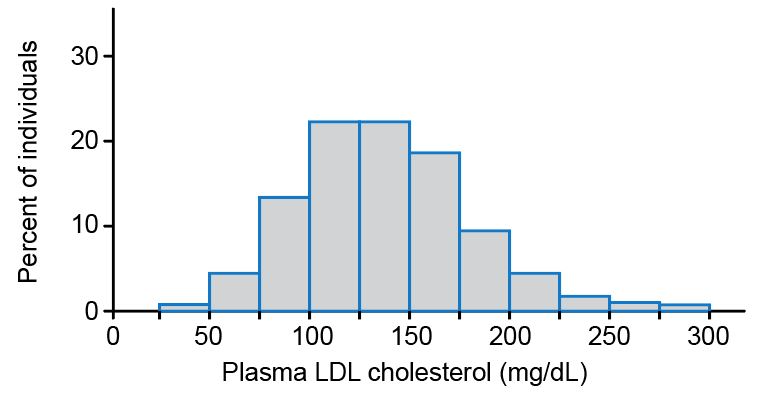
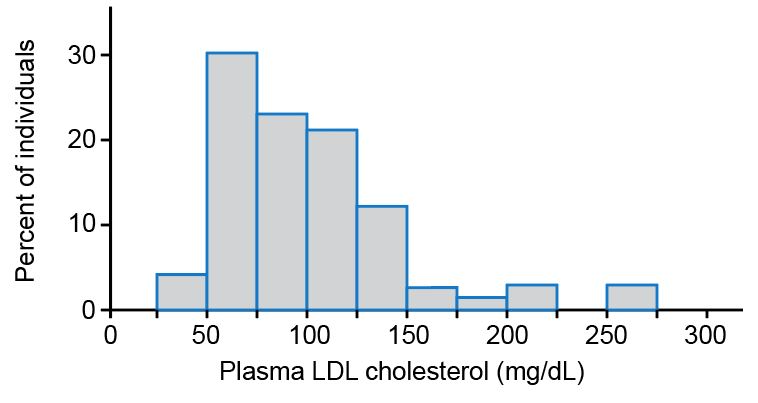
The results are presented using a variant of a bar graph called a histogram. In a histogram, the variable on the x-axis is grouped into ranges. The height of each bar in this histogram reflects the percentage of samples that fall into the range specified on the x-axis for that bar. For example, in the top histogram, about 4% of individuals studied had plasma LDL cholesterol levels in the 25鈥�50 mg/dL (milligrams per deciliter) range. Add the percentages for the relevant bars to calculate the percentage of individuals in the study and control groups that had an LDL level of 100 mg/dL or less. (For additional information about histograms, see the Scientific Skills Review in Appendix F and in the Study Area in MasteringBiology.)
Q42.3-3CC.
If you had additional hearts distributed throughout your body, what would be one likely advantage and one likely disadvantage?
Q42.3-5ITD.
Comparing these two histograms allowed researchers to draw a conclusion regarding the effect of PCSK9 mutations on LDL cholesterol levels in the blood. Consider two individuals with a plasma LDL level cholesterol of 160 mg/dL, one from the study group and one from the control group. What do you predict regarding their relative risk of developing cardiovascular disease? Explain how you arrived at your prediction. What role did the histograms play in making your prediction?
Q42.4-2CC.
Clots in arteries can cause heart attacks and strokes. Why, then, does it make sense to treat people with hemophilia by introducing clotting factors into their blood?
Q42.4-4CC.
How do stem cells from the bone marrow of an adult differ from embryonic stem cells (see Concept 20.3)?
Q42-4TYU.
When you hold your breath, which of the following blood gas changes first leads to the urge to breathe?
(A) rising O2
(B) falling O2
(C) rising CO2
(D) falling CO2
Q42.5-1CC.
Why is an internal location for gas exchange tissues advantageous for terrestrial animals?
Q42.5-2CC.
After heavy rain, earthworms come to the surface. How would you explain this behavior in terms of an earthworm鈥檚 requirements for gas exchange?
Q42-5TYU.
One feature that amphibians and humans have in common is
(A) the number of heart chambers.
(B) a complete separation of circuits for circulation.
(C) the number of circuits for circulation.
(D) a low blood pressure in the systemic circuit.
Q42.6-1CC.
How does an increase in the CO2 concentration in the blood affect the pH of cerebrospinal fluid?
