/*! This file is auto-generated */ .wp-block-button__link{color:#fff;background-color:#32373c;border-radius:9999px;box-shadow:none;text-decoration:none;padding:calc(.667em + 2px) calc(1.333em + 2px);font-size:1.125em}.wp-block-file__button{background:#32373c;color:#fff;text-decoration:none} Q45E In the circuit shown in Fig. E26... [FREE SOLUTION] | 魅影直播

魅影直播

In the circuit shown in Fig. E26.47 each capacitor initially has a charge of magnitude 3.50 nC on its plates. After the switch S is closed, what will be the current in the circuit at the instant that the capacitors have lost 80.0% of their initial stored energy?

Short Answer

Expert verified

If each capacitor initially has a charge of magnitude 3.50 nC on the plates and after the switch, S is closed then the current in the circuit at the instant that the capacitors lost 80.0% of their initial stored energy is 13.5 A

Step by step solution

01

Capacitors in parallel

It is known that the capacitors are connected in parallel, therefore the equivalent capacitance is given by:

1C=1C1+1C2+1C3

02

Calculating the stored energy

Given data,

C_1 =15.0pF, C_2=20.0pF, C_3=10.0pF and resistor R=25ohm. Each of the capacitor has a charge of magnitude Q=3.50nC.

Since the capacitors are connected in parallel therefore the charge over the plates also has the same magnitude, given by:

Q=Q0e-tRC

And the stored energy is given by:

U=Q22C

Now, from both the equation we get:

U=Q0e-tRC22C=Q022Ce-21RC

But,U0=Q022C

Thus:U=U0e-21RC

03

Solving for t

Now, if the capacitor has lost 80% of its stored energy, then the stored energy is 20% of the total energy. Or it means that

U=20%U0=U05

Or it can also be written as:

15=e-21RC

Solving for t we get:

t=-RC2In15
04

Calculating the current

Since C1=32C3andC2=2C3 therefore we can also write:

1C=13C3+12C3+1C3=136C3

Substituting the values for t we get:

t=-6RC326In15=-3RC313In15

Putting the values, we get:

t=-325.010.010-12F13In15=9.2910-12S

Current in a circuit is given by:

I=dQdt=Q0RCe-tRC

Putting the values, we get:

I=3.5010-9C25.010.010-12Fe-9.2910-12S25.010.010-12F=13.5A

Therefore, the current is:13.5 A

Unlock Step-by-Step Solutions & Ace Your Exams!

  • Full Textbook Solutions

    Get detailed explanations and key concepts

  • Unlimited Al creation

    Al flashcards, explanations, exams and more...

  • Ads-free access

    To over 500 millions flashcards

  • Money-back guarantee

    We refund you if you fail your exam.

Over 30 million students worldwide already upgrade their learning with 魅影直播!

One App. One Place for Learning.

All the tools & learning materials you need for study success - in one app.

Get started for free

Most popular questions from this chapter

Question: Good conductors of electricity, such as metals, are typically good conductors of heat; insulators, such as wood, are typically poor conductors of heat. Explain why there is a relationship between conduction of electricity and conduction of heat in these materials.

The heating element of an electric dryer is rated at 4.1 kW when connected to a 240-V line. (a) What is the current in the heating element? Is 12-gauge wire large enough to supply this current? (b) What is the resistance of the dryer鈥檚 heating element at its operating temperature? (c) At 11 cents per kWh, how much does it cost per hour to operate the dryer?

Light Bulbs in Series and in Parallel. Two light bulbs have constant resistances of 400and 800. If the two light bulbs are connected in series across a 120Vline, find (a) the current through each bulb; (b) the power dissipated in each bulb; (c) the total power dissipated in both bulbs. The two light bulbs are now connected in parallel across the120Vline. Find (d) the current through each bulb; (e) the power dissipated in each bulb; (f) the total power dissipated in both bulbs. (g) In each situation, which of the two bulbs glows the brightest? (h) In which situation is there a greater total light output from both bulbs combined?

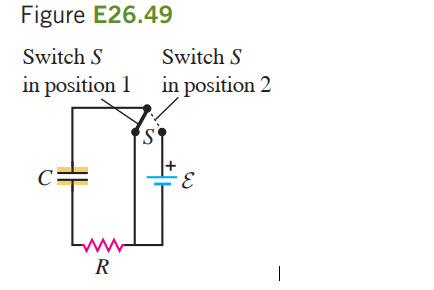
In the circuit shown in Fig. E26.49, C = 5.90 mF, 詯 = 28.0 V, and the emf has negligible resistance. Initially, the capacitor is uncharged and the switch S is in position 1. The switch is then moved to position 2 so that the capacitor begins to charge. (a) What will be the charge on the capacitor a long time after S is moved to position 2? (b) After S has been in position 2 for 3.00 ms, the charge on the capacitor is measured to be 110 mC What is the value of the resistance R? (c) How long after S is moved to position 2 will the charge on the capacitor be equal to 99.0% of the final value found in part (a)?

A current was sent through a helical coil spring. The spring contracted, as though it had been compressed. Why?

See all solutions

Recommended explanations on Physics Textbooks

View all explanations

What do you think about this solution?

We value your feedback to improve our textbook solutions.

Study anywhere. Anytime. Across all devices.