Chapter 4: Q9DQ (page 947)
A current was sent through a helical coil spring. The spring contracted, as though it had been compressed. Why?
Short Answer
Due to opposite poles which area attracted to each other cause the spring compress.
/*! This file is auto-generated */ .wp-block-button__link{color:#fff;background-color:#32373c;border-radius:9999px;box-shadow:none;text-decoration:none;padding:calc(.667em + 2px) calc(1.333em + 2px);font-size:1.125em}.wp-block-file__button{background:#32373c;color:#fff;text-decoration:none}
Learning Materials
Features
Discover
Chapter 4: Q9DQ (page 947)
A current was sent through a helical coil spring. The spring contracted, as though it had been compressed. Why?
Due to opposite poles which area attracted to each other cause the spring compress.
All the tools & learning materials you need for study success - in one app.
Get started for free
Two coils are wound around the same cylindrical form. When the current in the first coil is decreasing at a rate of , the induced emf in the second coil has magnitude . (a) What is the mutual inductance of the pair of coils? (b) If the second coil has 25 turns, what is the flux through each turn when the current in the first coil equals ? (c) If the current in the second coil increases at a rate of , what is the magnitude of the induced emf in the first coil?
A silver wire 2.6 mm in diameter transfers a charge of 420 C in 80
min. Silver containsfree electrons per cubic meter. (a) What is the
current in the wire? (b) What is the magnitude of thedrift velocity of the
electrons in the wire?
BIO Transmission of Nerve Impulses. Nerve cells transmit electric
signals through their long tubular axons. These signals propagate due to a
sudden rush of ions, each with charge , into the axon. Measurements
have revealed that typically about ions enter each meter of the
axon during a time of . What is the current during this inflow of charge
in a meter of axon?
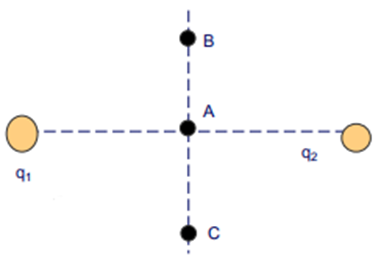
Question: The two charges q1 and q2shown in Fig. have equal magnitudes. What is the direction of the net electric field due to these two charges at points A (midway between the charges), B, and C if (a) both charges are negative, (b) both charges are positive, (c) q1 is positive and q2 is negative?

Sufficiently strong electric fields can cause atoms tobecome positively ionized-that is, to lose one or more electrons.Explain how this can happen. What determines how strong thefield must be to make this happen?
What do you think about this solution?
We value your feedback to improve our textbook solutions.