Explanations
  Textbooks
  Flashcards
  魅影直播 AI
  Notes
Notes  Study Plans
  Study Sets
  Find a degree
  Magazine
 Chapter 8: Rotational Motion
Q93GP
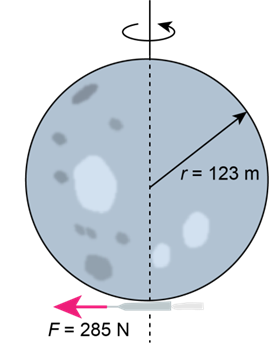
A spherical asteroid with radius\(r = 123\;{\rm{m}}\)and mass\(M = 2.25 \times {10^{10}}\;{\rm{kg}}\)rotates about an axis at four revolutions per day. A 鈥渢ug鈥� spaceship attaches itself to the asteroid鈥檚 south pole (as defined by the axis of rotation) and fires its engine, applying a force F tangentially to the asteroid鈥檚 surface as shown in Fig. 8鈥�65. If\(F = 285\;{\rm{N}}\)how long will it take the tug to rotate the asteroid鈥檚 axis of rotation through an angle of 5.0掳 by this method?
Q94GP
Most of our Solar System鈥檚 mass is contained in the Sun, and the planets possess almost all of the Solar System鈥檚 angular momentum. This observation plays a key role in theories attempting to explain the formation of our Solar System. Estimate the fraction of the Solar System鈥檚 total angular momentum that is possessed by planets using a simplified model which includes only the large outer planets with the most angular momentum. The central Sun (mass\(1.99 \times {10^{30}}\;{\rm{kg}}\), radius\(6.96 \times {10^8}\;{\rm{m}}\)) spins about its axis once every 25 days and the planets Jupiter, Saturn, Uranus, and Neptune move in nearly circular orbits around the Sun with orbital data given in the Table below. Ignore each planet鈥檚 spin about its own axis.
Planet | Mean Distance from Sun\(\left( { \times {{10}^6}\;{\rm{km}}} \right)\) | Orbital Period (Earth Years) | Mass \(\left( { \times {{10}^{25}}\;{\rm{kg}}} \right)\) |
Jupiter | 778 | 11.9 | 190 |
Saturn | 1427 | 29.5 | 56.8 |
Uranus | 2870 | 84.0 | 8.68 |
Neptune | 4500 | 165 | 10.2 |
Q95
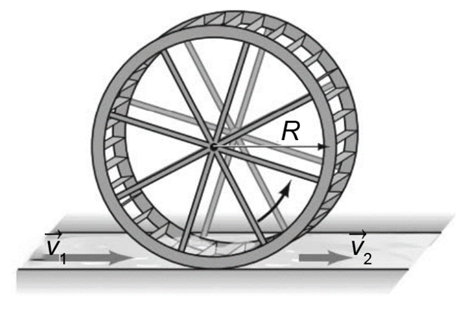
I) Water drives a waterwheel (or turbine) of radius R = 3.0 m as shown in Fig. 8鈥�66. The water enters at a speed\({v_1} = 7.0\;{\rm{m/s}}\)and exits from the waterwheel at a speed\({v_2} = 3.8\;{\rm{m/s}}\). (a) If 85 kg of water passes through per second, what is the rate at which the water delivers angular momentum to the waterwheel? (b) What is the torque the water applies to the waterwheel? (c) If the water causes the waterwheel to make one revolution every 5.5 s, how much power is delivered to the wheel?
Q96GP
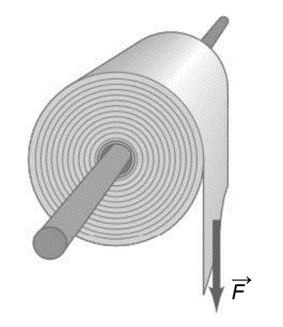
The radius of the roll of paper shown in Fig. 8鈥�67 is 7.6 cm and its moment of inertia is \(I = 3.3 \times {10^{ - 3}}\;{\rm{kg}} \cdot {{\rm{m}}^2}\). A force of 3.5 N is exerted on the end of the roll for 1.3 s, but the paper does not tear so it begins to unroll. A constant friction torque of \(I = 0.11\;{\rm{m}} \cdot {\rm{N}}\) is exerted on the roll which gradually brings it to a stop. Assuming that the paper鈥檚 thickness is negligible, calculate (a) the length of paper that unrolls during the time that the force is applied (1.3 s) and (b) the length of paper that unrolls from the time the force ends to the time when the roll has stopped moving