
 Explanations
  Textbooks
  Flashcards
  魅影直播 AI
  Notes
Notes  Study Plans
  Study Sets
  Find a degree
  Magazine
 Chapter 8: Rotational Motion
Q83
A hollow cylinder (hoop) is rolling on a horizontal surface at speed v = 3.0 m/s when it reaches a 15掳 incline. (a) How far up the incline will it go? (b) How long will it be on the incline before it arrives back at the bottom?
Q84GP
Determine the angular momentum of the Earth (a) about its rotation axis (assume the Earth is a uniform sphere), and (b) in its orbit around the Sun (treat the Earth as a particle orbiting the Sun).
Q85GP
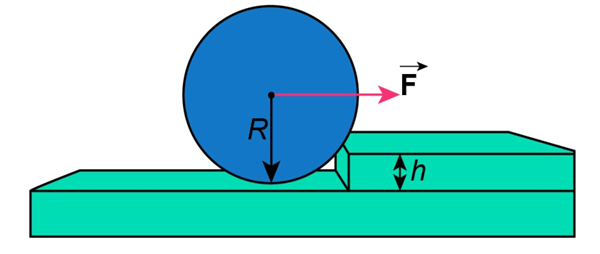
A wheel of mass M has radius R. It is standing vertically on the floor, and we want to exert a horizontal force F at its axle so that it will climb a step against which it rests (Fig. 8鈥�60). The step has height h, where h < R. What minimum force F is needed?
Q86GP
If the coefficient of static friction between a car鈥檚 tires and the pavement is 0.65, calculate the minimum torque that must be applied to the 66-cm-diameter tire of a 1080-kg automobile in order to 鈥渓ay rubber鈥� (make the wheels spin, slipping as the car accelerates). Assume each wheel supports an equal share of the weight.
Q87GP
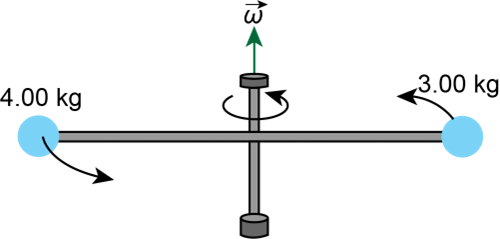
A 4.00-kg mass and a 3.00-kg mass are attached to opposite ends of a very light 42.0-cm-long horizontal rod (Fig. 8鈥�61). The system is rotating at angular speed\(\omega = 5.60\;{\rm{rad/s}}\)about a vertical axle at the center of the rod. Determine (a) the kinetic energy KE of the system, and (b) the net force on each mass.
Q88GP
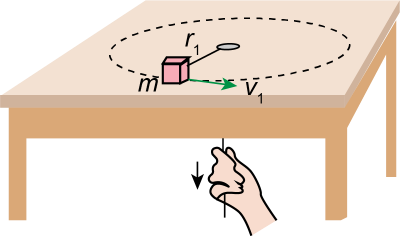
A small mass m attached to the end of a string revolves in a circle on a frictionless table top. The other end of the string passes through a hole in the table (Fig. 8鈥�62). Initially, the mass revolves with a speed\({v_1} = 2.4\;{\rm{m/s}}\)in a circle of radius\({r_1} = 0.80\;{\rm{m}}\). The string is then pulled slowly through the hole so that the radius is reduced to\({r_2} = 0.48\;{\rm{m}}\). What is the speed,\({v_2}\), of the mass now?
Q89GP
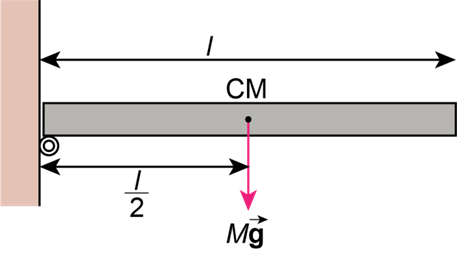
A uniform rod of mass M and length l can pivot freely (i.e., we ignore friction) about a hinge attached to a wall, as in Fig. 8鈥�63. The rod is held horizontally and then released. At the moment of release, determine (a) the angular acceleration of the rod, and (b) the linear acceleration of the tip of the rod. Assume that the force of gravity acts at the center of mass of the rod, as shown. [Hint: See Fig. 8鈥�20g.]
Q90GP
Suppose a star the size of our Sun, but with mass 8.0 times as great, were rotating at a speed of 1.0 revolution every 9.0 days. If it were to undergo gravitational collapse to a neutron star of radius 12 km, losing\(\frac{3}{4}\)of its mass in the process, what would its rotation speed be? Assume the star is a uniform sphere at all times. Assume also that the thrown off mass carries off either (a) no angular momentum, or (b) its proportional share\(\left( {\frac{3}{4}} \right)\)of the initial angular momentum.
Q91GP
A large spool of rope rolls on the ground with the end of the rope lying on the top edge of the spool. A person grabs the end of the rope and walks a distance l, holding onto it, Fig. 8鈥�64. The spool rolls behind the person without slipping. What length of rope unwinds from the spool? How far does the spool鈥檚 center of mass move?

Q92GP
The Moon orbits the Earth such that the same side always faces the Earth. Determine the ratio of the Moon鈥檚 spin angular momentum (about its own axis) to its orbital angular momentum. (In the latter case, treat the Moon as a particle orbiting the Earth.)
