
 Explanations
  Textbooks
  Flashcards
  魅影直播 AI
  Notes
Notes  Study Plans
  Study Sets
  Find a degree
  Magazine
 Chapter 6: Q 21. (page 369)
Exercises 21 and 22 examine how Benford鈥檚 law (Exercise 9) can be used to detect fraud.
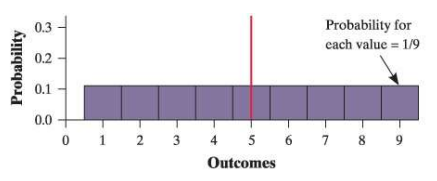
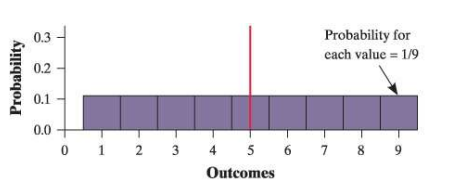
Benford鈥檚 law and fraud A not-so-clever employee decided to fake his monthly expense report. He believed that the first digits of his expense amounts should be equally likely to be any of the numbers from 1 to 9. In that case, the first digit Yof a randomly selected expense amount would have the probability distribution shown in the histogram.
(a) What鈥檚 ? According to Benford鈥檚 law (see Exercise 9), what proportion of first digits in the employee鈥檚 expense amounts should be greater than 6? How could this information be used to detect a fake expense report?
(b) Explain why the mean of the random variable Yis located at the solid red line in the figure.
(c) According to Benford鈥檚 law, the expected value of the first digit is . Explain how this information could be used to detect a fake expense report.
Short Answer
Part (a) , Benford鈥檚 law:
If the proportion of first digits greater than 6 is closer to 0.3333 than 0.155, the cost report is likely to be incorrect.
Part (b) The distribution is symmetric, and the mean for a symmetric distribution is exactly in the center of the distribution, implying that the mean must be at 5.
Part (c) If the average of the first digits in an expense report is less than 3.441, the expense report is likely to be fake.
Step by step solution
Part (a) Step 1. Given information.
The probability for each value is .
Part (a) Step 2. Find PY>6.
| First digit | |
| Probability |
The probability of each event is given as .
It can not be possible for the 1st digit to be 2 different kinds of digits at the same time, therefore the above events are mutually exclusive.
Apply the addition rule for events of a mutually exclusive nature:
Part (a) Step 3. Use Benford’s law.
Benford's Law:
| First Digit | 1 | 2 | 3 | 4 | 5 | 6 | 7 | 8 | 9 |
| Probability | 0.301 | 0.176 | 0.125 | 0.097 | 0.079 | 0.067 | 0.058 | 0.051 | 0.046 |
It can not be possible for the 1st digit to be 2 different kinds of digits at the same time, therefore the above events are mutually exclusive.
Apply the addition rule for events of a mutually exclusive nature:
If the fraction of the first digit greater than 6 is closer to 0.3333 than 0.155, the cost report is likely to be fraudulent.
Part (b) Step 1. An explanation for the mean of the random variable Y is located at the solid red line in the figure.
In the following graphic, we can see that the anticipated value is 5 because the distribution is symmetric. The mean sits exactly in the middle of the distribution for a symmetric distribution, implying that the mean must be 5.
Part (c) Step 1. Explanation.
The uniform distribution's mean is 5, and Benford's law's mean is 3.441.
If the average of the first digits in an expense report is less than 3.441, the expense report is likely to be fake.
As a result, if we get an expense report with a mean of all initial digits that is closer to 5 than 3.441, we'll conclude it's a fake.

Over 30 million students worldwide already upgrade their learning with 魅影直播!


