Chapter 6: Q.15 (page 355)
Spell-checking Refer to Exercise 3. Calculate and interpret the standard deviation of the random variable . Show your work
Short Answer
The number of nonword errors is on average words from the mean.
/*! This file is auto-generated */ .wp-block-button__link{color:#fff;background-color:#32373c;border-radius:9999px;box-shadow:none;text-decoration:none;padding:calc(.667em + 2px) calc(1.333em + 2px);font-size:1.125em}.wp-block-file__button{background:#32373c;color:#fff;text-decoration:none}
Learning Materials
Features
Discover
Chapter 6: Q.15 (page 355)
Spell-checking Refer to Exercise 3. Calculate and interpret the standard deviation of the random variable . Show your work
The number of nonword errors is on average words from the mean.
All the tools & learning materials you need for study success - in one app.
Get started for free
Knees Patients receiving artificial knees often experience pain after surgery. The pain is measured on a subjective scale with possible values of 1 (low) to 5 (high). Let X be the pain score for a randomly selected patient. The following table gives part of the probability distribution for X.
| Value | |||||
| Probability | ? |
(a) Find
(b) If two patients who received artificial knees are chosen at random, what鈥檚 the probability that both of them report pain scores of or ? Show your work.
(c) Compute the mean and standard deviation of . Show your work.
A small ferry runs every half hour from one side of a large river to the other. The number of cars on a randomly chosen ferry trip has the probability distribution shown below. You can check that and .

(a) The cost for the ferry trip is . Make a graph of the probability distribution for the random variable money collected on a randomly selected ferry trip. Describe its shape.
(b) Find and interpret .
(c) Compute and interpret .
Working out Refer to Exercise 6. Consider the events A = works out at least once and B = works out less than 5 times per week.
(a) What outcomes makeup event A? What is P(A)?
(b) What outcomes make up event B? What is P(B)?
(c) What outcomes make up the event 鈥淎 and B鈥? What is P(A and B)? Why is this probability not equal to P(A) 路 P(B)?
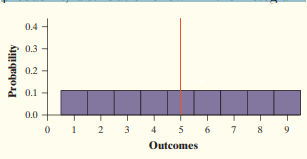
Benford鈥檚 law and fraud A not-so-clever employee decided to fake his monthly expense report. He believed that the first digits of his expense amounts should be equally likely to be any of the numbers from to . In that case, the first digit of a randomly selected expense amount would have the probability distribution shown in the histogram.

(a). Explain why the mean of the random variable Y is located at the solid red line in the figure.
(b) The first digits of randomly selected expense amounts actually follow Benford鈥檚 law (Exercise 5). What鈥檚 the expected value of the first digit? Explain how this information could be used to detect a fake expense report.
(c) What鈥檚 ? According to Benford鈥檚 law, what proportion of first digits in the employee鈥檚 expense amounts should be greater than ? How could this information be used to detect a fake expense report?
Checking for survey errors One way of checking the effect of undercoverage, nonresponse, and other sources of error in a sample survey is to compare the sample with known facts about the population. About % of American adults identify themselves as black. Suppose we take an SRS of American adults and let be the number of blacks in the sample.
(a) Show that is approximately a binomial random variable.
(b) Check the conditions for using a Normal approximation in this setting.
(c) Use the Normal approximation to 铿乶d the probability that the sample will contain between and blacks. Show your work.
What do you think about this solution?
We value your feedback to improve our textbook solutions.