
 Explanations
  Textbooks
  Flashcards
  魅影直播 AI
  Notes
Notes  Study Plans
  Study Sets
  Find a degree
  Magazine
 Chapter 4: Q101SE (page 193)
The completion time X for a certain task has cdf F(x) given by
\(\left\{ {\begin{array}{*{20}{c}}{0\,\,\,\,\,\,\,\,\,\,\,\,\,\,\,\,\,\,\,\,\,\,\,\,\,\,\,\,x < 0}\\{\frac{{{x^3}}}{3}\,\,\,\,\,\,\,\,\,\,\,\,\,\,\,\,\,\,0 \le x \le \frac{7}{3}}\\{1 - \frac{1}{2}\left( {\frac{7}{3} - x} \right)\left( {\frac{7}{4} - \frac{3}{4}x} \right)\,\,\,\,\,\,1 \le x \le \frac{7}{3}}\\{1\,\,\,\,\,\,\,\,\,\,\,\,\,\,\,x > \frac{7}{3}}\end{array}} \right.\)
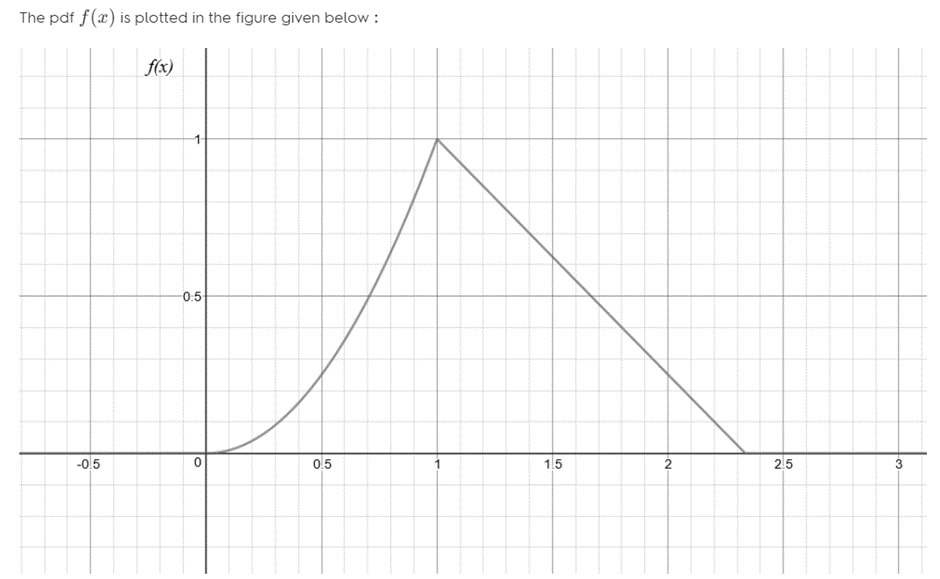
a. Obtain the pdf f (x) and sketch its graph.
b. Compute\({\bf{P}}\left( {.{\bf{5}} \le {\bf{X}} \le {\bf{2}}} \right)\). c. Compute E(X).
Short Answer
\(\begin{array}{l}(a)\,f(x) = \left\{ {\begin{array}{*{20}{l}}{{x^2}}&{0 \le x < 1}\\{\frac{7}{4} - \left( {\frac{3}{4}} \right)x}&{1 \le x \le \frac{7}{3}}\\0&{{\rm{ otherwise }}}\end{array}} \right.\\(b)\,0.9167\\(c)\,1.213\end{array}\)
Step by step solution
Definition of Probability
Probability is a branch of mathematics that studies the probability of a random event occurring. When a coin is tossed into the air, for example, the possible outcomes are Head and Tail.
Calculation for the determination of the pdf f(x) in part a.
(a) It is given that X is a random variable denoting the completion time for a certain task. Its CDF F(x) is given as:
Proposition: If X is a continuous rv with pdf f(x) and cdf F(x), then at every x at which the derivative\({F^\prime }(x)\)exists,
\(f(x) = {F^\prime }(x)\)
For intervals\(x < 0\)and\(x > \frac{7}{3}\):
\(f(x) = {F^\prime }(X) = 0\)
For interval\(0 \le x < 1\):
\(f(x) = \frac{d}{{dx}}\left( {\frac{{{x^3}}}{3}} \right) = {x^2}\)
For interval\(1 \le x \le \frac{7}{3}\)
\(\begin{array}{l}f(x) = \frac{d}{{dx}}\left( {1 - \frac{1}{2}\left( {\frac{7}{3} - x} \right)\left( {\frac{7}{4} - \frac{3}{4}x} \right)} \right)\\f(x) = \frac{1}{2}\left( {\frac{7}{4} - \frac{3}{4}x} \right) + \frac{1}{2}\left( {\frac{7}{3} - x} \right)\left( {\frac{3}{4}} \right)\\f(x) = \frac{7}{4} - \frac{3}{4}x\end{array}\)
Calculation for the determination of the pdf f(x) in part a.
Hence pdf f(x) can finally be given as:
\(f(x) = \left\{ {\begin{array}{*{20}{l}}{{x^2}}&{0 \le x < 1}\\{\frac{7}{4} - \left( {\frac{3}{4}} \right)x}&{1 \le x \le \frac{7}{3}}\\0&{{\rm{ otherwise }}}\end{array}} \right.\)
Calculation for the determination of the probability in part b.
(b) compute\(P(0.5 < X < 2)\)
\(\begin{aligned}P(0.5 < X < 2) &= F(2) - F(0.5) \hfill \\\,\,\,\,\,\,\,\,\,\,\,\,\,\,\,\,\,\,\,\,\,\,\,\,\,\,\,\,\,\,\,\,\,\, &= \left[ {1 - \frac{1}{2}\left( {\frac{7}{3} - 2} \right)\left( {\frac{7}{4} - \frac{3}{4} \cdot 2} \right)} \right] - \left[ {\frac{{{{(0.5)}^3}}}{3}} \right] \hfill \\\,\,\,\,\,\,\,\,\,\,\,\,\,\,\,\,\,\,\,\,\,\,\,\,\,\,\,\,\,\,\,\,\,\, &= \frac{{23}}{{24}} -\frac{1}{{24}} \hfill \\ P(0.5 < X < 2) &= 0.9167 \hfill \\\end{aligned}\)
Proposition: Let\({\rm{X}}\)be a continuous\({\rm{rv}}\)with\({\rm{pdff}}({\rm{x}})\)and\(cdf\;{\rm{F}}({\rm{x}})\). Then for any two numbers a and\({\rm{b}}\)with\(a < b\),
\(P(a \le X \le b) = F(b) - F(a)\)
Calculation for the determination of the expected value in part c
(c) The mean value of the given distribution can be given as:
\(\begin{aligned}E(X)&= \int_{ - \infty }^i\cdot f(x) \cdot dx \\ &= \int_0^1 x \cdot {x^2} \cdot dx + \int_1^{7/3} x \cdot \left( {\frac{7}{4} - \frac{3}{4}x} \right) \cdot dx \\&= \int_0^1 {{x^3}} \cdot dx + \int_1^{7/3} {\frac{{7x}}{4}} \cdot dx - \int_1^{7/3} {\frac{{3{x^2}}}{4}} \cdot dx \\&= \left[ {\frac{{{x^4}}}{4}} \right]_0^1 + \left[ {\frac{{7{x^2}}}{8}} \right]_1^{7/3} + \left[ {\frac{{{x^3}}}{4}} \right]_1^{7/3} = {\left[ {\frac{{{1^4}}}{4}} \right]_1} + \left[ {\frac{{343}}{{72}} - \frac{7}{8}} \right] + \left[ {\frac{{343}}{{108}} - \frac{1}{4}} \right] \\&= \frac{1}{4} + \frac{{35}}{9} - \frac{{316}}{{108}} \\E(X) &= 1.213 \\\end{aligned} \)
Definition: The expected or mean value of a continuous\(rv\;X\)with pdf f(x) is
\(\mu = E(X) = \int_{ - \infty }^\infty x \cdot f(x) \cdot dx\)

Over 30 million students worldwide already upgrade their learning with 魅影直播!

