Chapter 5: Q.92 (page 356)
What is the probability that a phone will fail within two years of the date of purchase?
a.
b.
c.
d.
Short Answer
The correct answer is Option (b).
/*! This file is auto-generated */ .wp-block-button__link{color:#fff;background-color:#32373c;border-radius:9999px;box-shadow:none;text-decoration:none;padding:calc(.667em + 2px) calc(1.333em + 2px);font-size:1.125em}.wp-block-file__button{background:#32373c;color:#fff;text-decoration:none}
Learning Materials
Features
Discover
Chapter 5: Q.92 (page 356)
What is the probability that a phone will fail within two years of the date of purchase?
a.
b.
c.
d.
The correct answer is Option (b).
All the tools & learning materials you need for study success - in one app.
Get started for free
The time(in minutes) until the next bus departs a major bus depot follows a distribution with \(f(x)=\frac{1}{20}\) where \(x\) goes from \(25\) to \(45\) minutes.
a. Define the random variable. \(X=\).
b. \(X~\)
c. Graph the probability distribution.
The time (in years) after reaching age that it takes an individual to retire is approximately exponentially distributed with a mean of about five years. Suppose we randomly pick one retired individual. We are interested in the time after age
to retirement.
a. Define the random variable.
b. Is continuous or discrete?
c.
d.
e.
f. Draw a graph of the probability distribution. Label the axes.
g. Find the probability that the person retired after age .
h. Do more people retire before age or after age ?
i. In a room of people over age , how many do you expect will NOT have retired yet?
In a small city, the number of automobile accidents occur with a Poisson distribution at an average of three per week.
a. Calculate the probability that there are at most accidents occur in any given week.
b. What is the probability that there is at least two weeks between any accidents?
What is the area under f(x) if the function is a continuous probability density function?
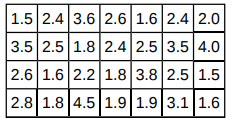
The data that follow are the square footage (in 1,000 feet squared) of 28 homes.

The sample mean = 2.50 and the sample standard deviation = 0.8302. The distribution can be written as .
Find the probability that a randomly selected home has more than square feet given that you already know the house has more than square feet.
What do you think about this solution?
We value your feedback to improve our textbook solutions.