Chapter 2: Q3 (page 35)
State the hypothesis and the conclusion of each conditional.
I鈥檒l try if you will.
Short Answer
The hypothesis is you will try and the conclusion is I鈥檒l try.
/*! This file is auto-generated */ .wp-block-button__link{color:#fff;background-color:#32373c;border-radius:9999px;box-shadow:none;text-decoration:none;padding:calc(.667em + 2px) calc(1.333em + 2px);font-size:1.125em}.wp-block-file__button{background:#32373c;color:#fff;text-decoration:none}
Learning Materials
Features
Discover
Chapter 2: Q3 (page 35)
State the hypothesis and the conclusion of each conditional.
I鈥檒l try if you will.
The hypothesis is you will try and the conclusion is I鈥檒l try.
All the tools & learning materials you need for study success - in one app.
Get started for free
Tell whether each statement is true or false. Then write the converse and tell whether it is true or false.
If points D, E, and F are collinear, then .
Give an example of a false conditional whose converse is true.
Use the conditional: If and intersect, then and intersect.
Write the converse of the conditional. Is the converse true or false?
Provide a counterexample to show that each statement is false.
Statement: If a four-sided figure has four right angles, then it has four congruent sides.
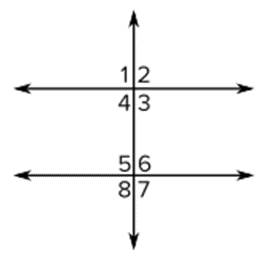
a. Are there any angles in the diagram that must be congruent to鈭4? Explain.
b. If 鈭4 and 鈭5 are supplementary, name all angles shown that must be congruent to 鈭4.

What do you think about this solution?
We value your feedback to improve our textbook solutions.