
 Explanations
  Textbooks
  Flashcards
  魅影直播 AI
  Notes
Notes  Study Plans
  Study Sets
  Find a degree
  Magazine
 Chapter 6: 2RQ (page 133)
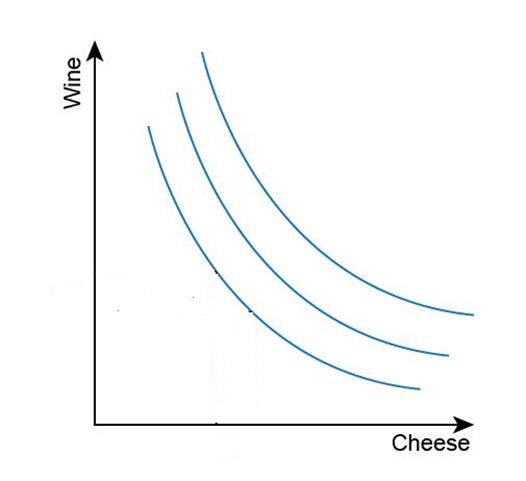
Draw a consumer鈥檚 indifference curves for wine and cheese. Describe and explain four properties of these indifference curves.
Short Answer
The indifference curve is shown below:
Step by step solution
Indifference curve

The indifference curve shows the different bundles of two goods (cheese and wine) where the satisfaction level is the same at any point. It slopes down to the right.
Higher IC will get higher utility
The higher IC will be preferred more than the lower IC. The combination of cheese and wine increases when a higher IC is concerned. Thus, the utility is also high, and a rational consumer will always prefer higher IC.
IC cannot intersect
The IC cannot intersect with one another.

Consider the above diagram where two indifference curves intersect at point C. Point C and B are equal as they are on the same indifference curve, IC1,and offer the same level of satisfaction. Similarly, points C and A are equal as they are on IC2.
The above implies that point A should also be equal to B in terms of satisfaction level (as both are equal to C). However, this does not happen; at point A, the quantity of good Y is more than its quantity at point B. It implies that A>B (should be preferred over B), which contradicts the above relation.
Thus, ICs cannot intersect each other.
IC is convex to the origin
The IC is convex to origin because of the marginal substitution rate, i.e., how much one good is to get one more of another good. The marginal rate of substitution falls as the consumption of one good increases, i.e., on the upper portion of the IC, the marginal rate of substitution is high, and on the lower portion, the marginal rate of substitution is low. Thus, the IC is convex. If the marginal rate of substitution is increasing, then IC will be concave.
IC slopes downward to the right
The IC slopes downward to the right because of the trade-off. If one wishes to consume more of one good, the quantity of the other good has to be reduced; that is, to increase the consumption of cheese, the consumption of wine has to decrease. Thus, it slopes downward.

Over 30 million students worldwide already upgrade their learning with 魅影直播!

