/*! This file is auto-generated */ .wp-block-button__link{color:#fff;background-color:#32373c;border-radius:9999px;box-shadow:none;text-decoration:none;padding:calc(.667em + 2px) calc(1.333em + 2px);font-size:1.125em}.wp-block-file__button{background:#32373c;color:#fff;text-decoration:none} 29P Draw the both chair conformation... [FREE SOLUTION] | ÷ÈÓ°Ö±²¥

÷ÈÓ°Ö±²¥

Draw the both chair conformations of each of the following substituted cyclohexanes. In each case, label the more stable conformation.

(a) cis-1-ethyl-2-methylcyclohexane

(b)trans-1,2-diethylcyclohexane

(c) cis-1-ethyl-4-isopropylcyclohexane

(d)trans-1-ethyl-4-methylcyclohexane


Short Answer

Expert verified

(a)

(more stable)

(b)

(more stable)

(c)

(more stable)

(d)

(more stable)

Step by step solution

01

Drawing cis and trans isomers for cycloalkanes

In the case of cycloalkanes, if the two substituents point toward the same faces, they are known as cis isomers. Again, if the two substituents point toward the opposite faces, they are known as trans-isomers. These two geometric isomers cannot interconvert without breaking and forming the bonds again.

02

Axial and equatorial positions of cyclohexane

Axial bonds are directed vertically parallel to the axis of the ring, and the equatorial bonds are directed outward from the equator of the ring. As the carbon atoms are numbered in cyclohexane, it can be seen that the odd-numbered carbons have their upward bonds in theaxial position and their downward bonds in an equatorial position. The even-numbered carbons have their downward bondsin the axial position and their upward bonds in an equatorial position.

03

Different sizes of substituents

The substituents are of different sizes in many substituted cyclohexanes. For a larger (bulkier) group, the energy difference between axial and equatorial positions is greater than that of a smaller group (less bulky).

04

Identifying the most stable conformation

Larger (bulkier) substituents tend to be in an equatorial position.If both the groups cannot be in equatorial positions, the most stable conformation will have the larger (bulkier) group in an equatorial position and the smaller (less bulky) group inthe axial position.

The axial position is shown by a solid blue line, and the equatorial position is shown by a solid red line in the structures drawn.

(a)
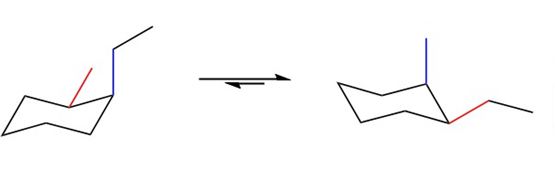
(more stable)

(b) The more stable conformation is when the ethyl group is present in an equatorial position.
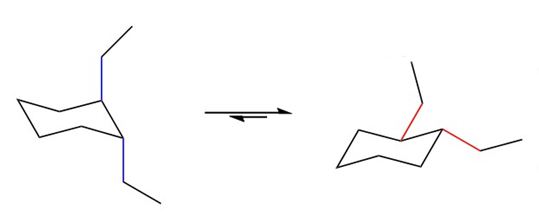
(more stable)

The more stable conformation is when both the ethyl groups are present in an equatorial position.

(c)
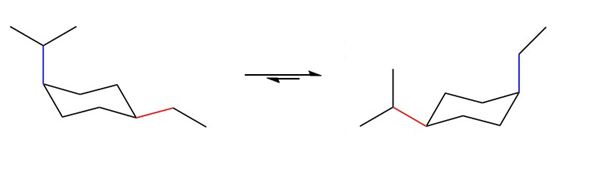
(more stable)

The more stable conformation is when the isopropyl group is present in an equatorial position.

(d)
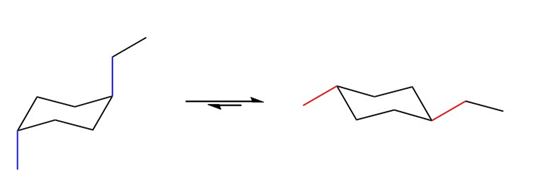
The more stable conformation is when the methyl group and ethyl groupare present in anequatorial position.

Unlock Step-by-Step Solutions & Ace Your Exams!

  • Full Textbook Solutions

    Get detailed explanations and key concepts

  • Unlimited Al creation

    Al flashcards, explanations, exams and more...

  • Ads-free access

    To over 500 millions flashcards

  • Money-back guarantee

    We refund you if you fail your exam.

Over 30 million students worldwide already upgrade their learning with ÷ÈÓ°Ö±²¥!

One App. One Place for Learning.

All the tools & learning materials you need for study success - in one app.

Get started for free

Most popular questions from this chapter

Draw 1,2,3,4,5,6-hexamethylcyclohexane with all the methyl groups

(a) in axial positions. (b) in equatorial positions.

(a) Draw the two chair conformations of cis-1,3-dimethylcyclohexane, and label all the positions as axial or equatorial.

(b) Label the higher-energy conformation and the lower-energy conformation.

(c) The energy difference in these two conformations has been measured to be about23 k´³â€‰(5.4 k³¦²¹±ô)per mole. How much of this energy difference is due to the torsional energy of gauche relationships?

(d) How much energy is due to the additional steric strain of the1,3-diaxial interaction?

There are eight different five-carbon alkyl groups.

(a) Draw them

(b) Give them systematic names.

(c) In each case, label the degree of substitution (primary, secondary, or tertiary) of the head carbon atom bonded to the main chain.

Table 3-6 shows that the axial-equatorial energy difference for methyl, ethyl, and isopropyl groups increases gradually: 7.6, 7.9 and 8.8 kJ/mol (1.8, 1.9, and 2.1 kcal/mol). The tert-butyl group jumps to an energy difference of 23 kJ/mol (5.4 kcal/mol), over twice the value for the isopropyl group. Draw pictures of the axial conformations of isopropylcyclohexane and tert-butylcyclohexane and explain why the tert-butyl substituent experiences such a large increase in axial energy over the isopropyl group.

Question: Which of the following cycloalkanes are capable of geometric (cis-trans) isomerism? Draw the cis and trans isomers

(a)3 - ethyl - 1,1 - dimethylcyclohexane

(b)1 - ethyl - 3 - methylcycloheptane

(c)1 - ethyl - 3 - methylcyclopentane

(d)1 - cyclopropyl - 2 - methylcyclohexane

See all solutions

Recommended explanations on Chemistry Textbooks

View all explanations

What do you think about this solution?

We value your feedback to improve our textbook solutions.

Study anywhere. Anytime. Across all devices.
