Explanations
  Textbooks
  Flashcards
  魅影直播 AI
  Notes
Notes  Study Plans
  Study Sets
  Find a degree
  Magazine
 Chapter 9: Q28P (page 493)
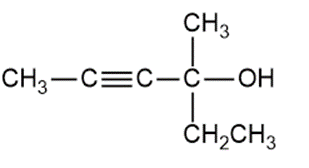
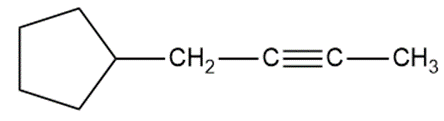
Question: Give IUPAC names for the following compounds.
a.
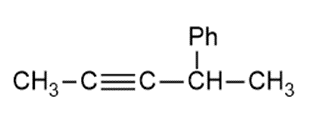
b.
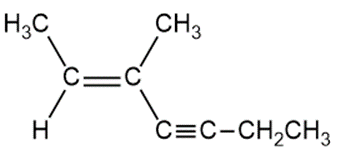
c.

d.

e.
f.
Short Answer
Answer
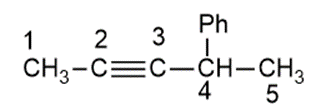
a) 4-phenylpent-2-yne
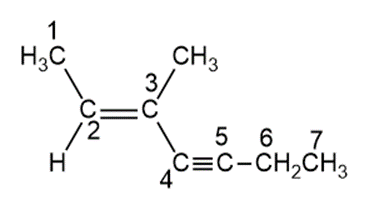
b) (E)-3-methylhept-2-en-4-yne
c) 2,2,5-trimethylhept-3-yne
d) 4,4-dibromopent-2-yne
e) (S)-3-methylhex-4-yn-3-ol
f) but-2-yn-1-ylcyclopentane
Step by step solution
About IUPAC nomenclature
The rules governed by the International Union of Pure and Applied Chemistry to name the organic compounds systematically is IUPAC nomenclature. The naming depends on the name of the parent chain, substituents attached, configurations, etc.
Naming of the compound (a)
The parent chain is made up of five carbons. Thus, the word 鈥榩ent鈥� is used in the prefix. The numbering is given in such a way that the triple bond gets the lowest possible number. The numbering is shown below.
Numbering of alkyne
The triple bond is at second carbon and the phenyl group is at fourth carbon. Thus, the IUPAC name of this compound is 4-phenylpent-2-yne.
Naming of compound (b)
The parent chain is made up of seven carbons. Thus, the word 鈥榟ept鈥� is used in the prefix. The numbering is given in such a way that the double bond gets the lowest possible number. The numbering is shown below.
Numbering of alkyne
The double bond is present at the second carbon and the triple bond is present at the fourth carbon. There is one methyl group at the third carbon atom. The configuration at the double bond is E because the higher priority groups are on the opposite side of the double bond. Thus, the IUPAC name of the given compound is (E)-3-methylhept-2-en-4-yne.
Naming of compound (c)
The parent chain is made up of seven carbons. Thus, the word 鈥榟ept鈥� is used in the prefix. The numbering is given in such a way that the triple bond gets the lowest possible number. The numbering is shown below.
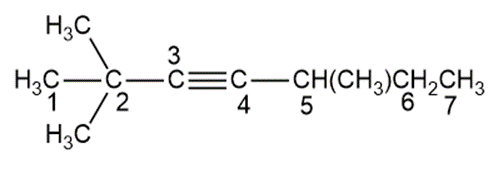
Numbering of alkyne
The triple bond is present at the third carbon. There are two methyl groups at the second carbon atom and one methyl group at the fifth carbon atom. Thus, the IUPAC name of the given compound is 2,2,5-trimethylhept-3-yne.
Naming of compound (d)
The parent chain is made up of five carbons. Thus, the word 鈥榩ent鈥� is used in the prefix. The numbering is given in such a way that the triple bond gets the lowest possible number. The numbering is shown below.
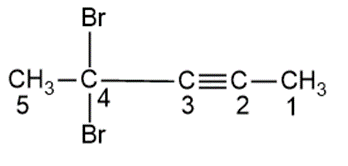
Numbering of alkyne
The triple bond is present at the second carbon atom. There are two bromo groups at the fourth carbon atom. Thus, the IUPAC name of the given compound is 4,4-dibromopent-2-yne.
Naming of compound (e)
The parent chain is made up of six carbons. Thus, the word 鈥榟ex鈥� is used in the prefix. The numbering is given in such a way that the functional group (OH) gets the lowest possible number. The numbering is shown below.
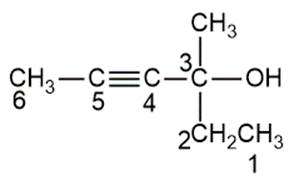
Numbering of alkyne
The functional group OH is present at the third carbon and the methyl group is present at the third carbon atom. The triple bond is present at the fourth carbon atom. Thus, the IUPAC name of the given compound is 3-methylhex-4-yn-3-ol.
Naming of compound (f)
The parent chain is made up of four carbons. Thus, the word 鈥榖ut鈥� is used in the prefix. The numbering is given in such a way that the functional group cyclopentyl ring gets the lowest possible number. The numbering is shown below.
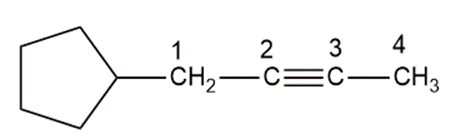
Numbering of alkyne
The cyclopentyl group is present at the first carbon and the triple bond is present at the second carbon. Thus, the IUPAC name of the given compound is 1-cyclopentylbut-2-yne.

Over 30 million students worldwide already upgrade their learning with 魅影直播!