
 Explanations
  Textbooks
  Flashcards
  魅影直播 AI
  Notes
Notes  Study Plans
  Study Sets
  Find a degree
  Magazine
 Chapter 9: Q36P (page 494)
Question: Predict the products formed when reacts with the following compounds.
(a)ethyl bromide
(b)tert-butyl bromide
(c)formaldehyde
(d)cyclohexanone
(e)
(f)cyclohexanol
(g)butan-2-one,
Short Answer
Answer
Step by step solution
About sodium but-1-yne-1-ide
The sodium salt that has four carbons in the parent chain with one triple bond and one negative charge on the carbon is but-1-yne-1-ide. This is an ionic species and is an anion because of the negative charge on the carbon atom. The carbon atom also has a lone pair of electrons.
Reaction of with ethyl bromide CH3CH2-C≡C:Na+
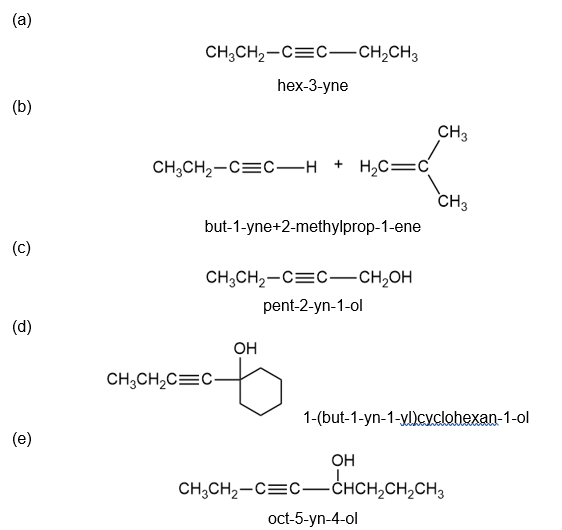
The reaction of with ethyl bromide result in the formation of hex-3-yne. The reaction is shown below.

The reaction ofwith ethyl bromide
Reaction of CH3CH2-C≡C:Na+ with tert-butyl bromide
The reaction of with tert-butyl bromide result in the formation of 2-methylprop-1-ene. The reaction is shown below.

The reaction of with tert-butyl bromide
Reaction of CH3CH2-C≡C:Na+with formaldehyde
The reaction of with formaldehyde result in the formation of pent-2-yn-1-ol. The reaction is shown below.

Reaction of with formaldehyde
Reaction of CH3CH2-C≡C:Na+with cyclohexanone
The reaction of with cyclohexanone result in the formation of 1-(but-1-yn-1-yl)cyclohexan-1-ol. The reaction is shown below.

Reaction of with cyclohexanone
Reaction of CH3CH2-C≡C:Na+ with data-custom-editor="chemistry" CH3CH2CH2CHO
The reaction of with result in the formation of oct-5-yn-4-ol. The reaction is shown below.

Reaction of with
Reaction of CH3CH2-C≡C:Na+with cyclohexanol
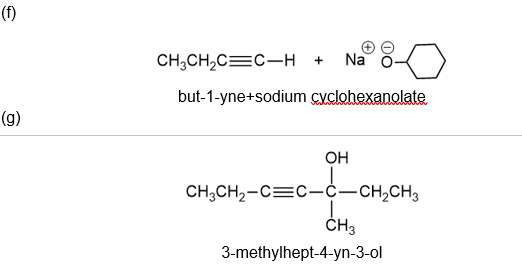
The reaction of with cyclohexanol result in the formation of oct-but-1-yne and sodium cyclohexanolate. The reaction is shown below

Reaction of with cyclohexanol
Reaction of CH3CH2-C≡C:Na+ with butan-2-one, CH3CH2COCH3
The reaction of with butan-2-one result in the formation of 3-methylhept-4-yn-3-ol. The reaction is shown below.

Reaction of with butan-2-one

Over 30 million students worldwide already upgrade their learning with 魅影直播!

