/*! This file is auto-generated */ .wp-block-button__link{color:#fff;background-color:#32373c;border-radius:9999px;box-shadow:none;text-decoration:none;padding:calc(.667em + 2px) calc(1.333em + 2px);font-size:1.125em}.wp-block-file__button{background:#32373c;color:#fff;text-decoration:none} Q130Q. Question: Here is a network with... [FREE SOLUTION] | ÷ÈÓ°Ö±²¥

÷ÈÓ°Ö±²¥

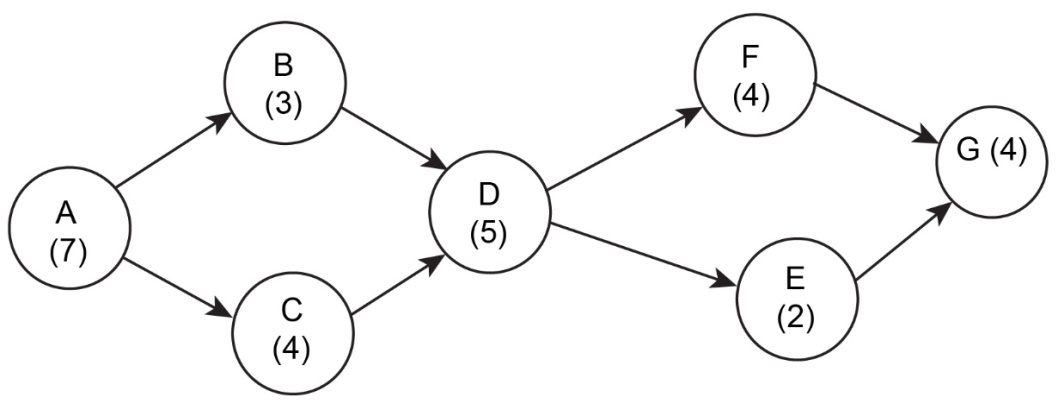
Question: Here is a network withthe activity times shown in days:
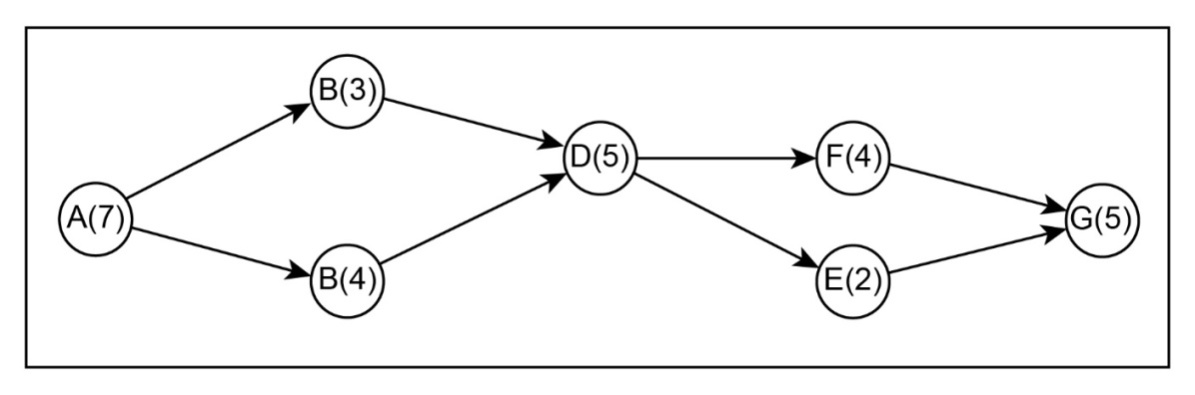

a. Find the critical path.

b. The following table shows the normal times and the crash times, along with the associated costs for each activity.


If the project is to be shortened by four days, show which activities, in order of reduction, would be shortened and the resulting cost.

Short Answer

Expert verified

Answer

The A, C, D, and F will be the movement to be decreased by 4 days and the complete crash cost of the project is $40200.

Crashing is a process used in project planning to shorten the time at the slightest amount of unnecessary price either with no purchasing costs added to the project. This is implemented by crashing several of the highly used resources.

Step by step solution

01

(a) The critical path

We can use the below table to find the critical pathof the project:

The total time of each path is given below:

The longest timeof 25 days belongs to the path A-C-D-F-G and this path would be the critical pathof the project.

02

(b) Calculation

Totalcrashtime=Normaltime-crashtimeTotalcrashcost=Normalcost-crashcostCrashcostperweek=TotalcrashcostTotalcrashtime

By using the above equation we can find the crash costsfor all the activities using excel:

role="math" localid="1650869487593" Totalnormalcost=$7000+5000+9000+3000+2000+4000+5000=$35,000

03

Crash movement A

Crash movement A is the best option because it has the lowest crash cost and is also on the critical path. It can only be crashed individually. For one day, crash it. The path duration after crashing is as follows:

Costofcrashing=Numberofweekscrashed×Crashcostperweek=1×1000=1000Totalcostcrashing=35,000+1000=$36,000

04

Crash movement D

Crash movement D is the best choice because it has the cheapest crash cost and is located on both critical paths. It can only be crashed individually. For one day, crash it. The path duration after crashing is as follows:

Costofcrashing=Numberofweekcrashed×Crashcostperweek=1×1500=1500Totalcostofcrashing=36000+1500=$37,500

05

Crash movement F

Crash movement F is the top pick because it has the cheapest crash cost and is also on the critical path. This can only be crashed individually. For one day, crash it. Ignoring the fact that it is much more pricey than E, it can minimize the duration of the two approaches. The path duration after crashing is as follows:

Costofcrashing=Numberofweekcrashed×Crashcostperweek=1×1500=1500Totalcostofcrashing=37500+1500=$39,000

06

Crash movement C

Crash movement C is the top pick and has the cheapest crash cost and is also on the critical track. Can only be crashed individually. Once per day, crash it. Because G has a larger cost than C, C should be crushed using the least crash cost model. The path duration after crashing is as follows:

Costofcrashing=Numberofweekscrashed×Crashedcostperweek=1×1200=1200Totalcostofcrashing=39000+1200=$40,200

Unlock Step-by-Step Solutions & Ace Your Exams!

  • Full Textbook Solutions

    Get detailed explanations and key concepts

  • Unlimited Al creation

    Al flashcards, explanations, exams and more...

  • Ads-free access

    To over 500 millions flashcards

  • Money-back guarantee

    We refund you if you fail your exam.

Over 30 million students worldwide already upgrade their learning with ÷ÈÓ°Ö±²¥!

One App. One Place for Learning.

All the tools & learning materials you need for study success - in one app.

Get started for free

Most popular questions from this chapter

Assume the network and data that follow:

Activity

Normal Time(Weeks)

Normal Cost

Crash Time(weeks)

Crash cost

Immediate Processors

A

2

\(50

1

\)70

-

B

4

80

2

160

A

C

8

70

4

110

A

D

6

60

5

80

A

E

7

100

6

130

B

F

4

40

3

100

D

G

5

100

4

150

C,E,F

a. Construct the network diagram.

b. Indicate the critical path when normal activity times are used.

c. Compute the minimum total direct cost for each project duration based on the cost associated with each activity. Consider the duration of 13, 14, 15, 16, 17, and 18 weeks.

d. If the indirect costs for each project duration are \(400 (18 weeks), \)350 (17 weeks), \(300 (16 weeks), \)250 (15 weeks), \(200 (14 weeks), and \)150 (13 weeks), what is the total project cost for each duration? Indicate the minimum total project cost duration.

A facility has a maximum capacity of 4,000 units per day using overtime and skipping the daily maintenance routine. At 3,500 units per day, the facility operates at a level where the average cost per unit is minimized. Currently, the process is scheduled to operate at a level of 3,000 units per day. What is the capacity utilization rate?

Johnson Industries received a contract to develop and produce four high-intensity long-distance receiver/transmitters for cellular telephones. The first took 2,000 labor hours and \(39,000 worth of purchased and manufactured parts; the second took 1,500 labor hours and \)37,050 in parts; the third took 1,450 labor hours and \(31,000 in parts, and the fourth took 1,275 labor hours and \)31,492 in parts. Johnson was asked to bid on a follow-on contract for another dozen receiver/transmitter units. Ignoring any forgetting factor effects, what should Johnson estimate time and parts costs to be for the dozen units? (Hint: There are two learning curves—one for laborand one for parts.)

United Research Associates (URA) had received a contract to produce two units of a new cruise missile guidance control. The first unit took 4,000 hours to complete and cost \(30,000 in materials and equipment usage. The second took 3,200 hours and cost \)21,000 in materials and equipment usage. Labor cost is charged at $18 per hour.

The prime contractor has now approached URA and asked to submit a bid for the cost of producing another 20 guidance controls.

a. What will the last unit cost to build?

b. What will be the average time for the 20 missile guidance controls?

c.What will the average cost be for guidance control for the 20 in the contract?

Question: Two of the efficiency ratios mentioned in the chapter are the receivable turnover ratio and the inventory turnover ratio. While they are two completely separate measures, they are very similar in one way. What is the common thread between these two?

See all solutions

Recommended explanations on Business Studies Textbooks

View all explanations

What do you think about this solution?

We value your feedback to improve our textbook solutions.

Study anywhere. Anytime. Across all devices.