/*! This file is auto-generated */ .wp-block-button__link{color:#fff;background-color:#32373c;border-radius:9999px;box-shadow:none;text-decoration:none;padding:calc(.667em + 2px) calc(1.333em + 2px);font-size:1.125em}.wp-block-file__button{background:#32373c;color:#fff;text-decoration:none} Q23E An electron is bound in a square... [FREE SOLUTION] | ÷ÈÓ°Ö±²¥

÷ÈÓ°Ö±²¥

An electron is bound in a square well of width 1.50nmand depth U0=6E1-IDW. If the electron is initially in the ground level and absorbs a photon, what maximum wavelength can the photon have and still liberate the electron from the well?

Short Answer

Expert verified

The maximum wavelength can the photon have and still liberate the electron from the well is1.38μm.

Step by step solution

01

Define the energy level.

The energy level of a particle of massmin a box of widthLis:

En=Pn22m=n2h28mL=n2Ï€2h22mL(n=1,2,3...)

The ground state energy as a fraction of the ground-level energy for an infinitely deep well E1-1DWis given by:

E1=0.625E1-1DW

The difference between the energy of the ground level and the depth of the potential well is equal to the minimum energy required for photon to release the electron.

Emin=U0-E1

The energy of photon E=hcλwhere, λis the wavelength.

02

Determine the minimum energy.

Given that, the energy level of square well of depth isU0=6E1-1DWand the width of well is1.50nm=1.50×10⁻⁹m.

The mass of electron is9.11×10-31kgand value ofh=1.055×10⁻³⁴J⋅s.

The minimum energyEmin:

localid="1664000583493" Emin=6E1-1DW-0.625E1-1DW=5.375E1-1DW=5.375π2h22mL2=5.375π21.055×10-3429.11×10-311.50×10-9=1.44×10⁻¹⁹J

Hence, the minimum energy required for photon to release the electron is1.44×10-19J.

03

Determine the wavelength of photon.

The speed cof light is 3.00×10⁸m/sand the Planck’s constant is localid="1664000733663" 6.626×1034J⋅s.

The wavelength of photon λis:

λ=hcEmin

=6.26×10-343.00×1081.44×10-19=1.38×10⁶m=1.38μm

Hence, the maximum wavelength can the photon have and still liberate the electron from the well is 1.38μm.

Unlock Step-by-Step Solutions & Ace Your Exams!

  • Full Textbook Solutions

    Get detailed explanations and key concepts

  • Unlimited Al creation

    Al flashcards, explanations, exams and more...

  • Ads-free access

    To over 500 millions flashcards

  • Money-back guarantee

    We refund you if you fail your exam.

Over 30 million students worldwide already upgrade their learning with ÷ÈÓ°Ö±²¥!

One App. One Place for Learning.

All the tools & learning materials you need for study success - in one app.

Get started for free

Most popular questions from this chapter

In what ways do photons resemble other particles such as electrons? In what ways do they differ? Do photons have mass? Do they have electric charge? Can they be accelerated? What mechanical properties do they have?

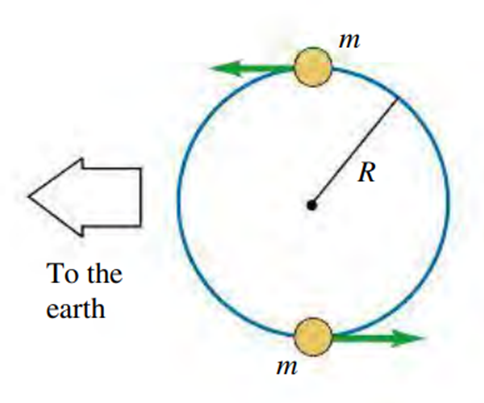
Many of the stars in the sky are actually binary stars, in which two stars orbit about their common centre of mass. If the orbital speeds of the stars are high enough, the motion of the stars can be detected by the Doppler shifts of the light they emit. Stars for which this is the case are called spectroscopic binary stars. Figure p=37.68 shows the simplest case of a spectroscopic binary star: two identical stars, each with mass m, orbiting their centre of mass in a circle of radius R. The plane of the stars’ orbits is edge-on to the line of sight of an observer on the earth. (a) The light produced by heated hydrogen gas in a laboratory on the earth has a frequency of 4.56811×10¹⁴Hz. In the light received from the stars by a telescope on the earth, hydrogen light is observed to vary in frequency between 4.56771×10¹⁴Hzand 4.56891×10¹⁴Hz. Determine whether the binary star system as a whole is moving toward or away from the earth, the speed of this motion, and the orbital speeds of the stars. (Hint: The speeds involved are much less than c, so you may use the approximate result ∆ff=uc given in Section 37.6.) (b) The light from each star in the binary system varies from its maximum frequency to its minimum frequency and back again in 11 days. Determine the orbital radius R and the massm of each star. Give your answer form in kilograms and as a multiple of the mass of the sun, 1.99×1030kg. Compare the value of to the distance from the earth to the sun, 1.5×10¹¹m. (This technique is actually used in astronomy to determine the masses of stars. In practice, the problem is more complicated because the two stars in a binary system are usually not identical, the orbits are usually not circular, and the plane of the orbits is usually tilted with respect to the line of sight from the earth.)

(a) What is the probability that an electron in the 1s state of a hydrogen atom will be found at a distance less than a>2 from the nucleus? (b) Use the results of part (a) and of Example 41.4 to calculate the probability that the electron will be found at distances between a>2 and a from the nucleus.

Human skin is relatively insensitive to visible light, but ultraviolet radiation can cause severe burns. Does this have anything to do with photon energies? Explain.

According to the photon model, light carries its energy in packets called quanta or photons. Why then don’t we see a series of flashes when we look at things?

See all solutions

Recommended explanations on Physics Textbooks

View all explanations

What do you think about this solution?

We value your feedback to improve our textbook solutions.

Study anywhere. Anytime. Across all devices.