/*! This file is auto-generated */ .wp-block-button__link{color:#fff;background-color:#32373c;border-radius:9999px;box-shadow:none;text-decoration:none;padding:calc(.667em + 2px) calc(1.333em + 2px);font-size:1.125em}.wp-block-file__button{background:#32373c;color:#fff;text-decoration:none} Q39E Consider the circuit of Fig. E25... [FREE SOLUTION] | ÷ÈÓ°Ö±²¥

÷ÈÓ°Ö±²¥

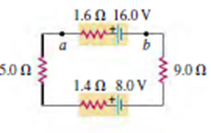
Consider the circuit of Fig. E25.30. (a)What is the total rate at which electrical energy is dissipated in the 5.0-Ω and 9.0-Ω resistors? (b) What is the power output of the 16.0-V battery? (c) At what rate is electrical energy being converted to other forms in the 8.0-V battery? (d) Show that the power output of the 16.0-V battery equals the overall rate of consumption of electrical energy in the rest of the circuit.

Fig. E25.30.
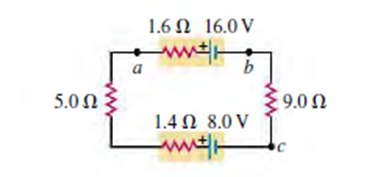
Short Answer

Expert verified
  1. The total rate at which electrical energy is dissipated in 5.0 Ω and 9.0 Ω is.
  2. The power output of the 16.0 V battery is 7.2 W
  3. The rate at which electrical energy is converted to other forms in the 8.0 V battery is 4.1 W
  4. It is shown that the power output of the 16.0-V battery equals the overall rate of consumption of electrical energy in the rest of the circuit.

Step by step solution

01

(a) Determination of the total rate at which electrical energy is dissipated in 5.0 Ω and 9.0 Ω.

Expression of power dissipation in a resistor of resistance R is,

P=l2R

Solve for current using Ohm’s Law,

l=VR=8.0V17Ω=0.47A

Use the value of I in the power expression,

P5Ω=l2R=(0.47A)25.0Ω=1.1WSimilarly,P9Ω=l2R=(0.47A)29.0Ω=2.0WThus,thetotalpoweris,P=P5Ω+P9Ω=1.1W+2.0W=3.1W

02

(b) Determination of the power output of the 16.0 V batteries.

The power output is given by,

P16V=ε±ô-l2rSubstituteε=16V,l=0.47Aandr=1.6ΩP16V=(16V)(0.47A)-(0.47A)2(1.6Ω)=7.2W

Thus, the power output of the 16.0 V battery is 7.2 W

03

(c) Determination of the rate at which electrical energy is converted to other forms in the 8.0 V batteries.

Rate of conversion of electrical energy is the power output and the expression for the 8.0 V battery is given as,

P8V=ε±ô-l2rSubstituteε=8.0V,l=0.47Aandr=1.4ΩP8V=(8V)(0.47A)-(0.47A)2(1.4Ω)=4.1W

Thus, the power output of the 8.0 V battery is 4.1 W.

04

(d) Proof that the power output of the 16.0-V battery equals the overall rate of consumption of electrical energy in the rest of the circuit.    

Infer from part (a), (b) and (c)

It is shown that the power output for 16.0 V in part (b) is equal to the power dissipated for 8.0 V battery in part (c) and the combined power loss across 5.0Ω and 9.0 Ω resistor in part (a).

Unlock Step-by-Step Solutions & Ace Your Exams!

  • Full Textbook Solutions

    Get detailed explanations and key concepts

  • Unlimited Al creation

    Al flashcards, explanations, exams and more...

  • Ads-free access

    To over 500 millions flashcards

  • Money-back guarantee

    We refund you if you fail your exam.

Over 30 million students worldwide already upgrade their learning with ÷ÈÓ°Ö±²¥!

One App. One Place for Learning.

All the tools & learning materials you need for study success - in one app.

Get started for free

Most popular questions from this chapter

The circuit shown in Fig. E25.33 contains two batteries, each with an emf and an internal resistance, and two resistors. Find (a) the current in the circuit (magnitude and direction) and (b) the terminal voltage Vabof the 16.0-V battery.

Fig. E25.33

A circular area with a radius of6.50cmlies in the xy-plane. What is the magnitude of the magnetic flux through this circle due to a uniform magnetic fieldlocalid="1655727900569" B→=0.230T(a) in the direction of +z direction; (b) at an angle of53.1°from the direction; (c) in the direction?

Two copper wires with different diameter are joined end to end. If a current flow in the wire combination, what happens to electrons when they move from the large diameter wire into the smaller diameter wire? Does their drift speed increase, decrease, or stay the same? If the drift speed change, what is the role the force that causes the change? Explain your reasoning.

A metal bar with length L, mass m, and resistance R is placed on frictionless metal rails that are inclined at an angle f above the horizontal. The rails have negligible resistance. A uniform magnetic field of magnitude B is directed downward as shown in Fig. P29.69 . the bar is released from rest and slides down the rails. (a) Is the direction of the current induced in the
bar from a to b or from b to a? (b) What is the terminal speed of the bar? (c) What is the induced current in the bar when the terminal speed has been reached? (d) After the terminal speed has been reached, at what rate is electrical energy being converted to thermal energy in the resistance of the bar? (e) After the terminal speed has been reached, at what rate is work being done on the bar by gravity? Compare your answer to that in part (d)


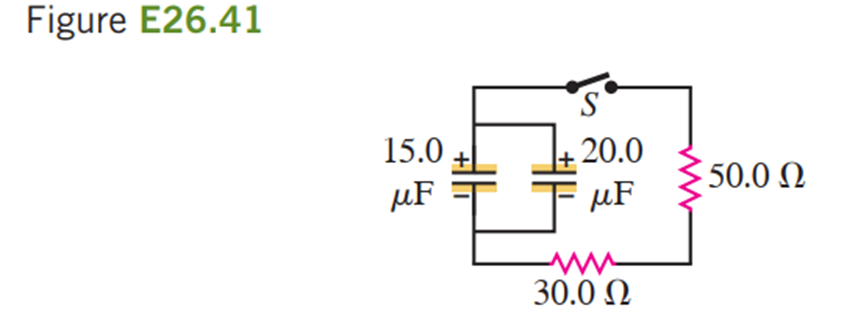
In the circuit shown in Fig. E26.41, both capacitors are initially charged to 45.0 V. (a) How long after closing the switch S will the potential across each capacitor be reduced to 10.0 V, and (b) what will be the current at that time?

See all solutions

Recommended explanations on Physics Textbooks

View all explanations

What do you think about this solution?

We value your feedback to improve our textbook solutions.

Study anywhere. Anytime. Across all devices.