/*! This file is auto-generated */ .wp-block-button__link{color:#fff;background-color:#32373c;border-radius:9999px;box-shadow:none;text-decoration:none;padding:calc(.667em + 2px) calc(1.333em + 2px);font-size:1.125em}.wp-block-file__button{background:#32373c;color:#fff;text-decoration:none} Q16P A golf ball of mass 0.045 kg is ... [FREE SOLUTION] | ÷ÈÓ°Ö±²¥

÷ÈÓ°Ö±²¥

A golf ball of mass 0.045 kg is hit off the tee at a speed of 38 m/s. The golf club was in contact with the ball for \({\bf{3}}{\bf{.5 \times 1}}{{\bf{0}}^{{\bf{ - 3}}}}\;{\bf{s}}\). Find

(a) the impulse imparted to the golf ball, and

(b) the average force exerted on the ball by the golf club.

Short Answer

Expert verified

a. The impulse imparted to the golf ball is 1.7 m/s.

b. The average force exerted on the ball by the golf club is 490 N.

Step by step solution

01

Newton’s second law

According to Newton’s second law, the rate of change of momentum of an object is equal to the net force applied on it, i.e.,

\(F = \frac{{\Delta p}}{{\Delta t}}\).

Here,\(\Delta p\)is the change in momentum of the object in\(\Delta t\)time.

In this problem,the average force exerted on the ball by the golf club is equal to the rate of change of momentum of the golf ball.

02

Given information

Mass of the golf ball,\(m = 0.045\;{\rm{kg}}\).

Contact time between the golf club and the ball is\(\Delta t = 3.5 \times {10^{ - 3}}\;{\rm{s}}\).

Ifthe direction of motion of the golf ball from the golf club to the pitch is considered as the positive direction, then

The initial velocity of the golf ball is\(u = 0\;{\rm{m/s}}\).

The final velocity of the golf ball with which it hits off the tee is \(v = 38\;{\rm{m/s}}\).

03

(a) Determination of the impulse imparted to the golf ball

The impulse imparted to the golf ball is equal to the total change in the momentum of the ball, i.e.,

\(\begin{array}{c}{\rm{Impulse}} = \Delta p\\ = m\left( {v - u} \right)\\ = \left( {0.045\;{\rm{kg}}} \right)\left[ {38\;{\rm{m/s}} - 0\;{\rm{m/s}}} \right]\\ = 1.71\;{\rm{m/s}}\\ = 1.7\;{\rm{m/s}}\end{array}\)

Thus, the impulse imparted to the golf ball is 1.7 m/s.

04

(b) Determination of the average force exerted on the ball by the golf club

From Newton’s second law, theaverage force exerted on the ball is calculated as follows:

\(\begin{array}{c}\bar F = \frac{{\Delta p}}{{\Delta t}}\\ = \frac{{1.7\;{\rm{m/s}}}}{{\left( {3.5 \times {{10}^{ - 3}}\;{\rm{s}}} \right)}}\\ = \;0.49 \times {10^3}\;{\rm{N}}\\ = 490\;{\rm{N}}\end{array}\)

Thus, the average force exerted on the ball by the golf club is 490 N.

Unlock Step-by-Step Solutions & Ace Your Exams!

  • Full Textbook Solutions

    Get detailed explanations and key concepts

  • Unlimited Al creation

    Al flashcards, explanations, exams and more...

  • Ads-free access

    To over 500 millions flashcards

  • Money-back guarantee

    We refund you if you fail your exam.

Over 30 million students worldwide already upgrade their learning with ÷ÈÓ°Ö±²¥!

One App. One Place for Learning.

All the tools & learning materials you need for study success - in one app.

Get started for free

Most popular questions from this chapter

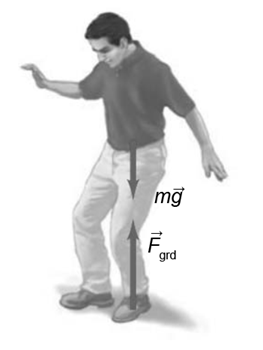
(a) Calculate the impulse experienced when a 55-kg person lands on firm ground after jumping from a height of 2.8 m.

(b) Estimate the average force exerted on the person’s feet by the ground if the landing is stiff-legged, and again

(c) with bent legs. With stiff legs, assume the body moves 1.0 cm during impact, and when the legs are bent, about 50 cm. [Hint: The average net force on him, which is related to impulse, is the vector sum of gravity and the force exerted by the ground. See Fig. 7–34.] We will see in Chapter 9 that the force in (b) exceeds the ultimate strength of bone (Table 9–2).

FIGURE 7-34 Problem 24.

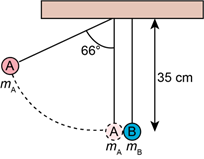
Two balls, of masses\({m_{\rm{A}}} = 45\;{\rm{g}}\)and\({m_{\rm{B}}} = 65\;{\rm{g}}\), are suspended as shown in Fig. 7–46. The lighter ball is pulled away to a 66° angle with the vertical and released.

(a) What is the velocity of the lighter ball before impact?

(b) What is the velocity of each ball after the elastic collision?

(c) What will be the maximum height of each ball after the elastic collision?

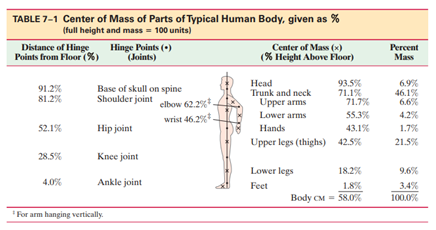
Assume that your proportions are the same as those in Table 7–1, and calculate the mass of one of your legs.

A meteor whose mass was about \(1.5 \times {10^8}\;{\rm{kg}}\) struck the Earth \(\left( {{m_{\rm{E}}} = 6.0 \times {{10}^{24}}\;{\rm{kg}}} \right)\) with a speed of about 25 km/s and came to rest in the Earth.

(a) What was the Earth’s recoil speed (relative to Earth at rest before the collision)?

(b) What fraction of the meteor’s kinetic energy was transformed to kinetic energy of the Earth?

(c) By how much did the Earth’s kinetic energy change as a result of this collision?

Two astronauts, one of mass 55 kg and the other 85 kg, are initially at rest together in outer space. They then push each other apart. How far apart are they when the lighter astronaut has moved 12 m?

See all solutions

Recommended explanations on Physics Textbooks

View all explanations

What do you think about this solution?

We value your feedback to improve our textbook solutions.

Study anywhere. Anytime. Across all devices.