Chapter 26: Q. 14 (page 738)
The electric potential along the V, where is in meters. What is at
(a) and
(b) ?
Short Answer
The field is and .
/*! This file is auto-generated */ .wp-block-button__link{color:#fff;background-color:#32373c;border-radius:9999px;box-shadow:none;text-decoration:none;padding:calc(.667em + 2px) calc(1.333em + 2px);font-size:1.125em}.wp-block-file__button{background:#32373c;color:#fff;text-decoration:none}
Learning Materials
Features
Discover
Chapter 26: Q. 14 (page 738)
The electric potential along the V, where is in meters. What is at
(a) and
(b) ?
The field is and .
All the tools & learning materials you need for study success - in one app.
Get started for free
A typical cell has a membrane potential of , meaning that the potential inside the cell is less than the potential outside due to a layer of negative charge on the inner surface of the cell wall and a layer of positive charge on the outer surface. This effectively makes the cell wall a charged capacitor. Because a cell's diameter is much larger than the wall thickness, it is reasonable to ignore the curvature of the cell and think of it as a parallel-plate capacitor. How much energy is stored in the electric field of a diameter cell with a thick cell wall whose dielectric constant is ?
What is the equivalent capacitance of the three capacitors in Figure ?
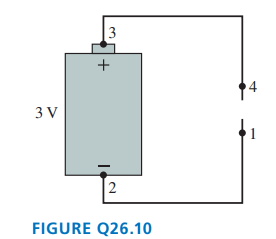
Figure Q26.10 shows a battery with metal wires attached to each end. What are the potential differences ?

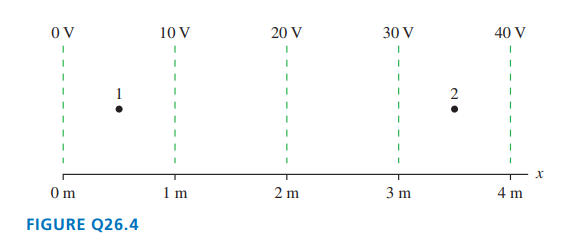
Estimate the electric fields and at points 1 and 2 in Figure Q26.4. Don’t forget that is a vector.

An electric dipole at the origin consists of two charges q spaced apart along the y-axis.
a. Find an expression for the potential V(x, y) at an arbitrary point in the xy-plane. Your answer will be in terms of q, s, x, and y.
b. Use the binomial approximation to simplify your result from part a when s V x and s V y.
c. Assuming s V x and y, find expressions for Ex and Ey, the components of E u for a dipole.
d. What is the on-axis field E? Does your result agree with Equation 23.10?
e. What is the field E u on the bisecting axis? Does your result agree with Equation 23.11?
What do you think about this solution?
We value your feedback to improve our textbook solutions.