/*! This file is auto-generated */ .wp-block-button__link{color:#fff;background-color:#32373c;border-radius:9999px;box-shadow:none;text-decoration:none;padding:calc(.667em + 2px) calc(1.333em + 2px);font-size:1.125em}.wp-block-file__button{background:#32373c;color:#fff;text-decoration:none}

÷ÈÓ°Ö±²¥

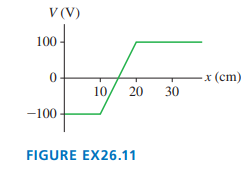
Figure EX26.11 is a graph ofVversusx. Draw the corresponding graph ofExversusx.

Short Answer

Expert verified

We've drawn the required graph withEx=-2000

Step by step solution

01

Given information and theory used  

Given :

Theory used :

The field component E is equal to minus the slope of the graph of the potential V

02

Calculating Ex

The field component Eis equal to minus the slope of the graph of the potential V

As a result, forxbetween 0and10cmandx>20cm, because Vdoes not vary. Between 10and20cm, the potential varies in a consistent manner from -100Vto100V,assuming a constant field of :

Ex=-100V-(-100V)0.2m-0.1m=-2000V/m.

03

Formulating table and graph

Table :

PositionElectric Field
0-10cm
0V/m
10-20cm
-2000V/m
20-30cm
0V/m

Graph :

Unlock Step-by-Step Solutions & Ace Your Exams!

  • Full Textbook Solutions

    Get detailed explanations and key concepts

  • Unlimited Al creation

    Al flashcards, explanations, exams and more...

  • Ads-free access

    To over 500 millions flashcards

  • Money-back guarantee

    We refund you if you fail your exam.

Over 30 million students worldwide already upgrade their learning with ÷ÈÓ°Ö±²¥!

One App. One Place for Learning.

All the tools & learning materials you need for study success - in one app.

Get started for free

Most popular questions from this chapter

Engineers discover that the electric potential between two electrodes can be modeled as V(x)=V0In(1+x/d), where V0is a constant, xis the distance from the first electrode in the direction of the second, and dis the distance between the electrodes. What is the electric field strength midway between the electrodes?

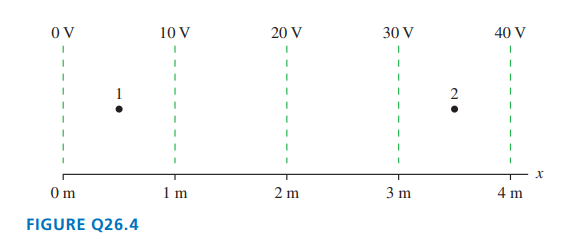
Estimate the electric fields E→1and E→2 at points 1 and 2 in Figure Q26.4. Don’t forget thatE→ is a vector.

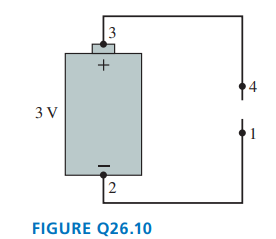
Figure Q26.10 shows a 3Vbattery with metal wires attached to each end. What are the potential differences ∆V12=V2-V1,∆V23=V3-V2,∆V34=V4-V3,and∆V41=V1-V4?

Consider a uniformly charged sphere of radius R and total cAlC charge Q. The electric field Eout outside the sphere(r≥R) is simply that of a point charge Q. In Chapter 24, we used Gauss's law to find that the electric field Ein inside the sphere(r≤R) is radially outward with field strength

Ein=14πϵ0QR3r

a. The electric potential Voutoutside the sphere is that of a point charge Q. Find an expression for the electric potentialVinat position r inside the sphere. As a reference, let Vin=Voutat the surface of the sphere.

b. What is the ratio Vcenter/Vsurface?

c. Graph V versus r for 0 ≤r ≤3 R.

A typical cell has a membrane potential of -70mV, meaning that the potential inside the cell is 70mV less than the potential outside due to a layer of negative charge on the inner surface of the cell wall and a layer of positive charge on the outer surface. This effectively makes the cell wall a charged capacitor. Because a cell's diameter is much larger than the wall thickness, it is reasonable to ignore the curvature of the cell and think of it as a parallel-plate capacitor. How much energy is stored in the electric field of a 50μmdiameter cell with a 7.0nmthick cell wall whose dielectric constant is 9.0?

See all solutions

Recommended explanations on Physics Textbooks

View all explanations

What do you think about this solution?

We value your feedback to improve our textbook solutions.

Study anywhere. Anytime. Across all devices.