/*! This file is auto-generated */ .wp-block-button__link{color:#fff;background-color:#32373c;border-radius:9999px;box-shadow:none;text-decoration:none;padding:calc(.667em + 2px) calc(1.333em + 2px);font-size:1.125em}.wp-block-file__button{background:#32373c;color:#fff;text-decoration:none} Q55P (a) A long metal pipe of square ... [FREE SOLUTION] | ÷ÈÓ°Ö±²¥

÷ÈÓ°Ö±²¥

(a) A long metal pipe of square cross-section (side a) is grounded on three sides, while the fourth (which is insulated from the rest) is maintained at constant potential V0.Find the net charge per unit length on the side oppositeto Vo. [Hint:Use your answer to Prob. 3.15 or Prob. 3.54.]

(b) A long metal pipe of circular cross-section (radius R) is divided (lengthwise)

into four equal sections, three of them grounded and the fourth maintained at

constant potential Vo.Find the net charge per unit length on the section opposite

to V0.[Answer to both (a) and (b) : localid="1657624161900" -ε0V0ττIn2.]

Short Answer

Expert verified

(a) The charge per unit length on the insulated side of a square pipe having side length a is -ε0V0ττIn2.

(b) The charge per unit length on the insulated side of a cylindrical pipe having radius R is -ε0V0ττIn2.

Step by step solution

01

Given data

The side length of the long square metal pipe is a.

The potential on one side is V0and the other three sides are zero potential.

V(y=0)=0.....(1)V(y=a)=V0.......(2)V(x=a/2)=0......(3)V(x=-a/2)......(4)

The boundary conditions for the square pipe are

VR,-p4<f<p4=0....(5)VRf>p4=0.......(6)

02

Potential of a square pipe, cylindrical pipe and the surface charge density

The potential inside the rectangular pipe of sides a, b with V0potential at and zero potential on the other boundaries is

localid="1657628313896" V0[ya+2ττ∑(-1)nncosh(nττxa)sin(nττxa)cosh(nττxa)].....(7)

The surface charge density as a function of x is given by

σ(x)=-ε0∂V∂yy=0.....(8)

The general solution for the potential function in cylindrical coordinates is

V(r,f)=a0+b0Inr+∑k=1∞(akrk+bkr-k)[ckcos(kf)+dksin(kf)]....(9)

03

Charge per unit length at the boundary of square pipe

Equation (7) for b = a/2 reduces to

V0[ya+2ττ∑(-1)nncosh(²Ôττ³æa)sin(²Ôττ³æa)cosh(²Ôττ³æa)].....(7)

The surface charge density in accordance with equation (8) is as follows

σ(x)=-ε0V0V0[ya+2ττ∑nnÏ€a(-1)ncosh(²Ôττ³æa)cos(²Ôττya)ncosh(²Ôττ³æa)]=0=-ε0V0a1+2∑n(-1)ncosh(²Ôττ³æa)cosh(nÏ€2)

The charge per unit length is

λ=∫-a2a2σ(x)dx=-ε0V0a∫-a2a21+2∑n(-1)ncosh(²Ôττ³æa)cosh(nÏ€2)dx=-ε0V0aa+2∑n(-1)ncoshnÏ€2∫-a2a2coshnÏ€³æa=-ε0V0aa+4ππ∑n(-1)ntanhnÏ€2n

This can be numerically solved to

λ=-ε0V0πIn2

04

Charge per unit length at the boundary of cylindrical pipe

From equation (9), for potential inside the pipe, b0and bkmust be zero, otherwise the potential will blow up at r = 0. The configuration is symmetric in Ï•, hence dk=0. Absorption of ckinto akreduces equation (3) to

V(r,ϕ)=a0+∑k-1∞akrkcos(kϕ)

Apply Fourier trick on the boundary equation to get

∑k=0∞akRk∫-ππcos(kϕ)cos(k'ϕ)dϕ=V0∫-π/4π/4cos(k'ϕ)dϕ=V0K'sinK'π4ifK'≠0V0π2ifK'=0

Also

∫-ππcos(kϕ)cos(k'ϕ)dϕ2πk=K'=0πk=K'≠0

Use these two solutions to get

a0=V04ak=2V0Ï€°ì¸éksinkÏ€4

The potential function thus becomes

V(r,ϕ)=V014+2π∑k=1∞sin(kπ/4)krkkcos(kϕ)

To find the line charge, first differentiate with respect to r, integrate with respect to ϕand finally put the limit r→R.

role="math" localid="1657688183512" σ=ε0∂V∂r=2ε0V0Ï€¸é∑k=1∞sin(kÏ€/4)kkrRk-1cos(kÏ•)=2ε0V0Ï€¸é∑k=1∞rRk-1sin(kÏ€/4)cos(kÏ•)

The line charge on the opposite wall to that with potential V0is

λ=2∫3Ï€4πσRdÏ•=2∫3Ï€4Ï€2ε0V0Ï€¸é∑k=1∞rRk-1sin(kÏ€/4)cos(kÏ•)RdÏ•=4ε0V0π∑k=1∞rRk-1sin(kÏ€/4)∫3Ï€4Ï€cos(kÏ•)dÏ•=-4ε0V0π∑k=1∞rRk-1sin(kÏ€/4)∫3Ï€4Ï€sin(3kÏ€/4)

This can be expanded in terms of x = r/ R as

λ=-4ε0V0Ï€12xx+x33+x35+....-1xx22+x66+x1010+...=-2ε0V0Ï€³æ12In1+x1-x-12In1+x21-x2=-ε0V0Ï€³æIn1+x1-x×1+x21-x2=-ε0V0Ï€³æIn(1+x2)1-x2

Thus, the charge for the limit r→R(x→1)is

λx→1=-ε0V0πIn(1+1)21+12=-ε0V0πIn2

Unlock Step-by-Step Solutions & Ace Your Exams!

  • Full Textbook Solutions

    Get detailed explanations and key concepts

  • Unlimited Al creation

    Al flashcards, explanations, exams and more...

  • Ads-free access

    To over 500 millions flashcards

  • Money-back guarantee

    We refund you if you fail your exam.

Over 30 million students worldwide already upgrade their learning with ÷ÈÓ°Ö±²¥!

One App. One Place for Learning.

All the tools & learning materials you need for study success - in one app.

Get started for free

Most popular questions from this chapter

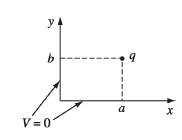
Two semi-infinite grounded conducting planes meet at right angles. In the region between them, there is a point chargeq, situated as shown in Fig. 3.15. Set up the image configuration, and calculate the potential in this region. What charges do you need, and where should they be located? What is the force onq? How much Work did it take to bringqin from infinity? Suppose the planes met at some angle other than; would you still be able to solve the problem by the method of images? If not, for what particular anglesdoesthe method work?

Here's an alternative derivation of Eq. 3.10 (the surface charge density

induced on a grounded conducted plane by a point charge qa distance dabove

the plane). This approach (which generalizes to many other problems) does not

rely on the method of images. The total field is due in part to q,and in part to the

induced surface charge. Write down the zcomponents of these fields-in terms of

qand the as-yet-unknown σ(x,y)-just below the surface. The sum must be zero,

of course, because this is inside a conductor. Use that to determine σ.

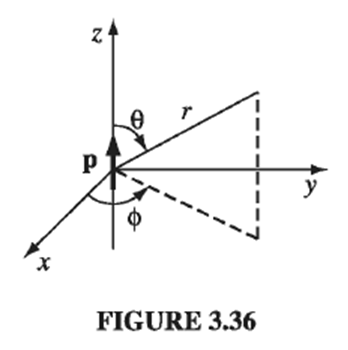
An ideal electric dipole is situated at the origin, and points in the direction, as in Fig. 3.36. An electric charge is released from rest at a point in the x-y plane. Show that it swings back and forth in a semi-circular arc, as though it were apendulum supported at the origin.

(a) Show that the quadrupole term in the multipole expansion can be written as

V"quad"(r⃗)=14πε01r3∑(i,j=13r^ir^jQij     .....(1)

(in the notation of Eq. 1.31) where

localid="1658485520347" Qij=12∫[3ri'rj'-(r')2δij]ÒÏ(r⃗')dÏ„'     .....(2)

Here

δ_ij={1ifi=j0ifi≠j       .....(3)

is the Kronecker Deltalocalid="1658485013827" (Qij)and is the quadrupole moment of the charge distribution. Notice the hierarchy

localid="1658485969560" Vmon=14πε0Qr;Vdip=14πε0∑r^ipjr2;Vquad(r⇶Ä)=14πε01r3∑i,j=13r^ir^jQIJ;...

The monopole moment localid="1658485018381" (Q) is a scalar, the dipole moment localid="1658485022577" (p⇶Ä) is a vector, the quadrupole moment localid="1658485026647" (Qij)is a second rank tensor, and so on.

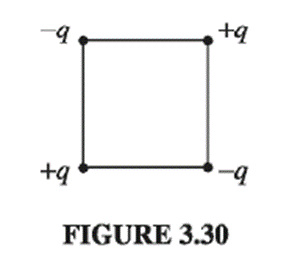
(b) Find all nine components of localid="1658485030553" (Qij)for the configuration given in Fig. 3.30 (assume the square has side and lies in the localid="1658485034755" x-y plane, centered at the origin).

(c) Show that the quadrupole moment is independent of origin if the monopole and

dipole moments both vanish. (This works all the way up the hierarchy-the

lowest nonzero multipole moment is always independent of origin.)

(d) How would you define the octopole moment? Express the octopole term in the multipole expansion in terms of the octopole moment.

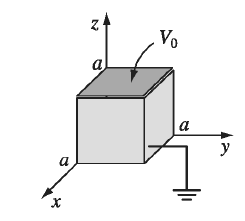
A cubical box (sides of length a) consists of five metal plates, which are welded together and grounded (Fig. 3.23). The top is made of a separate sheet of metal, insulated from the others, and held at a constant potentialV0. Find the potential inside the box. [What should the potential at the center (a/2,a/2,a/2)be ? Check numerically that your formula is consistent with this value.]

See all solutions

Recommended explanations on Physics Textbooks

View all explanations

What do you think about this solution?

We value your feedback to improve our textbook solutions.

Study anywhere. Anytime. Across all devices.