/*! This file is auto-generated */ .wp-block-button__link{color:#fff;background-color:#32373c;border-radius:9999px;box-shadow:none;text-decoration:none;padding:calc(.667em + 2px) calc(1.333em + 2px);font-size:1.125em}.wp-block-file__button{background:#32373c;color:#fff;text-decoration:none} Q3.42P You can use the superposition pr... [FREE SOLUTION] | ÷ÈÓ°Ö±²¥

÷ÈÓ°Ö±²¥

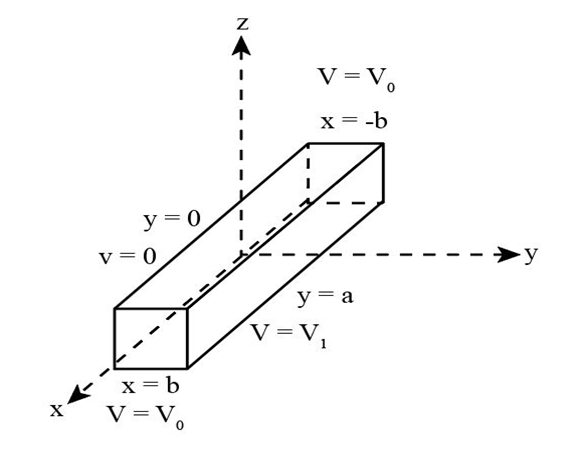
You can use the superposition principle to combine solutions obtained by separation of variables. For example, in Prob. 3.16 you found the potential inside a cubical box, if five faces are grounded and the sixth is at a constant potential V0; by a six-fold superposition of the result, you could obtain the potential inside a cube with the faces maintained at specified constant voltages . V1,V2,......V6In this way, using Ex. 3.4 and Prob. 3.15, find the potential inside a rectangular pipe with two facing sides (x=±b)at potential V0, a third (y=a)at V1. and the last at(y=a) grounded.

Short Answer

Expert verified

Total potential inside a rectangular pipe with two sides at potential V0and at V1is

4π∑n=1,3,5,...1nV0coshnπxacoshnπbasinnπya+V1sinhnπy2bsinhnπa2bsinnπx+b2b

Step by step solution

01

Define function 

Write the expression for the potential inside the rectangular pipe.

Vx,y=4V0π∑n=1,3,51ncoshnπxacoshnπbasinnπya…… (1)

Here, V0is the constant, are the dimensions of the rectangular pipe on x and y axes.

The below figure shows, the rectangular pipe is placed on the coordinates.
02

Determine the potential inside the rectangular pipe 

Write the expression for potential when V0y=V0.

Vx,y=4V0π∑n=1,3,5,...1nsinhnπxasinhnπbasinnπya

Substitute V1for V0, yfor xland X for Y .

Vx,y=4V1π∑N=1,3,5,...1nsinhnπyasinhnπbasinnπxa …… (2)

Here, V1is the constant voltage through one side of the rectangular cube.

The above expression defines that the rectangle is placed in reference with x=0axis.

Substitute x+a2for x1, a forb1and b for a2in equation (2).

Vx,y=4V1π∑N=1,3,5,...1nsinhnπy2bsinhnπa2bsinnπx+a22b=4V1π∑N=1,3,5,...1nsinhnπy2bsinhnπa2bsinnπx+b2b

From the above expression it is clear that the rectangle is mirrored by y axis.

03

Determine the potential inside the rectangular pipe with two sides

Now, find the potential inside the rectangle pipe with two sides facing.

V=4V0π∑n=1,3,5,...1ncoshnπxacoshnπbasinnπya+4V1π∑N=1,3,5,...1nsinhnπy2bsinhnπa2bsinnπx+b2b=4π∑n=1,3,5,...1nV0coshnπxacoshnπbasinnπya+V1sinhnπy2bsinhnπa2bsinnπx+b2b

Hence, total potential inside a rectangular pipe with two sides at potential V0and at V1is .

4π∑n=1,3,5,...1nV0coshnπxacoshnπbasinnπya+V1sinhnπy2bsinhnπa2bsinnπx+b2b

Unlock Step-by-Step Solutions & Ace Your Exams!

  • Full Textbook Solutions

    Get detailed explanations and key concepts

  • Unlimited Al creation

    Al flashcards, explanations, exams and more...

  • Ads-free access

    To over 500 millions flashcards

  • Money-back guarantee

    We refund you if you fail your exam.

Over 30 million students worldwide already upgrade their learning with ÷ÈÓ°Ö±²¥!

One App. One Place for Learning.

All the tools & learning materials you need for study success - in one app.

Get started for free

Most popular questions from this chapter

(a) Show that the quadrupole term in the multipole expansion can be written as

V"quad"(r⃗)=14πε01r3∑(i,j=13r^ir^jQij     .....(1)

(in the notation of Eq. 1.31) where

localid="1658485520347" Qij=12∫[3ri'rj'-(r')2δij]ÒÏ(r⃗')dÏ„'     .....(2)

Here

δ_ij={1ifi=j0ifi≠j       .....(3)

is the Kronecker Deltalocalid="1658485013827" (Qij)and is the quadrupole moment of the charge distribution. Notice the hierarchy

localid="1658485969560" Vmon=14πε0Qr;Vdip=14πε0∑r^ipjr2;Vquad(r⇶Ä)=14πε01r3∑i,j=13r^ir^jQIJ;...

The monopole moment localid="1658485018381" (Q) is a scalar, the dipole moment localid="1658485022577" (p⇶Ä) is a vector, the quadrupole moment localid="1658485026647" (Qij)is a second rank tensor, and so on.

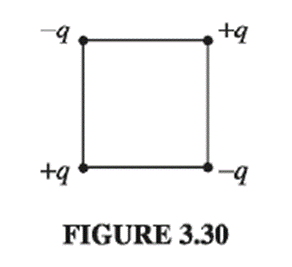
(b) Find all nine components of localid="1658485030553" (Qij)for the configuration given in Fig. 3.30 (assume the square has side and lies in the localid="1658485034755" x-y plane, centered at the origin).

(c) Show that the quadrupole moment is independent of origin if the monopole and

dipole moments both vanish. (This works all the way up the hierarchy-the

lowest nonzero multipole moment is always independent of origin.)

(d) How would you define the octopole moment? Express the octopole term in the multipole expansion in terms of the octopole moment.

Use Green's reciprocity theorem (Prob. 3.50) to solve the following

two problems. [Hint:for distribution 1, use the actual situation; for distribution 2,

removeq,and set one of the conductors at potential V0.]

(a) Both plates of a parallel-plate capacitor are grounded, and a point charge qis

placed between them at a distance xfrom plate 1. The plate separation is d. Find the induced charge on each plate. [Answer: Q1=q(xd-1);Q1=qx/d]

(b) Two concentric spherical conducting shells (radii aand b)are grounded, and a point charge is placed between them (at radius r). Find the induced charge on each sphere.

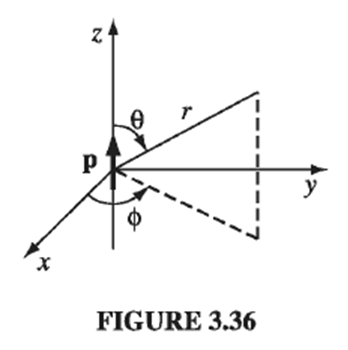
An ideal electric dipole is situated at the origin, and points in the direction, as in Fig. 3.36. An electric charge is released from rest at a point in the x-y plane. Show that it swings back and forth in a semi-circular arc, as though it were apendulum supported at the origin.

Two infinite parallel grounded conducting planes are held a distanceapart. A point chargeqis placed in the region between them, a distance xfromone plate. Find the force on q20Check that your answer is correct for the special

cases a→∞and x=a2.

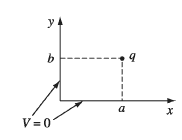
Two semi-infinite grounded conducting planes meet at right angles. In the region between them, there is a point chargeq, situated as shown in Fig. 3.15. Set up the image configuration, and calculate the potential in this region. What charges do you need, and where should they be located? What is the force onq? How much Work did it take to bringqin from infinity? Suppose the planes met at some angle other than; would you still be able to solve the problem by the method of images? If not, for what particular anglesdoesthe method work?

See all solutions

Recommended explanations on Physics Textbooks

View all explanations

What do you think about this solution?

We value your feedback to improve our textbook solutions.

Study anywhere. Anytime. Across all devices.