/*! This file is auto-generated */ .wp-block-button__link{color:#fff;background-color:#32373c;border-radius:9999px;box-shadow:none;text-decoration:none;padding:calc(.667em + 2px) calc(1.333em + 2px);font-size:1.125em}.wp-block-file__button{background:#32373c;color:#fff;text-decoration:none} Q29P Four particles (one of charge q,... [FREE SOLUTION] | ÷ÈÓ°Ö±²¥

÷ÈÓ°Ö±²¥

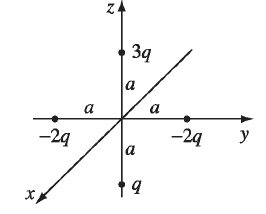
Four particles (one of charge q,one of charge 3q,and two of charge -2q)are placed as shown in Fig. 3.31, each a distance from the origin. Find a

simple approximate formula for the potential, valid at points far from the origin.

(Express your answer in spherical coordinates.)
Short Answer

Expert verified

The potential at the origin for the point charge is V=12πε02qacosθr2.

Step by step solution

01

Define function

The dipole moment is the product of charge and distance of separation charge from the origin.

Write the expression for dipole moment.

p=∑i=1nqiri ……. (1)

Here, is the charge of ithparticle,ri is the distance of separation charge form the origin.

02

Given data

The position of particle is shown in figure.
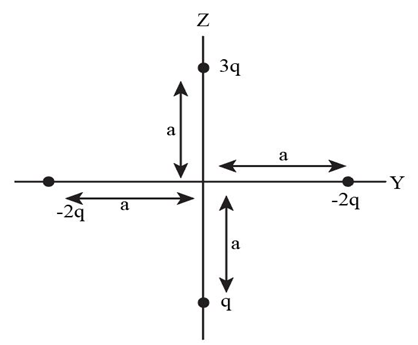
It consist of charges as q ,3q-2q,-2q. The separation between the charges denoted by a.

03

Determine potential

Write the expression for the total dipole moment due to four charges.

P=3qaz^-qaz^+-2qay^+-2qa-y^=2qaz^+2qay^+2qay^.........(2)=2qaz^

Write the expression for the position of the point in spherical coordinates.

x=rsinθcosθq=rsinθsinθz=rcosθ

The scalar product of dipole P and position vector r^is,

P.r^ ......(3)

Substitute 2qaz^ for P in equation (3).

P.r^=2qaz^.r^=2qaz^.r^=2qar^cosθ.r^

Substitute r^.r^=1

Thus,

P.r^=2qacosθ.......(4)

Write the equation for potential at distance rdue to point charge q.

V=14πε0P.r^r2......(5)

Substitute 2qacosθ for P .r^, in equation (5)

V=14πε02qacosθr2

Thus, the potential at the origin for the point charge is V=14πε2qacosθr2.

Unlock Step-by-Step Solutions & Ace Your Exams!

  • Full Textbook Solutions

    Get detailed explanations and key concepts

  • Unlimited Al creation

    Al flashcards, explanations, exams and more...

  • Ads-free access

    To over 500 millions flashcards

  • Money-back guarantee

    We refund you if you fail your exam.

Over 30 million students worldwide already upgrade their learning with ÷ÈÓ°Ö±²¥!

One App. One Place for Learning.

All the tools & learning materials you need for study success - in one app.

Get started for free

Most popular questions from this chapter

Find the charge density σ(θ) on the surface of a sphere (radius R ) that

produces the same electric field, for points exterior to the sphere, as a charge qat the point a<R onthe zaxis.

For the infinite rectangular pipe in Ex. 3.4, suppose the potential on

the bottom (y= 0) and the two sides (x= ±b) is zero, but the potential on the top

(y=a) is a nonzero constant ³Õ0•Find the potential inside the pipe. [Note:This is a

rotated version of Prob. 3.15(b), but set it up as in Ex. 3.4, using sinusoidal functions in yand hyperbolics in x.It is an unusual case in which k= 0 must be included. Begin by finding the general solution to Eq. 3.26 when k= 0.]

Charge density

σ(ϕ)=asin(5ϕ)

(whereais a constant) is glued over the surface of an infinite cylinder of radiusR

(Fig. 3.25). Find the potential inside and outside the cylinder. [Use your result from Prob. 3.24.]

In Ex. 3.2 we assumed that the conducting sphere was grounded ( V=0). But with the addition of a second image charge, the same basic modelwill handle the case of a sphere at any potentialV0 (relative, of course, to infinity). What charge should you use, and where should you put it? Find the force of attraction between a point charge q and a neutral conducting sphere.

A solid sphere, radius R, is centered at the origin. The "northern" hemisphere carries a uniform charge density ÒÏ0, and the "southern" hemisphere a uniform charge density -ÒÏ0• Find the approximate field E(r,θ)for points far from the sphere (r>>R).

See all solutions

Recommended explanations on Physics Textbooks

View all explanations

What do you think about this solution?

We value your feedback to improve our textbook solutions.

Study anywhere. Anytime. Across all devices.