
 Explanations
  Textbooks
  Flashcards
  魅影直播 AI
  Notes
Notes  Study Plans
  Study Sets
  Find a degree
  Magazine
 Chapter 12: Electrodynamics and Relativity
Q2P
As an illustration of the principle of relativity in classical mechanics, consider the following generic collision: In inertial frame S, particle A (mass, velocity ) hits particle B (mass, velocity ). In the course of the collision some mass rubs off A and onto B, and we are left with particles C (mass, velocity ) and D (mass , velocity ). Assume that momentum is conserved in S.
(a) Prove that momentum is also conserved in inertial frame, which moves with velocity relative to S. [Use Galileo鈥檚 velocity addition rule鈥攖his is an entirely classical calculation. What must you assume about mass?]
(b) Suppose the collision is elastic in S; show that it is also elastic in .
Q30P
particle鈥檚 kinetic energy is ntimes its rest energy, what is its speed?
Q31P
Suppose you have a collection of particles, all moving in the x direction, with energies . and momenta . Find the velocity of the center of momentum frame, in which the total momentum is zero.
Q32P
Find the velocity of the muon in Ex. 12.8.
Q33P
A particle of mass m whose total energy is twice its rest energy collides with an identical particle at rest. If they stick together, what is the mass of the resulting composite particle? What is its velocity?
Q34P
A neutral pion of (rest) mass mand (relativistic) momentum decays into two photons. One of the photons is emitted in the same direction as the original pion, and the other in the opposite direction. Find the (relativistic) energy of each photon.
Q35P
In the past, most experiments in particle physics involved stationary targets: one particle (usually a proton or an electron) was accelerated to a high energy E, and collided with a target particle at rest (Fig. 12.29a). Far higher relative energies are obtainable (with the same accelerator) if you accelerate both particles to energy E, and fire them at each other (Fig. 12.29b). Classically, the energy of one particle, relative to the other, is just (why?) . . . not much of a gain (only a factor of ). But relativistically the gain can be enormous. Assuming the two particles have the same mass, m, show that
(12.58)
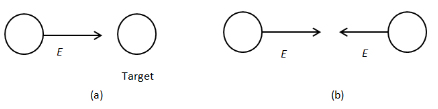
FIGURE 12.29
Suppose you use protons with . What do you get? What multiple of E does this amount to? [Because of this relativistic enhancement, most modern elementary particle experiments involve colliding beams, instead of fixed targets.]
Q36P
In a pair annihilation experiment, an electron (mass m) with momentum hits a positron (same mass, but opposite charge) at rest. They annihilate, producing two photons. (Why couldn鈥檛 they produce just one photon?) If one of the photons emerges at to the incident electron direction, what is its energy?
Q37P
In classical mechanics, Newton鈥檚 law can be written in the more familiar form . The relativistic equation, , cannot be so simply expressed. Show, rather, that
where is the ordinary acceleration.
Q39P
Define proper acceleration in the obvious way:
(a) Findand 伪 in terms of u and a (the ordinary acceleration).
(b) Expressin terms of u and a.
(c) Show that.
(d) Write the Minkowski version of Newton鈥檚 second law, in terms of. Evaluate the invariant product.
