/*! This file is auto-generated */ .wp-block-button__link{color:#fff;background-color:#32373c;border-radius:9999px;box-shadow:none;text-decoration:none;padding:calc(.667em + 2px) calc(1.333em + 2px);font-size:1.125em}.wp-block-file__button{background:#32373c;color:#fff;text-decoration:none} Q. 2.10 Use a computer to produce a tabl... [FREE SOLUTION] | ÷ÈÓ°Ö±²¥

÷ÈÓ°Ö±²¥

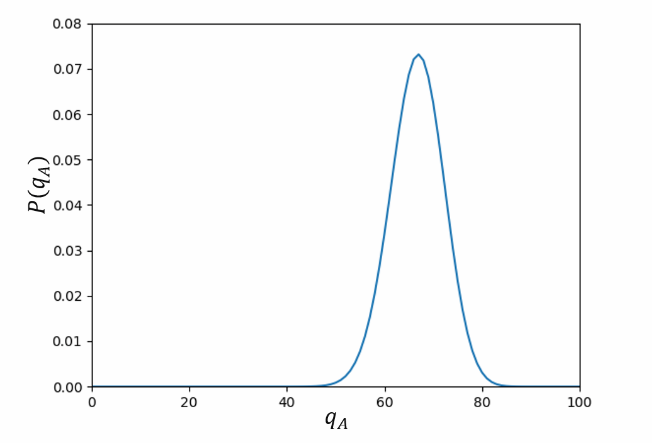
Use a computer to produce a table and graph, like those in this section, for the case where one Einstein solid contains 200 oscillators, the other contains100 oscillators, and there are 100 units of energy in total. What is the most probable macrostate, and what is its probability? What is the least probable macrostate, and what is its probability?

Short Answer

Expert verified

The most likely macrostate is when 67energy units out of the total energy units are in solid A,qA=67and qB=33, with a probability of 0.07315; the least likely macrostate is when all energy units are in partitionBqA=0or when qB=100, with a probability of 2.6926×10-37.

Step by step solution

01

Calculation for overall multiplicity

Probability is,

PqA=ΩAΩBΩoverall

Over all multiplicity is,

ΩoverallNoverall,qoverall=qoverall+Noverall-1qoverall

=qoverall+Noverall-1!qoverall!Noverall-1!

Where,

qoverall=qA+qB=100

Noverall=NA+NB=300

Then,

Ωoverall=100+300-1100

=(100+300-1)!100!(300-1)!

=1.681×1096

02

Calculation for total multiplicity and probability

Total multiplicity is,

Ωtotal=ΩAΩB

NA=200

ΩA=qA+199qA

=qA+199!qA!(199!)

ΩB=qB+NB-1qB

For NB=100,qB=100-qA

ΩB=100-qA+100-1100-qA

=199-qA!100-qA!(99)!

probability is,

PqA=ΩAΩBΩoverall

=11.681×1096qA+199!qA!(199!)199-qA!100-qA!(99)!

PqA=11.681×1096qA+199!qA!(199!)199-qA!100-qA!(99)!

03

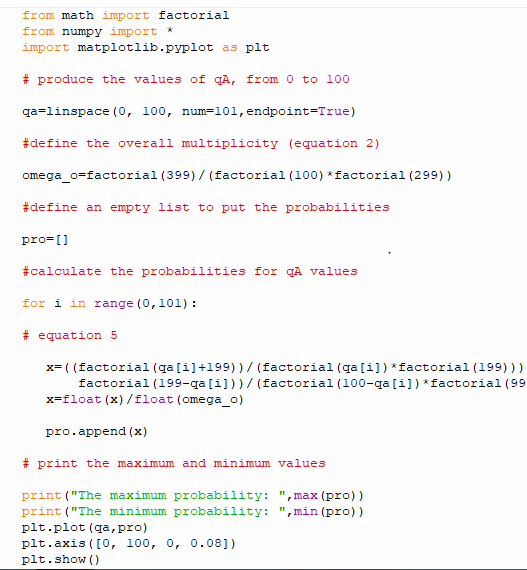
Python program for creation of graph

04

Graph for probability versus energy

Unlock Step-by-Step Solutions & Ace Your Exams!

  • Full Textbook Solutions

    Get detailed explanations and key concepts

  • Unlimited Al creation

    Al flashcards, explanations, exams and more...

  • Ads-free access

    To over 500 millions flashcards

  • Money-back guarantee

    We refund you if you fail your exam.

Over 30 million students worldwide already upgrade their learning with ÷ÈÓ°Ö±²¥!

One App. One Place for Learning.

All the tools & learning materials you need for study success - in one app.

Get started for free

Most popular questions from this chapter

Find an expression for the entropy of the two-dimensional ideal gas considered in Problem 2.26. Express your result in terms of U,AandN.

Calculate the multiplicity of an Einstein solid with 30oscillators and 30units of energy. (Do not attempt to list all the microstates.)

The mathematics of the previous problem can also be applied to a one-dimensional random walk: a journey consisting of Nsteps, all the same sic, cache chosen randomly to be cither forward or backward. (The usual mental image is that of a drunk stumbling along an alley.)

(a) Where are you most likely to find yourself, after the end of a long random walk?

(b) Suppose you take a random walk of 10,000steps (say each a yard long). About how far from your starting point would you expect to be at the end?

(c) A good example of a random walk in nature is the diffusion of a molecule through a gas; the average step length is then the mean free path, as computed in Section 1.7.Using this model, and neglecting any small numerical factors that might arise from the varying step size and the multidimensional nature of the path, estimate the expected net displacement of an air molecule (or perhaps a carbon monoxide molecule traveling through air) in one second, at room temperature and atmospheric pressure. Discuss how your estimate would differ if the clasped time or the temperature were different. Check that your estimate is consistent with the treatment of diffusion in Section1.7.

Consider a system of two Einstein solids, with N{A} = 300, N{B} = 200 and q{total} = 100 (as discussed in Section 2.3). Compute the entropy of the most likely macrostate and of the least likely macrostate. Also compute the entropy over long time scales, assuming that all microstates are accessible. (Neglect the factor of Boltzmann's constant in the definition of entropy; for systems this small it is best to think of entropy as a pure number.) 65

Show that during the quasistatic isothermal expansion of a monatomic ideal gas, the change in entropy is related to the heat input Qby the simple formula

∆s=QT

In the following chapter I'll prove that this formula is valid for any quasistatic process. Show, however, that it is not valid for the free expansion process described above.

See all solutions

Recommended explanations on Physics Textbooks

View all explanations

What do you think about this solution?

We value your feedback to improve our textbook solutions.

Study anywhere. Anytime. Across all devices.