/*! This file is auto-generated */ .wp-block-button__link{color:#fff;background-color:#32373c;border-radius:9999px;box-shadow:none;text-decoration:none;padding:calc(.667em + 2px) calc(1.333em + 2px);font-size:1.125em}.wp-block-file__button{background:#32373c;color:#fff;text-decoration:none} Q 19. Size of American households In g... [FREE SOLUTION] | ÷ÈÓ°Ö±²¥

÷ÈÓ°Ö±²¥

Size of American households In government data, a household consists of all occupants of a dwelling unit, while a family consists of two or more persons who live together and are related by blood or marriage. So all families form households, but some households are not families. Here are the distributions of household size and family size in the United States:

Let H = the number of people in a randomly selected U.S. household and F= the number of people in a randomly chosen U.S. family.

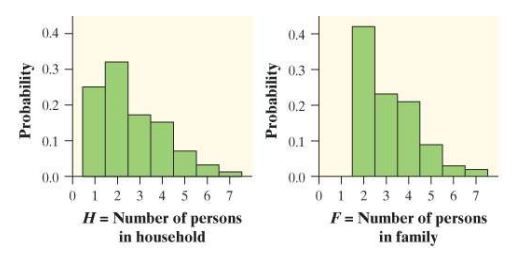
(a) Here are histograms comparing the probability distributions of Hand F. Describe any differences that you observe.

(b) Find the expected value of each random variable. Explain why this difference makes sense.
(c) The standard deviations of the two random variables are σH=1.421and σF=1.249.Explain why this difference makes sense.

Short Answer

Expert verified

Part (a) Both distributions are skewed to the right. The most typical number of people in a family and in a household is both 2.

Part (b) Household: 2.6 and Family: 3.14

Part (c) A household can only have one person, while a family must always have more than one person, hence there are more possible values for the number of people in a household (leading to a higher standard deviation).

Step by step solution

01

Part (a) Step 1. Given information.

The given information is:

02

Part (a) Step 2. Describe any differences that you observe. in the given histograms H and F.

The highest bars in the histograms are to the left, while a tail of lower bars is to the right, both distributions are skewed to the right.

The largest bar in both histograms is centered at 2, the most common number of people in a family and a household is both 2.

The histogram of families is narrower than the histogram of households, the spread of the number of people in a household is bigger than the spread of the number of people in a family.

There are no outliers in either distribution since there are no gaps in the histogram.

03

Part (b) Step 1. Find the expected value of each variable.

Mean of Household:

μ=∑xPX=x=1×0.25+2×0.32+3×0.17+4×0.15+5×0.07+6×0.03+7×0.01=2.6

Mean of Family:

μ=∑xPX=x=1×0+2×0.42+3×0.23+4×0.21+5×0.09+6×0.03+7×0.02=3.14

We can see that the Family has a greater expected value than the household which means all household has a minimum of one person and all families have a minimum of 2 persons.

04

Part (c) step 1. Differences in standard deviation.

The histogram of the household distribution is bigger, we inferred in part (a) that the spread of the home distribution was greater than the spread of the family distribution.

This is supported by standard deviations, which show that the household standard deviation is higher than the family standard deviation.

Furthermore, this makes sense because a household can only have one person, whereas a family must always have more than one person, and so there are more possible values for such a number of people in a household (leading to a higher standard deviation).

Unlock Step-by-Step Solutions & Ace Your Exams!

  • Full Textbook Solutions

    Get detailed explanations and key concepts

  • Unlimited Al creation

    Al flashcards, explanations, exams and more...

  • Ads-free access

    To over 500 millions flashcards

  • Money-back guarantee

    We refund you if you fail your exam.

Over 30 million students worldwide already upgrade their learning with ÷ÈÓ°Ö±²¥!

One App. One Place for Learning.

All the tools & learning materials you need for study success - in one app.

Get started for free

Most popular questions from this chapter

Take a spin An online spinner has two colored regions-blue and yellow. According to the website, the probability that the spinner lands in the blue region on any spin is 0.80. Assume for now that this claim is correct. Suppose we spin the spinner12 times and let X= the number of times it lands in the blue region. Make a graph of the probability distribution of X. Describe its shape.

Time and motion A time-and-motion study measures the time required for an assembly-line worker to perform a repetitive task. The data show that the time required to bring a part from a bin to its position on an automobile chassis varies from car to car according to a Normal distribution with mean 11seconds and standard deviation 2seconds. The time required to attach the part to the chassis follows a Normal distribution with mean 20seconds and standard deviation 4seconds. The study finds that the times required for the two steps are independent. A part that takes a long time to position, for example, does not take more or less time to attach than other parts.

(a) Find the mean and standard deviation of the time required for the entire operation of positioning and attaching the part.

(b) Management’s goal is for the entire process to take less than 30seconds. Find the probability that this goal will be met. Show your work

Toothpaste Ken is traveling for his business. He has a new 0.85-ounce tube of toothpaste that's supposed to last him the whole trip. The amount of toothpaste Ken squeezes out of the tube each time he brushes varies according to a Normal distribution with mean 0.13ounces and standard deviation 0.02ounces. If Ken brushes his teeth six times during the trip, what's the probability that he'll use all the toothpaste in the tube? Follow the four-step process.

Red light! Pedro drives the same route to work on Monday through Friday. His route includes one traffic light. According to the local traffic department, there is a 55%chance

that the light will be red on a randomly selected work day. Suppose we choose 10 of Pedro's work days at random and let Y= the number of times that the light is red. Make a graph of the probability distribution of Y . Describe its shape.

A company’s single-serving cereal boxes advertise 1.63ounces of cereal. In fact, the amount of cereal X in a randomly selected box can be modeled by a Normal distribution with a mean of 1.70ounces and a standard deviation of 0.03ounce. Let Y=the excess amount of cereal beyond what’s advertised in a randomly selected box, measured in grams (1ounce=28.35grams).

a. Find the mean of Y.

b. Calculate and interpret the standard deviation of Y.

c. Find the probability of getting at least 1grammore cereal than advertised.

See all solutions

Recommended explanations on Math Textbooks

View all explanations

What do you think about this solution?

We value your feedback to improve our textbook solutions.

Study anywhere. Anytime. Across all devices.
