
 Explanations
  Textbooks
  Flashcards
  魅影直播 AI
  Notes
Notes  Study Plans
  Study Sets
  Find a degree
  Magazine
 Chapter 10: Comparing Two Populations or Treatments
Q. T10.13
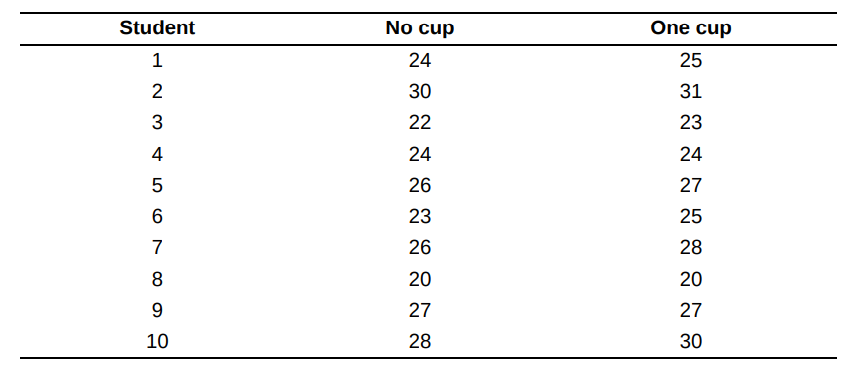
鈥淚 can鈥檛 get through my day without coffee鈥� is a common statement from many college students. They assume that the benefits of coffee include staying awake during lectures and remaining more alert during exams and tests. Students in a statistics class designed an experiment to measure memory retention with and without drinking a cup of coffee 1 hour before a test. This experiment took place on two different days in the same week (Monday and Wednesday). Ten students were used. Each student received no coffee or one cup of coffee 1 hour before the test on a particular day. The test consisted of a series of words flashed on a screen, after which the student had to write down as many of the words as possible. On the other day, each student received a different amount of coffee (none or one cup).
a. One of the researchers suggested that all the subjects in the experiment drink no coffee before Monday鈥檚 test and one cup of coffee before Wednesday鈥檚 test. Explain to the researcher why this is a bad idea and suggest a better method of deciding when each subject receives the two treatments.
b. The researchers actually used the better method of deciding when each subject receives the two treatments that you identified in part (a). For each subject, the number of words recalled when drinking no coffee and when drinking one cup of coffee is recorded in the table. Carry out an appropriate test to determine whether there is convincing evidence that drinking coffee improves memory, on average, for students like the ones in this study.
Q. T10.3
The power takeoff driveline on tractors used in agriculture is a potentially serious hazard to operators of farm equipment. The driveline is covered by a shield in new tractors, but for a variety of reasons, the shield is often missing on older tractors. Two types of shields are the bolt-on and the flip-up. It was believed that the boll-on shield was perceived as a nuisance by the operators and deliberately removed, but the flip-up shield is easily lifted for inspection and maintenance and may be left in place. In a study initiated by the US National Safety Council, random samples of older tractors with both types of shields were taken to see what proportion of shields were removed. Of tractors designed to have bolt-on shields, had been removed. Of the tractors with flip-up shields, were removed. We wish to perform a test of versus , where and are the proportions of all the tractors with bolt-on and flip-up shields removed, respectively. Which of the following is not a condition for performing the significance test ?
(a) Both populations are Normally distributed.
(b) The data come from two independent samples.
(c) Both samples were chosen at random.
(d) The counts of successes and failures are large enough to use Normal calculations.
(e) Both populations are at least times the corresponding sample sizes.
Q. T10.4
A quiz question gives random samples of observations from each of two Normally distributed populations. Tom uses a table of t distribution critical values and degrees of freedom to calculate a confidence interval for the difference in the two population means. Janelle uses her calculator's two-sample t Interval with degrees of freedom to compute the confidence interval. Assume that both students calculate the intervals correctly. Which of the following is true?
(a) Tom's confidence interval is wider.
(b) Janelle's confidence Interval is wider.
(c) Both confidence Intervals are the same.
(d) There is insufficient information to determine which confidence interval is wider.
(e) Janelle made a mistake, degrees of freedom has to be a whole number.
Q. T10.5
A researcher wished to compare the average amount of time spent in extracurricular activities by high school students in a suburban school district with that in a school district of a large city. The researcher obtained an SRS of 60 high school students in a large suburban school district and found the mean time spent in extracurricular activities per week to be 6 hours with a standard deviation of 3 hours. The researcher also obtained an independent SRS of 40 high school students in a large city school district and found the mean time spent in extracurricular activities per week to be 5 hours with a standard deviation of 2 hours. Suppose that the researcher decides to carry out a significance test of versus a two-sided alternative. Which is the correct standardized test statistic ?
(a)
(b)
(c) role="math" localid="1654192807425"
(d)
(e)
Q. T10.6
A researcher wished to compare the average amount of time spent in extracurricular activities by high school students in a suburban school district with that in a school district of a large city. The researcher obtained an SRS of high school students in a large suburban school district and found the mean time spent in extracurricular activities per week to be hours with a standard deviation of hours. The researcher also obtained an independent SRS of high school students in a large city school district and found the mean time spent in extracurricular activities per week to be hours with a standard deviation of hours. Suppose that the researcher decides to carry out a significance test of : 渭suburban=渭city versus a two-sided alternativ
The P-value for the test is . A correct conclusion is to
a. fail to reject because. There is convincing evidence of a difference in the average time spent on extracurricular activities by students in the suburban and city school districts.
b. fail to reject because . There is not convincing evidence of a difference in the average time spent on extracurricular activities by students in the suburban and city school districts.
c. fail to reject because. There is convincing evidence that the average time spent on extracurricular activities by students in the suburban and city school districts is the same.
d. reject because . There is not convincing evidence of a difference in the average time spent on extracurricular activities by students in the suburban and city school districts.
e. reject because . There is convincing evidence of a difference in the average time spent on extracurricular activities by students in the suburban and city school districts.
Q. T10.7
At a baseball game, of randomly selected people own an iPod. At a rock concert occurring at the same time across town, of randomly selected people own an iPod. A researcher wants to test the claim that the proportion of iPod owners at the two venues is different. A confidence interval for the difference (Game 鈭� Concert) in population proportions is . Which of the following gives the correct outcome of the researcher鈥檚 test of the claim?
a. Because the confidence interval includes , the researcher can conclude that the proportion of iPod owners at the two venues is the same.
b. Because the center of the interval is , the researcher can conclude that a higher proportion of people at the rock concert own iPods than at the baseball game.
c. Because the confidence interval includes , the researcher cannot conclude that the proportion of iPod owners at the two venues is different.
d. Because the confidence interval includes more negative than positive values, the researcher can conclude that a higher proportion of people at the rock concert own iPods than at the baseball game.
e. The researcher cannot draw a conclusion about a claim without performing a significance test.
Q. T10.8
An SRS of size is taken from Population A with proportion of successes. An independent SRS of size is taken from Population B with proportion of successes. The sampling distribution of the difference (A 鈭� B) in sample proportions has what mean and standard deviation?
a. mean; standard deviation
b. mean; standard deviation
c. mean; standard deviation
d. mean; standard deviation
e. mean; standard deviation
Q. T10.9
Are TV commercials louder than their surrounding programs? To find out, researchers collected data on randomly selected commercials in a given week. With the television鈥檚 volume at a fixed setting, they measured the maximum loudness of each commercial and the maximum loudness in the first seconds of regular programming that followed. Assuming conditions for inference are met, the most appropriate method for answering the question of interest is
a. a two-sample t test for a difference in means.
b. a two-sample t interval for a difference in means.
c. a paired t test for a mean difference.
d. a paired t interval for a mean difference.
e. a two-sample z test for a difference in proportions.
