/*! This file is auto-generated */ .wp-block-button__link{color:#fff;background-color:#32373c;border-radius:9999px;box-shadow:none;text-decoration:none;padding:calc(.667em + 2px) calc(1.333em + 2px);font-size:1.125em}.wp-block-file__button{background:#32373c;color:#fff;text-decoration:none} Q112SE Latex allergy in health care wor... [FREE SOLUTION] | ÷ÈÓ°Ö±²¥

÷ÈÓ°Ö±²¥

Latex allergy in health care workers. Health care workers who use latex gloves with glove powder on a daily basis are particularly susceptible to developing a latex allergy. Each sample of 46 hospital employees who were diagnosed with a latex allergy based on a skin-prick test reported their exposure to latex gloves (Current Allergy& Clinical Immunology, March 2004). Summary statistics for the number of latex gloves used per week is ,x¯=19.3

s = 11.9.

a. Give a point estimate for the average number of latex gloves used per week by all health care workers with a latex allergy.

b. Form a 95% confidence interval for the average number of latex gloves used per week by all health care workers with a latex allergy.

c. Give a practical interpretation of the interval, part b.

d. Give the conditions required for the interval, part b, to be valid.

Short Answer

Expert verified

a. The point estimate for average number of latex gloves used per week by all health care workers with a latex allergy isx¯=19.3

b. The 95% confidence interval is (15.861, 22.738)

c. This means that a 95% confidence interval of the mean isa range with an upper and lower number calculated from a sample.

d. The assumptions that should be met to build a confidence interval are that the sample should be derived by random sampling, and the variables in the sample should have Independence.

Step by step solution

01

Given Information

It is given that the sample size consists of 46 hospital employees, therefore, n=46.

The summary statistics for the number of latex gloves used per week are x¯=19.3,s=11.9, that is sample mean and sample standard deviation respectively.

02

Find the point estimate for average number of latex gloves.

a.

To find the point estimate for an average number of latex gloves used per week by all health care workers with a latex allergy we need to substitute it with the sample mean value that is already in the given information.

Therefore,x¯=19.3 , is the point estimate.

03

Find the confidence interval

b.

The 95% confidence interval for average number of latex gloves used per week by all health care workers with a latex allergy is denoted by the formula:

CI=x¯±zsn

Now, x¯=19.3,s=11.9and n=46. Since n=46, which is greater than 30, we will use the normal distribution. Therefore, we will use the Z confidence interval.

Also, z value for 95% level of significance is±1.96

Substituting the values we get,

CI=19.3±1.96×11.946=19.3±3.4389=15.861,22.738

Therefore the 95% confidence interval is (15.861, 22.738).

04

Interpreting the confidence interval

c.

The interval (15.861, 22.738) encloses an unknown population parameter with a certain level of confidence that is 95%. This means that one is 95% confident that the true mean lies in the given interval.

05

Specifying the assumptions of the confidence interval

c.

The assumptions that should be met to build a confidence interval are that the sample should be derived by random sampling, and the variables in the sample should have Independence. The Central Limit Theorem should be applicable.

Unlock Step-by-Step Solutions & Ace Your Exams!

  • Full Textbook Solutions

    Get detailed explanations and key concepts

  • Unlimited Al creation

    Al flashcards, explanations, exams and more...

  • Ads-free access

    To over 500 millions flashcards

  • Money-back guarantee

    We refund you if you fail your exam.

Over 30 million students worldwide already upgrade their learning with ÷ÈÓ°Ö±²¥!

One App. One Place for Learning.

All the tools & learning materials you need for study success - in one app.

Get started for free

Most popular questions from this chapter

Surface roughness of pipe. Refer to the Anti-corrosion Methods and Materials (Vol. 50, 2003) study of the surface roughness of coated interior pipe used in oil fields, Exercise 2.46 (p. 96). The data (in micrometers) for sampled pipe sections are reproduced in the accompanying table; a Minitab analysis of the data appears below.

a.Locate a 95%confidence interval for the mean surface roughness of coated interior pipe on the accompanying Minitab printout.

b.Would you expect the average surface roughness to beas high as 2.5micrometres? Explain.

A random sample of 70 observations from a normally distributed population possesses a sample mean equal to 26.2 and a sample standard deviation equal to 4.1.

a. Find an approximate 95% confidence interval for

b. What do you mean when you say that a confidence coefficient is .95?

c. Find an approximate 99% confidence interval for

d. What happens to the width of a confidence interval as the value of the confidence coefficient is increased while the sample size is held fixed?

e. Would your confidence intervals of parts a and c be valid if the distribution of the original population was not normal? Explain

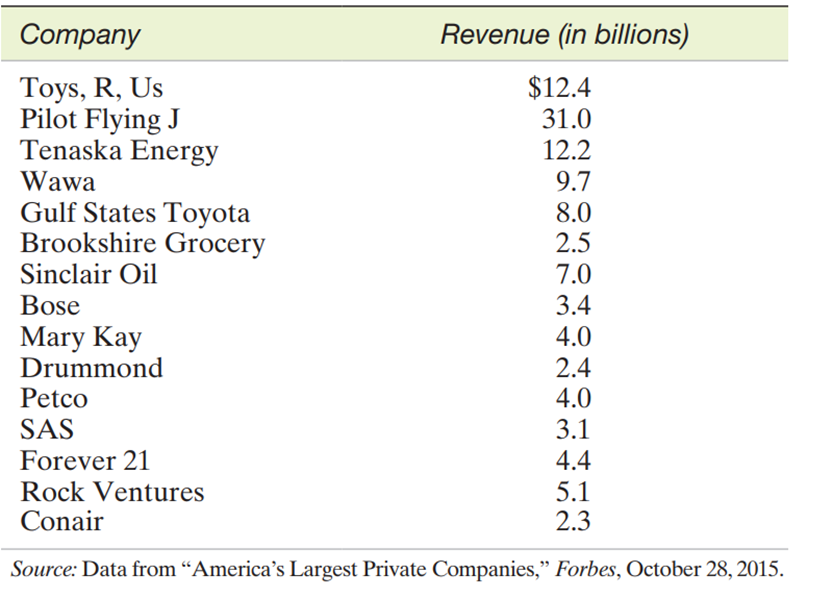
Largest private companies. IPOs—initial public offerings of stock—create billions of dollars of new wealth for owners, managers, and employees of companies that were previously privately owned. Nevertheless, hundreds of large and thousands of small companies remain privately owned. The revenues of a random sample of 15 firms from Forbes 216 Largest Private Companies list are given in the table below

a. Describe the population from which the random sample was drawn.

b. Use a 98% confidence interval to estimate the mean revenue of the population of companies in question

c. Interpret your confidence interval in the context of the problem

d. What characteristic must the population possess to ensure the appropriateness of the estimation procedure used in part b?

e. Suppose Forbes reports that the true mean revenue of the 216 companies on the list is $5.0 billion. Is the claim believable?

Unethical corporate conduct. How complicit are entrylevel accountants in carrying out an unethical request from their superiors? This was the question of interest in a study published in the journal Behavioral Research in Accounting (July 2015). A sample of 86 accounting graduate students participated in the study. After asking the subjects to perform what is clearly an unethical task (e.g., to bribe a customer), the researchers measured each subject’s intention to comply with the unethical request score. Scores ranged from -1.5 (intention to resist the unethical request) to 2.5 (intention to comply with the unethical request). Summary statistics on the 86 scores follow: x¯=2.42,s=2.84.

a. Estimate μ, the mean intention to comply score for the population of all entry-level accountants, using a 90% confidence interval.

b. Give a practical interpretation of the interval, part a.

c. Refer to part a. What proportion of all similarly constructed confidence intervals (in repeated sampling) will contain the true value of μ?

d. Compute the interval, x¯±2s. How does the interpretation of this interval differ from that of the confidence interval, part a?

A random sample of 50 consumers taste-tested a new snack food. Their responses were coded (0: do not like; 1: like; 2: indifferent) and recorded as follows:

a. Use an 80% confidence interval to estimate the proportion of consumers who like the snack food.

b. Provide a statistical interpretation for the confidence interval you constructed in part a.

See all solutions

Recommended explanations on Math Textbooks

View all explanations

What do you think about this solution?

We value your feedback to improve our textbook solutions.

Study anywhere. Anytime. Across all devices.