/*! This file is auto-generated */ .wp-block-button__link{color:#fff;background-color:#32373c;border-radius:9999px;box-shadow:none;text-decoration:none;padding:calc(.667em + 2px) calc(1.333em + 2px);font-size:1.125em}.wp-block-file__button{background:#32373c;color:#fff;text-decoration:none} Q29E As of April 2006, roughly 50 mil... [FREE SOLUTION] | 魅影直播

魅影直播

As of April 2006, roughly 50 million .com web domain names were registered (e.g., yahoo.com).

a. How many domain names consisting of just two letters in sequence can be formed? How many domain names of length two are there if digits as well as letters are permitted as characters? (Note: A character length of three or more is now mandated.)

b. How many domain names are there consisting of three letters in sequence? How many of this length are there if either letters or digits are permitted? (Note: All are currently taken.)

c. Answer the questions posed in (b) for four-character sequences.

d. As of April 2006, 97,786 of the four-character se - quences using either letters or digits had not yet been claimed. If a four-character name is randomly selected, what is the probability that it is already owned?

Short Answer

Expert verified

a) \({\rm{676 and 1296}}\)

b) \({\rm{17576 and 46656}}\)

c) \({\rm{ 456976 and 1679616}}\)

d) \({\rm{P(\{ }}\) four-character name is already owned \({\rm{\} ) = 0}}{\rm{.942}}{\rm{.}}\)

Step by step solution

01

determining the domain names are there consisting of three letters in sequence

The total number of domain names with just two letters (r=2) and characters (n=26) in a sequence may be computed as follows: number of potential outcomes = nr = 262 = 676 a2)

02

Determining  the domain names of length two are there if digits as well as letters are permitted as characters 

Assume that we can select first element of an ordered pair in \({{\rm{n}}_{\rm{1}}}\)ways, and that for each selected element we can select the second element in \({{\rm{n}}_{\rm{2}}}\)ways, then we have the number of pairs to be \({{\rm{n}}_{\rm{1}}}{{\rm{n}}_{\rm{2}}}\)

\({\rm{26*26 = 676}}\)

Domain names consisting of just two letters in sequence can be formed in ways, because \({{\rm{n}}_{\rm{1}}}{\rm{ = 26}}\)and \({{\rm{n}}_{\rm{2}}}{\rm{ = 26}}\)

If we allow digits as well, we'll get \({\rm{26 + 10 = 36}}\)characters, indicating that we can make a two-character sequence.

\({\rm{36*36 = 1296}}\) ways.

03

determining the length of there if either letters or digits are permitted

Domain names that consist of three letters in sequence may be made in the same way that domain names consisting of three letters in sequence can be formed in the same way that domain names consisting of three letters in sequence can be formed in the same way that domain names

\({\rm{26*26*26 = 17576}}\)

In the same way as in (a), when we add numbers, we get 36 characters.

\({\rm{36*36*36 = 46656}}\)

in a variety of ways,

To be more specific, for \({\rm{k = 3}}\), we utilize the following:

For k-Tuples, there is a Product Rule.

If we assume that we may pick the first element of an ordered pair in \({{\rm{n}}_{\rm{1}}}\)ways and the second element in \({{\rm{n}}_{\rm{2}}}\) ways for each selected element, then the number of pairings is \({{\rm{n}}_{\rm{1}}}{{\rm{n}}_{\rm{2}}}\)

Similarly, there are \({{\rm{n}}_{\rm{1}}}{{\rm{n}}_{\rm{2}}}{\rm{* \ldots *}}{{\rm{n}}_{\rm{k}}}\) potential \({\rm{k}}\)-tuples given an ordered collection of \({\rm{k}}\) components, where the \({{\rm{k}}^{{\rm{th\;}}}}\) can be selected in \({{\rm{n}}_{\rm{k}}}\) ways.

04

determining the four-character sequences.

Using the Product Rule for k-Tuplets, the number of ways to build a domain name with four letters in succession is \({\rm{k = }}\) \({\rm{4}}\)

\({\rm{26*26*26*26 = 456976}}\)

ways. In the same way, when we add digits, we get

\({\rm{36*36*36*36 = 1679616}}\)

05

determining the probability that it is already owned, If a four-character name is randomly selected

The likelihood of a four-character name being held is

\(\begin{aligned}{{\rm{P(\{ four - character name is already owned\} )}}}&{\mathop {\rm{ = }}\limits^{{\rm{(1)}}} {\rm{1 - P(\{ four - character name is available\} )}}}\\{}&{\mathop {\rm{ = }}\limits^{{\rm{(2)}}} {\rm{1 - }}\frac{{{\rm{97786}}}}{{{\rm{3}}{{\rm{6}}^{\rm{4}}}}}{\rm{ = 0}}{\rm{.942}}}\end{aligned}\)

(1): For each event A, $ \({\rm{P(A) + P}}\left( {{\rm{A'}}} \right){\rm{ = 1}}\), and the complement of the event that the four-character name is already taken is the event that the four-character name is taken;

(2): In the exercise, the number of good outcomes is provided, 97786, and all potential outcomes are stated in (c)

\({\rm{P(A) = }}\frac{{{\rm{\# favorable outcomes inA}}}}{{{\rm{\# outcomes in the sample space}}}}\)

Unlock Step-by-Step Solutions & Ace Your Exams!

  • Full Textbook Solutions

    Get detailed explanations and key concepts

  • Unlimited Al creation

    Al flashcards, explanations, exams and more...

  • Ads-free access

    To over 500 millions flashcards

  • Money-back guarantee

    We refund you if you fail your exam.

Over 30 million students worldwide already upgrade their learning with 魅影直播!

One App. One Place for Learning.

All the tools & learning materials you need for study success - in one app.

Get started for free

Most popular questions from this chapter

A box in a supply room contains \({\rm{15}}\) compact fluorescent lightbulbs, of which \({\rm{5}}\) are rated \({\rm{13}}\)-watt, \({\rm{6}}\)are rated \({\rm{18}}\)-watt, and \({\rm{4}}\) are rated \({\rm{23}}\)-watt. Suppose that three of these bulbs are randomly selected.

a. What is the probability that exactly two of the selected bulbs are rated \({\rm{23}}\)-watt?

b. What is the probability that all three of the bulbs have the same rating?

c. What is the probability that one bulb of each type is selected?

d. If bulbs are selected one by one until a \({\rm{23}}\)-watt bulb is obtained, what is the probability that it is necessary to examine at least 6 bulbs?

If \({\rm{A}}\)and \({\rm{B}}\) are independent events, show that \({{\rm{A}}^\prime }\) and \({\rm{B}}\)are also independent. (Hint: First establish a relationship between \({\rm{P}}\left( {{{\rm{A}}^{\rm{垄}}}{\rm{脟B}}} \right){\rm{,P(B)}}\), and \(\left. {{\rm{P(A脟B)}}{\rm{.}}} \right)\)

Suppose identical tags are placed on both the left ear and the right ear of a fox. The fox is then let loose for a period of time. Consider the two events \({{\rm{C}}_{\rm{1}}}{\rm{ = }}\){left ear tag is lost} and \({{\rm{C}}_{\rm{2}}}{\rm{ = }}\){right ear tag is lost}. Let 颅 \({\rm{\pi = P(}}{{\rm{C}}_{\rm{1}}}{\rm{) = P(}}{{\rm{C}}_{\rm{2}}}{\rm{)}}\),and assume \({{\rm{C}}_{\rm{1}}}\)and \({{\rm{C}}_{\rm{2}}}\) are independent events. Derive an expression (involving p) for the probability that exactly one tag is lost, given that at most one is lost (鈥淓ar Tag Loss in Red Foxes,鈥 J. Wildlife Mgmt., \({\rm{1976: 164--167)}}{\rm{.}}\) (Hint: Draw a tree diagram in which the two initial branches refer to whether the left ear tag was lost.)

Consider randomly selecting a single individual and having that person test drive \({\rm{3}}\) different vehicles. Define events \({{\rm{A}}_{\rm{1}}}\), \({{\rm{A}}_{\rm{2}}}\), and \({{\rm{A}}_{\rm{3}}}\) by

\({{\rm{A}}_{\rm{1}}}\)=likes vehicle #\({\rm{1}}\)\({{\rm{A}}_{\rm{2}}}\)= likes vehicle #\({\rm{2}}\)\({{\rm{A}}_{\rm{3}}}\)=likes vehicle #\({\rm{3}}\)Suppose that\({\rm{ = }}{\rm{.65,}}\)\({\rm{P(}}{{\rm{A}}_3}{\rm{)}}\)\({\rm{ = }}{\rm{.70,}}\)\({\rm{P(}}{{\rm{A}}_{\rm{1}}} \cup {{\rm{A}}_{\rm{2}}}{\rm{) = }}{\rm{.80,P(}}{{\rm{A}}_{\rm{2}}} \cap {{\rm{A}}_{\rm{3}}}{\rm{) = 40,}}\)and\({\rm{P(}}{{\rm{A}}_{\rm{1}}} \cup {{\rm{A}}_{\rm{2}}} \cup {{\rm{A}}_{\rm{3}}}{\rm{) = }}{\rm{.88}}{\rm{.}}\)

a. What is the probability that the individual likes both vehicle #\({\rm{1}}\)and vehicle #\({\rm{2}}\)?

b. Determine and interpret\({\rm{p}}\)(\({{\rm{A}}_{\rm{2}}}\)|\({{\rm{A}}_{\rm{3}}}\)).

c. Are \({{\rm{A}}_{\rm{2}}}\)and \({{\rm{A}}_{\rm{3}}}\)independent events? Answer in two different ways.

d. If you learn that the individual did not like vehicle #\({\rm{1}}\), what now is the probability that he/she liked at least one of the other two vehicles?

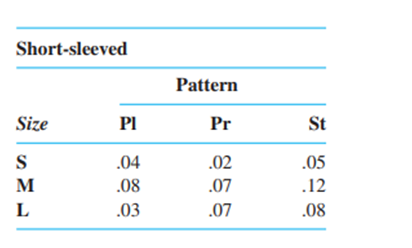
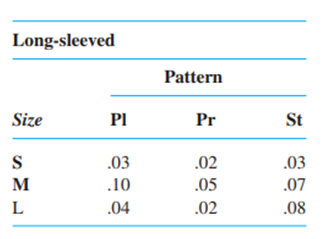
A department store sells sports shirts in three sizes (small, medium, and large), three patterns (plaid, print, and stripe), and two sleeve lengths (long and short). The accompanying tables give the proportions of shirts sold in the various category combinations.

a. What is the probability that the next shirt sold is a medium, long-sleeved, print shirt?

b. What is the probability that the next shirt sold is a medium print shirt?

c. What is the probability that the next shirt sold is a short-sleeved shirt? A long-sleeved shirt?

d. What is the probability that the size of the next shirt sold is the medium? That the pattern of the next shirt sold as a print?

e. Given that the shirt just sold was a short-sleeved plaid, what is the probability that its size was medium?

f. Given that the shirt just sold was a medium plaid, what is the probability that it was short-sleeved? Long-sleeved?

See all solutions

Recommended explanations on Math Textbooks

View all explanations

What do you think about this solution?

We value your feedback to improve our textbook solutions.

Study anywhere. Anytime. Across all devices.