
 Explanations
  Textbooks
  Flashcards
  魅影直播 AI
  Notes
Notes  Study Plans
  Study Sets
  Find a degree
  Magazine
 Chapter 5: Q77SE (page 243)
A health-food store stocks two different brands of a certain type of grain. Let \(X = \)the amount (lb) of brand A on hand and \(Y = \)the amount of brand B on hand. Suppose the joint pdf of X and Y is
\(f(x,y) = \left\{ {\begin{array}{*{20}{c}}{kxy\;\;\;\;\;\;\;x \ge 0,\;y \ge 0,\;20 \le x + y \le 30}\\{0\;\;\;\;\;\;\;\;\;\;\;\;\;\;\;\;\;\;\;\;\;\;\;\;\;\;\;\;\;\;otherwise}\end{array}} \right\}\)
a. Draw the region of positive density and determine the value of k.
b. Are X and Y independent? Answer by first deriving the marginal pdf of each variable.
c. Compute \(P\left( {X + Y \le 25} \right)\).
d. What is the expected total amount of this grain on hand?
e. Compute \(Cov\left( {X, Y} \right)\)and\(Corr\left( {X, Y} \right)\).
f. What is the variance of the total amount of grain on hand?
Short Answer
\(\begin{array}{l}(a)\;k = \frac{3}{{81250}}\\(b)\;{f_X}(x) = \left\{ {\begin{array}{*{20}{c}}{250kx - 10k{x^2}}&{0 \le x \le 20}\\{450kx - 30k{x^2} + \frac{1}{2}k{x^3}}&{20 < x \le 30}\end{array}} \right.\\{f_Y}(y) = \left\{ {\begin{array}{*{20}{c}}{250ky - 10k{y^2}}&{0 \le y \le 20}\\{450ky - 30k{y^2} + \frac{1}{2}k{y^3}}&{20 < y \le 30}\end{array}\;\;} \right.X\;and\;Y\;are\;NOT\;independent\\(c)\;P(X + Y \le 25) = \frac{{369}}{{1040}} \approx 0.3548 = 35.48\% \\(d)\;E(X + Y) = \frac{{1688}}{{65}} \approx 25.9692\\(e)\;{\mathop{\rm Cov}\nolimits} (X,Y) = - \frac{{408008}}{{12675}} \approx - 32.1900;\;{\mathop{\rm Corr}\nolimits} (X,Y) = - \frac{{102002}}{{114123}} \approx - 0.8938\\(f)\;{\mathop{\rm Var}\nolimits} (X + Y) = \frac{{621591}}{{81250}} \approx 7.6504\end{array}\)
Step by step solution
Definition of Variance
Variance is the expected squared variation of a random variable from its population mean or sample mean in probability theory and statistics. Variance is a measure of dispersion, or how far a set of numbers deviates from its average value.
Sketch of the region mentioned in part a.
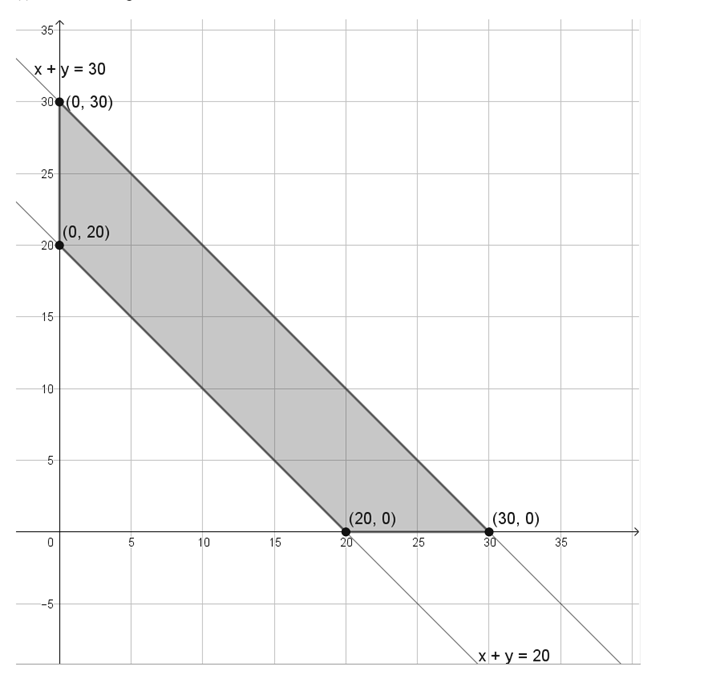
Determine the integral of the joint pdf over the given region in part a.
Determine the integral of the joint pdf over the given region when \(0 \le x \le 20\)(which is then bounded by the two straight lines):
\(\begin{aligned}\int_0^{20} {\int_{20 - x}^{30 - x} f } (x,y)dydx &= \int_0^{20} {\int_{20 - x}^{30 - x} k } xydydx\\ = \left. {\int_0^{20} {\left( {\frac{{kx{y^2}}}{2}} \right)} } \right|_{20 - x}^{30 - x}dx &= \int_0^{20} {\left( {\frac{{kx{{(30 - x)}^2}}}{2} - \frac{{kx{{(20 - x)}^2}}}{2}} \right)} dx\\ = \int_0^{20} 2 50kx - 10k{x^2}dx &= \left. {\left( {125k{x^2} - \frac{{10}}{3}k{x^3}} \right)} \right|_0^{20}\\ &= 125k{(20)^2} - \frac{{10}}{3}k{(20)^3} = \frac{{70000}}{3}k\end{aligned}\)
Determine the integral of the joint pdf over the given region when \(20 \le x \le 30\)(which is then bounded by the top line and the x-axis):
Determine the integral of the joint pdf over the given region in part a.
\(\begin{aligned}\int_{20}^{30} {\int_0^{30 - x} f } (x,y)dydx &= \int_{20}^{30} {\int_0^{30 - x} k } xydydx\\ &= \left. {\int_{20}^{30} {\left( {\frac{{kx{y^2}}}{2}} \right)} } \right|_0^{30 - x}dx = \int_0^{20} {\frac{{kx{{(30 - x)}^2}}}{2}} dx\\ &= \int_{20}^{30} 4 50kx - 30k{x^2} + \frac{1}{2}k{x^3}dx = \left. {\left( {225k{x^2} - 10k{x^3} + \frac{1}{8}k{x^4}} \right)} \right|_{20}^{30}\\ &= 3750k\end{aligned}\)
The total integral of the joint pdf over the indicated region is then the sum of these two areas:
\(\frac{{70000}}{3}k + 3750k = \frac{{81250}}{3}k\)
The joint pdf is only a valid pdf if the total integral is equal to \(1\):
\(\frac{{81250}}{3}k = 1\)
Divide each side by \(\frac{{81250}}{3}\):
\(k = \frac{3}{{81250}}\)
Explanation for the determination of independency of event in part b.
(b) The marginal pdf of X is the integral of the joint pdf over all possible values of Y:
First let \(0 \le x \le 20\)(region is then bounded by the two straight lines):
\(\begin{aligned}{f_X}(x) &= \int_{20 - x}^{30 - x} f (x,y)dy &= \int_{20 - x}^{30 - x} k xydy\\ &= \left. {\left( {\frac{{kx{y^2}}}{2}} \right)} \right|_{20 - x}^{30 - x} = \left( {\frac{{kx{{(30 - x)}^2}}}{2} - \frac{{kx{{(20 - x)}^2}}}{2}} \right)\\ &= 250kx - 10k{x^2}\end{aligned}\)
Next let \(20 < x \le 30\)(region is then bounded by the top line and the $x$-axis):
\(\begin{array}{c}{f_X}(x) = \int_0^{30 - x} f (x,y)dy = \int_0^{30 - x} k = \left. {\left( {\frac{{kx{y^2}}}{2}} \right)} \right|_0^{30 - x}\\ = \frac{{kx{{(30 - x)}^2}}}{2}\\ = 450kx - 30k{x^2} + \frac{1}{2}k{x^3}\end{array}\)
Explanation for the determination of independency of event in part b.
Combining these results, we then obtain:
\(\begin{array}{l}{f_X}(x) = \left\{ {\begin{array}{*{20}{c}}{250kx - 10k{x^2}}&{0 \le x \le 20}\\{450kx - 30k{x^2} + \frac{1}{2}k{x^3}}&{20 < x \le 30}\end{array}} \right.\\\end{array}\)
The marginal distribution of Y is the same as the marginal distribution of X, because the joint pdf does not change when you interchange x and y (neither does the region).
\({f_Y}(y) = \left\{ {\begin{array}{*{20}{c}}{250ky - 10k{y^2}}&{0 \le y \le 20}\\{450ky - 30k{y^2} + \frac{1}{2}k{y^3}}&{20 < y \le 30}\end{array}} \right.\)
X and Y are not independent, because if you multiply the marginal distributions, then you do not obtain the joint pdf.
Calculation for the determination of the probability in part c.
(c) Determine the integral of the joint pdf over the given region when \(0 \le x \le 20\)(which is then bounded by two straight lines):
\(\begin{array}{c}P(X + Y \le 25\mid 0 \le X \le 20) = \int_0^{20} {\int_{20 - x}^{25 - x} f } (x,y)dydx\\ = \int_0^{20} {\int_{20 - x}^{25 - x} k } xydydx = \left. {\int_0^{20} {\left( {\frac{{kx{y^2}}}{2}} \right)} } \right|_{20 - x}^{25 - x}dx\\ = \int_0^{20} {\left( {\frac{{kx{{(25 - x)}^2}}}{2} - \frac{{kx{{(20 - x)}^2}}}{2}} \right)} dx\\ = \int_0^{20} {\frac{{225}}{2}} kx - 5k{x^2}dx = \left. {\left( {\frac{{225}}{4}k{x^2} - \frac{5}{3}k{x^3}} \right)} \right|_0^{20}\\ = 125k{(20)^2} - \frac{{10}}{3}k{(20)^3} = \frac{{27500}}{3}k\end{array}\)
Determine the integral of the joint pdf over the given region when \(20 \le x \le 30\)(which is then bounded by the top line and the x-axis):
Calculation for the determination of the probability in part c.
\(\)\(\begin{array}{c}P(X + Y \le 25\mid 20 < X \le 30) = \int_{20}^{25} {\int_0^{25 - x} f } (x,y)dydx\\ = \int_{20}^{25} {\int_0^{25 - x} k } xydydx = \left. {\int_{20}^{25} {\left( {\frac{{kx{y^2}}}{2}} \right)} } \right|_0^{25 - x}dx\\ = \int_0^{25} {\frac{{kx{{(25 - x)}^2}}}{2}} dx = \int_{20}^{25} {\frac{{625}}{2}} kx - 25k{x^2} + \frac{1}{2}k{x^3}dx\\ = \left. {\left( {\frac{{625}}{4}k{x^2} - \frac{{25}}{3}k{x^3} + \frac{1}{8}k{x^4}} \right)} \right|_{20}^{25} = \frac{{10625}}{{24}}k\end{array}\)
The total probability is then the sum of the two probabilities:
\(P(X + Y \le 25) = \frac{{27500}}{3}k + \frac{{10625}}{{24}}k = \frac{{76875}}{8}k = \frac{{76875}}{8}\frac{3}{{81250}} = \frac{{369}}{{1040}} \approx 0.3548 = 35.48\% \)
Calculation for finding the expected total amount of this grain in part d.
(d) The total amount is X+Y.
The expected value of X+Y is then integral of the product of all possible values \((x + y)\)and the joint pdf.
Determine the integral of the joint pdf over the given region when \(0 \le x \le 20\)(which is then bounded by the two straight lines):
\(\begin{array}{c}\int_0^{20} {\int_{20 - x}^{30 - x} {(x + y)} } f(x,y)dydx = \int_0^{20} {\int_{20 - x}^{30 - x} k } {x^2}y + kx{y^2}dydx\\ = \left. {\int_0^{20} {\left( {\frac{{k{x^2}{y^2}}}{2} + \frac{{kx{y^3}}}{3}} \right)} } \right|_{20 - x}^{30 - x}dx\\ = \int_0^{20} {\left( {\frac{{k{x^2}{{(30 - x)}^2}}}{2} + \frac{{kx{{(30 - x)}^3}}}{3} - \frac{{k{x^2}{{(20 - x)}^2}}}{2} - \frac{{kx{{(20 - x)}^3}}}{3}} \right)} dx\\ = \int_0^{20} {\frac{{19000}}{3}} kx - 250k{x^2}dx = \left. {\left( {\frac{{19000}}{6}k{x^2} - \frac{{250}}{3}k{x^3}} \right)} \right|_0^{20}\\ = 125k{(20)^2} - \frac{{10}}{3}k{(20)^3} = 600000k\end{array}\)
Calculation for finding the expected total amount of this grain in part d.
Determine the integral of the joint pdf over the given region when \(20 \le x \le 30\)(which is then bounded by the top line and the $x$-axis):
\(\begin{array}{c}\int_{20}^{30} {\int_0^{30 - x} {(x + y)} } f(x,y)dydx = \int_{20}^{30} {\int_0^{30 - x} k } {x^2}y + kx{y^2}dydx\\ = \left. {\int_{20}^{30} {\left( {\frac{{k{x^2}{y^2}}}{2} + \frac{{kx{y^3}}}{3}} \right)} } \right|_0^{30 - x}dx = \int_0^{20} {\frac{{k{x^2}{{(30 - x)}^2}}}{2}} + \frac{{kx{{(30 - x)}^3}}}{3}dx\\ = \int_{20}^{30} 9 000kx - 450k{x^2} + \frac{1}{6}k{x^4}dx = \left. {\left( {4500k{x^2} - 150k{x^3} + \frac{1}{{30}}k{x^5}} \right)} \right|_{20}^{30}\\ = \frac{{310000}}{3}k\end{array}\)
The expected total amount is then the sum of these two expected values:
\(E(X + Y) = 600000k + \frac{{310000}}{3}k = \frac{{2110000}}{3}k = \frac{{2110000}}{3}\frac{3}{{81250}} = \frac{{1688}}{{65}} \approx 25.9692\)
Calculation for determining the following expected values in part e.
(e) Determine the following expected values in a similar manner as in part (a):
MEAN
\(\begin{array}{c}{\mu _X} = E(X) = \int_0^{30} x {f_X}(x)dx\\ = \int_0^{20} 2 50k{x^2} - 10k{x^3}dx + \int_{20}^{30} 4 50k{x^2} - 30k{x^3}\\ = \frac{{800000}}{3}k + 85000k = \frac{{1055000}}{3}k\\{\mu _Y} = E(Y) = E(X) = \frac{{1055000}}{3}k\end{array}\)
EXPECTED VALUE OF XY
\(\begin{array}{c}E(XY) = \int_0^{20} {\int_{20 - x}^{30 - x} x } yf(x,y)dydx + \int_{20}^{30} {\int_0^{30 - x} x } yf(x,y)dydx\\ = \int_0^{20} {\int_{20 - x}^{30 - x} k } {x^2}{y^2}dydx + \int_{20}^{30} {\int_0^{30 - x} k } {x^2}{y^2}dydx\\ = \frac{{29600000k}}{9} + \frac{{3650000k}}{9}\\ = \frac{{33250000k}}{9}\end{array}\)
Calculation for determining the following expected values in part e.
VARIANCE
\(\begin{array}{c}\sigma _X^2 = E\left( {{{\left( {X - {\mu _X}} \right)}^2}} \right) = \int_0^{30} {{{\left( {x - \frac{{1055000}}{3}k} \right)}^2}} {f_X}(x)dx\\ = \int_0^{20} {{{\left( {x - \frac{{1055000}}{3}k} \right)}^2}} \left( {250kx - 10k{x^2}} \right)dx + \int_{20}^{30} {{{\left( {x - \frac{{1055000}}{3}k} \right)}^2}} \left( {450kx - 30k{x^2} + \frac{1}{2}k{x^3}} \right)dx\\ = \frac{{400000}}{{27}}k\left( {243 - 12660000k + 194779375000{k^2}} \right) + \frac{{25000}}{3}k\left( {233 - 7174000k + 55651250000{k^2}} \right)\\ = \frac{{16625000k}}{3} - \frac{{2226050000000{k^2}}}{9} + \frac{{90433281250000000{k^3}}}{{27}}\\\sigma _Y^2 = \sigma _X^2 = \frac{{16625000k}}{3} - \frac{{2226050000000{k^2}}}{9} + \frac{{90433281250000000{k^3}}}{{27}}\end{array}\)
The covariance is the expected value of X Y decreased by the product of the two means:
\(\begin{array}{c}{\mathop{\rm Cov}\nolimits} (X,Y) = E(XY) - {\mu _X}{\mu _Y} = \frac{{33250000k}}{9} - \frac{{1055000}}{3}\frac{{1055000}}{3}{k^2}\\ = \frac{{33250000}}{9}\frac{3}{{81250}} - \frac{{1055000}}{3}\frac{{1055000}}{3}\frac{{{3^2}}}{{{{81250}^2}}}\\ = - \frac{{408008}}{{12675}} \approx - 32.1900\end{array}\)
Calculation for determining the following expected values in part e.
The correlation is the covariance divided by the product of the standard deviations. The standard deviations are the square root of the variances:\(\begin{array}{c}{\mathop{\rm Corr}\nolimits} (X,Y) = \frac{{{\mathop{\rm Cov}\nolimits} (X,Y)}}{{{\sigma _X}{\sigma _Y}}} = \frac{{ - \frac{{408008}}{{12675}}}}{{\frac{{16625000k}}{3} - \frac{{2226050000000{k^2}}}{9} + \frac{{90433281250000000{k^3}}}{{27}}}}\\ = \frac{{\frac{{16625000}}{3}\frac{3}{{81250}} - \frac{{2226050000000}}{9}\frac{{{3^2}}}{{{{81250}^2}}} + \frac{{90433281250000000}}{{27}}\frac{{{3^3}}}{{{{81250}^3}}}}}{9}\\ = - \frac{{102002}}{{114123}} \approx - 0.8938\end{array}\)
Note: The results of part (e) deviate from the result in the back of the book.
Calculation for determining the variance in part f.
(f) The variance is the expected value of the deviation of the mean. The mean was determined in part (d). This expected value can be determined similarly:
\(\begin{array}{c}{\mathop{\rm Var}\nolimits} (X + Y) = \int_0^{20} {\int_{20 - x}^{30 - x} {{{(x + y - 25.9692)}^2}} } f(x,y)dydx + \int_{20}^{30} {\int_0^{30 - x} {{{(x + y - 25.9692)}^2}} } f(x,y)dydx\\ = \int_0^{20} {\int_{20 - x}^{30 - x} {{{(x + y - 25.9692)}^2}} } kxydydx + \int_{20}^{30} {\int_0^{30 - x} {{{(x + y - 25.9692)}^2}} } kxydydx \approx 184056k + 23141k\\ = 207197k = 207197\frac{3}{{81250}} = \frac{{621591}}{{81250}} \approx 7.6504\end{array}\)

Over 30 million students worldwide already upgrade their learning with 魅影直播!

