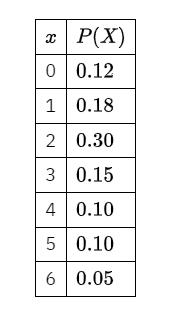
Chapter 4: Q.65 (page 287)
What values does X take on?
Short Answer
can take any positive integer value from zero to positive perpetuity.
/*! This file is auto-generated */ .wp-block-button__link{color:#fff;background-color:#32373c;border-radius:9999px;box-shadow:none;text-decoration:none;padding:calc(.667em + 2px) calc(1.333em + 2px);font-size:1.125em}.wp-block-file__button{background:#32373c;color:#fff;text-decoration:none}
Learning Materials
Features
Discover
Chapter 4: Q.65 (page 287)
What values does X take on?
can take any positive integer value from zero to positive perpetuity.
All the tools & learning materials you need for study success - in one app.
Get started for free
The literacy rate for a nation measures the proportion of people age 15 and over that can read and write. The literacy rate in Afghanistan is 28.1%. Suppose you choose 15 people in Afghanistan at random. Let X = the number of people who are literate.
a. Sketch a graph of the probability distribution of X.
b. Using the formulas, calculate the (i) mean and (ii) standard deviation of X.
c. Find the probability that more than five people in the sample are literate. Is it is more likely that three people or four people are literate.
What does the column 鈥鈥 sum to?
Use the following information to answer the next six exercises: A baker is deciding how many batches of muffins to make to
sell in his bakery. He wants to make enough to sell every one and no fewer. Through observation, the baker has established
a probability distribution.

In words, the random variable
a. the number of times Mrs. Plum鈥檚 cats wake her up each week.
b. the number of times Mrs. Plum鈥檚 cats wake her up each hour.
c. the number of times Mrs. Plum鈥檚 cats wake her up each night.
d. the number of times Mrs. Plum鈥檚 cats wake her up.
Find the probability that her cats will wake her up no more than five times next week.
Use the following information to answer the next eight exercises: The Higher Education Research Institute at UCLA collected data from incoming first-time, full-time freshmen from 270 four-year colleges and universities in the U.S. of those students replied that, yes, they believe that same-sex couples should have the right to legal marital status. Suppose that you randomly pick eight first-time, full-time freshmen from the survey. You are interested in the number that believes that same sex-couples should have the right to legal marital status.
What is the standard deviation?
What do you think about this solution?
We value your feedback to improve our textbook solutions.