Chapter 4: Q.20 (page 283)
Find the standard deviation.
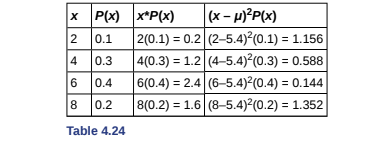
Short Answer
Standard deviation is
/*! This file is auto-generated */ .wp-block-button__link{color:#fff;background-color:#32373c;border-radius:9999px;box-shadow:none;text-decoration:none;padding:calc(.667em + 2px) calc(1.333em + 2px);font-size:1.125em}.wp-block-file__button{background:#32373c;color:#fff;text-decoration:none}
Learning Materials
Features
Discover
Chapter 4: Q.20 (page 283)
Find the standard deviation.

Standard deviation is
All the tools & learning materials you need for study success - in one app.
Get started for free
= _______
Find the probability that a physics major will do post-graduate research for at most three years. = _______
Approximately of students at a local high school participate in after-school sports all four years of high school. A group of seniors is randomly chosen. Of interest is the number that participated in after-school sports all four years of
high school.
a. In words, define the random variable .
b. List the values that may take on.
c. Give the distribution of
d. How many seniors are expected to have participated in after-school sports all four years of high school?
e. Based on numerical values, would you be surprised if none of the seniors participated in after-school sports all
four years of high school.
f. Based on numerical values, is it more likely that four or that five of the seniors participated in after-school sports
all four years of high school? Justify your answer numerically.
There are two similar games played for Chinese New Year and Vietnamese New Year. In the Chinese version, fair dice with numbers 1, 2, 3, 4, 5, and 6 are used, along with a board with those numbers. In the Vietnamese version, fair dice with pictures of a gourd, fish, rooster, crab, crayfish, and deer are used. The board has those six objects on it, also. We will play with bets being \(1. The player places a bet on a number or object. The 鈥渉ouse鈥 rolls three dice. If none of the dice show the number or object that was bet, the house keeps the \)1 bet. If one of the dice shows the number or object bet (and the other two do not show it), the player gets back his or her \(1 bet, plus \)1 profit. If two of the dice show the number or object bet (and the third die does not show it), the player gets back his or her \(1 bet, plus \)2 profit. If all three dice show the number or object bet, the player gets back his or her \(1 bet, plus \)3 profit. Let X = number of matches and Y = profit per game.
a. In words, define the random variable X.
b. List the values that X may take on.
c. Give the distribution of X. X ~ _____(_____,_____)
d. List the values that Y may take on. Then, construct one PDF table that includes both X and Y and their probabilities.
e. Calculate the average expected matches over the long run of playing this game for the player.
f. Calculate the average expected earnings over the long run of playing this game for the player
g. Determine who has the advantage, the player or the house.
Define or the probability of
What do you think about this solution?
We value your feedback to improve our textbook solutions.
