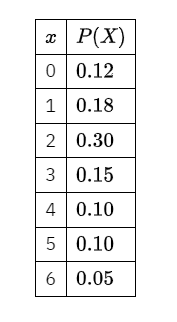
Chapter 4: Q. 39 (page 285)
What values does the random variable X take on?
Short Answer
The values are
/*! This file is auto-generated */ .wp-block-button__link{color:#fff;background-color:#32373c;border-radius:9999px;box-shadow:none;text-decoration:none;padding:calc(.667em + 2px) calc(1.333em + 2px);font-size:1.125em}.wp-block-file__button{background:#32373c;color:#fff;text-decoration:none}
Learning Materials
Features
Discover
Chapter 4: Q. 39 (page 285)
What values does the random variable X take on?
The values are
All the tools & learning materials you need for study success - in one app.
Get started for free
A trainer is teaching a dolphin to do tricks. The probability that the dolphin successfully performs the trick is 35%, and the probability that the dolphin does not successfully perform the trick is 65%. Out of 20 attempts, you want to find the probability that the dolphin succeeds 12 times. State the probability question mathematically.
The average number of children a Spanish woman has in her lifetime is 1.47. Suppose that one Spanish woman is randomly chosen.
a. In words, define the Random Variable X.
b. List the values that X may take on.
c. Give the distribution of X. X ~ _____(_____,_____)
d. Find the probability that she has no children.
e. Find the probability that she has fewer children than the Spanish average.
f. Find the probability that she has more children than the Spanish average .
A palette has 200 milk cartons. Of the 200 cartons, it is known that ten of them have leaked and cannot be sold. A stock clerk randomly chooses 18 for inspection. He wants to know the probability that among the 18, no more than two are leaking. Give five reasons why this is a hypergeometric problem.
What does the column 鈥鈥 sum to?
Use the following information to answer the next six exercises: A baker is deciding how many batches of muffins to make to
sell in his bakery. He wants to make enough to sell every one and no fewer. Through observation, the baker has established
a probability distribution.

Suppose that married adults in the United States were randomly surveyed as to the number of children they have. The results are compiled and are used as theoretical probabilities. Let X = the number of children married people have.
a. Find the probability that a married adult has three children.
b. In words, what does the expected value in this example represent?
c. Find the expected value.
d. Is it more likely that a married adult will have two to three children or four to six children? How do you know?
What do you think about this solution?
We value your feedback to improve our textbook solutions.