/*! This file is auto-generated */ .wp-block-button__link{color:#fff;background-color:#32373c;border-radius:9999px;box-shadow:none;text-decoration:none;padding:calc(.667em + 2px) calc(1.333em + 2px);font-size:1.125em}.wp-block-file__button{background:#32373c;color:#fff;text-decoration:none} Q.3.9 Consider two independent tosses ... [FREE SOLUTION] | ÷ÈÓ°Ö±²¥

÷ÈÓ°Ö±²¥

Consider two independent tosses of a fair coin. Let Abe the event that the first toss results in heads, let Bbe the event that the second toss results in heads, and let Cbe the event that in both tosses the coin lands on the same side. Show that the events A, B, and C are pairwise independent—that is, A and B are independent, A and C are independent, and B and C are independent—but not independent.

Short Answer

Expert verified

All the all three events are not independent:

P(ABC)=P({(H,H)})=14≠12⋅12⋅12=P(A)P(B)P(C)

Step by step solution

01

Step 1:Given Information

Given that two independent tosses of a fair coin. Let Abe the event that the first toss results in heads, let Bbe the event that the second toss results in heads, and let C be the event that in both tosses the coin lands on the same side.

02

Step 2:Explanation

On the off chance that a fair coin is thrown twice freely there are 4 similarly reasonable events:

(H,H)- both tosses resulted in heads,⇒P(H,H)=P(H)⋅P(H)=12⋅12=14

(H,T)- first toss is heads, the second tails,P(H,T)=14

(H,T)- first toss is tails, the second headsP(T,H)=14

(T,T)- both tosses resulted in tails,P(T,T)=14

These events are all mutually exclusive.

03

Explanation of Defined Events

Defined events:

P(A)=P({(H,H),(H,T)})=P({(H,H)})+P({(H,T)})=214=12

P(B)=P({(H,H),(T,H)})=12

P(C)=P({(H,H),(T,T)})=12

04

Step 4:Explanation of Characterization of Independence

Characterization of independence is that the probability of intersection is the result of the probabilities:

P(AB)=P({(H,H)})=14=12⋅12=P(A)P(B)⇒AandBare independent

P(BC)=P({(H,H)})=14=12⋅12=P(B)P(C)⇒BandCare independent

P(AC)=P({(H,H)})=14=12⋅12=P(A)P(C)⇒AandCare independent

All events are independent in pairs.

05

Step 5:Final Answer

Thus all three events are not independent:

P(ABC)=P({(H,H)})=14≠12⋅12⋅12=P(A)P(B)P(C)

Unlock Step-by-Step Solutions & Ace Your Exams!

  • Full Textbook Solutions

    Get detailed explanations and key concepts

  • Unlimited Al creation

    Al flashcards, explanations, exams and more...

  • Ads-free access

    To over 500 millions flashcards

  • Money-back guarantee

    We refund you if you fail your exam.

Over 30 million students worldwide already upgrade their learning with ÷ÈÓ°Ö±²¥!

One App. One Place for Learning.

All the tools & learning materials you need for study success - in one app.

Get started for free

Most popular questions from this chapter

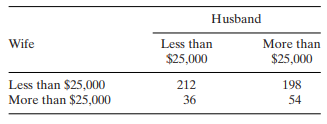
A total of 500 married working couples were polled about their annual salaries, with the following information resulting:

For instance, in 36 of the couples, the wife earned more and the husband earned less than \( 25,000. If one of the couples is randomly chosen, what is

(a) the probability that the husband earns less than \) 25,000 ?

(b) the conditional probability that the wife earns more than \( 25,000 given that the husband earns more than this amount?

(c) the conditional probability that the wife earns more than \) 25,000 given that the husband earns less than this amount?

Use Equation (2.1)to compute in a hand of bridge the conditional probability that East has 3spades given that North and South have a combined total of 8 spades.

Three cards are randomly selected, without replacement, from an ordinary deck of 52 playing cards. Compute the conditional probability that the first card selected is a spade given that the second and third cards are spades.

On rainy days, Joe is late to work with probability .3; on nonrainy days, he is late with probability .1. With probability .7, it will rain tomorrow.

(a) Find the probability that Joe is early tomorrow.

(b) Given that Joe was early, what is the conditional probability that it rained?

Die A has 4 red and 2 white faces, whereas die B has

2 red and 4 white faces. A fair coin is flipped once. If it

lands on heads, the game continues with die A; if it lands on tails, then die B is to be used.

(a) Show that the probability of red at any throw is 12

(b) If the first two throws result in red, what is the probability of red at the third throw?

(c) If red turns up at the first two throws, what is the probability

that it is die A that is being used?

See all solutions

Recommended explanations on Math Textbooks

View all explanations

What do you think about this solution?

We value your feedback to improve our textbook solutions.

Study anywhere. Anytime. Across all devices.