/*! This file is auto-generated */ .wp-block-button__link{color:#fff;background-color:#32373c;border-radius:9999px;box-shadow:none;text-decoration:none;padding:calc(.667em + 2px) calc(1.333em + 2px);font-size:1.125em}.wp-block-file__button{background:#32373c;color:#fff;text-decoration:none} Q8. How do economists distinguish be... [FREE SOLUTION] | ÷ÈÓ°Ö±²¥

÷ÈÓ°Ö±²¥

How do economists distinguish between the absolute and relative sizes of the public debt? Why is the distinction important? Distinguish between refinancing the debt and retiring the debt. How does an internally held public debt differ from an externally held public debt? Contrast the effects of retiring an internally held debt and retiring an externally held debt.

Short Answer

Expert verified

The absolute size of the public debt is the exact amount of debt held by the federal government. The relative size of the public debt is the public debt as a percentage of real GDP.

The distinction is important because the relative size gives a better international comparison and clear status of the economy.

Refinancing the debt is the selling of new bonds over the standing debt. Retiring the debt is buying back the bonds.

Internally held public debt comes from the domestic country bondholders. Externally held public debt comes from the foreign bondholders.

Retiring the internally held public debt creates unequal income distribution in the economy. Retiring the externally held debt leads to either the loss of foreign exchange reserve or domestic goods and services.

Step by step solution

01

Distinction between the absolute and relative size of the public debt

The absolute size of the public debt is the nominal amount that a country owes as the debt.It is the total deficits accumulated over time minus the surpluses.The public debt's relative size is expressed as the percentage of the economy's real GDP.

Relativesize=PublicDebtRealGDP×100

02

Need for the distinction

The distinction between the two methods for the measurement of public debt is crucial.The latter informs about repaying capacity of the economy. Also, the relative size gives a better international comparison. The total public debt's absolute size may sometimes overstate the problem, but relative size gives a clear picture.

For example, a public debt of $10 trillion for the U.S. federal government might seem huge. However, the total public debt relative to its GDP must be smaller than the other nations. And the U.S. economy must be capable of repaying its debt.

03

Distinction between refinancing and retiring the debt

Refinancing the debt means selling new bonds despite the existing loans at better terms.The funds from new bonds are used to pay off the previous debt. It is the overstanding of debt over the debt. The country can refinance the debt if the relative size is small, and the economy can repay further debts.

Retiring the debt is purchasing back the bonds by the federal government from those who hold the bonds. It can also be understood as the settling of the debt at maturity.

04

Distinction between internally held public debt and externally held public debt

An internally held public debt is when the bondholders belong to the domestic country. The bonds are transferred internally, and there is no foreign party involvement.

While the externally held public debt is when the debt process becomes overseas, the borrowers and bondholders belong to different economies. In externally held public debt, the exchange rate can vary due to the size of the debt.

05

Comparison between the effects of retiring an internal and an external public debt

Retiring an internally held public debt involves just purchasing back the bonds from the bondholders.The drawback of retiring an internally held public debt is equal income distribution.

The majority of the bondholders in an economy are the big business houses. Retiring of the debt transfers majority of the economy's income from lower-income groups (in the form of taxes) to the wealthier groups (repaying the debt). However, the money circulates inside the domestic country only.

Retiring an externally held public debt involves the exchange of currencies. Sometimes the foreign bondholders can ask for domestic products in exchange for the bonds.

Sometimes, the dollars gained in exchange for the bonds can be settled by the foreign exchange, declining the foreign exchange reserves of the home country. A decline in foreign exchange reserve can depreciate the domestic currency.

Unlock Step-by-Step Solutions & Ace Your Exams!

  • Full Textbook Solutions

    Get detailed explanations and key concepts

  • Unlimited Al creation

    Al flashcards, explanations, exams and more...

  • Ads-free access

    To over 500 millions flashcards

  • Money-back guarantee

    We refund you if you fail your exam.

Over 30 million students worldwide already upgrade their learning with ÷ÈÓ°Ö±²¥!

One App. One Place for Learning.

All the tools & learning materials you need for study success - in one app.

Get started for free

Most popular questions from this chapter

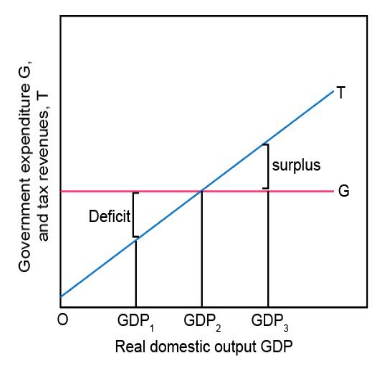
Define the cyclically adjusted budget, explain its significance, and state why it may differ from the actual budget. Suppose the full-employment, noninflationary level of real output is GDP3 (not GDP2) in the economy depicted in Figure 13.3. If the economy is operating at GDP2 instead of GDP3, what is the status of its cyclically adjusted budget? The status of its current fiscal policy? What change in fiscal policy would you recommend? How would you accomplish that in terms of the G and T lines in the figure?

Briefly state and evaluate the problem of time lags in enacting and applying fiscal policy. Explain the idea of a political business cycle. How might expectations of a near-term policy reversal weaken fiscal policy based on changes in tax rates? What is the crowding-out effect, and why might it be relevant to fiscal policy?

Why might economists be quite concerned if the annual interest payments on the US public debt sharply increase as a percentage of GDP?

What is the role of the Council of Economic Advisers (CEA) as it relates to fiscal policy? Use an Internet search to find the names and university affiliations of the present members of the CEA.

Last year, while a hypothetical economy was in a recession, government spending was \(595 billion, and government revenue was \)505 billion. Economists estimate that if the economy had been at its full employment level of GDP last year, government spending would have been \(555 billion and government revenue would have been \)550 billion. Which of the following statements about this government’s fiscal situation are true?

  1. The government has a non–cyclically adjusted budget deficit of \(595 billion.

  2. The government has a non–cyclically adjusted budget deficit of \)90 billion.

  3. The government has a non–cyclically adjusted budget surplus of \(90 billion.

  4. The government has a cyclically adjusted budget deficit of \)555 billion.

  5. The government has a cyclically adjusted budget deficit of \(5 billion.

  6. The government has a cyclically adjusted budget surplus of \)5 billion.

See all solutions

Recommended explanations on Economics Textbooks

View all explanations

What do you think about this solution?

We value your feedback to improve our textbook solutions.

Study anywhere. Anytime. Across all devices.