/*! This file is auto-generated */ .wp-block-button__link{color:#fff;background-color:#32373c;border-radius:9999px;box-shadow:none;text-decoration:none;padding:calc(.667em + 2px) calc(1.333em + 2px);font-size:1.125em}.wp-block-file__button{background:#32373c;color:#fff;text-decoration:none} Q10P PROBLEM 18-10Predict the product... [FREE SOLUTION] | ÷ÈÓ°Ö±²¥

÷ÈÓ°Ö±²¥

PROBLEM 18-10

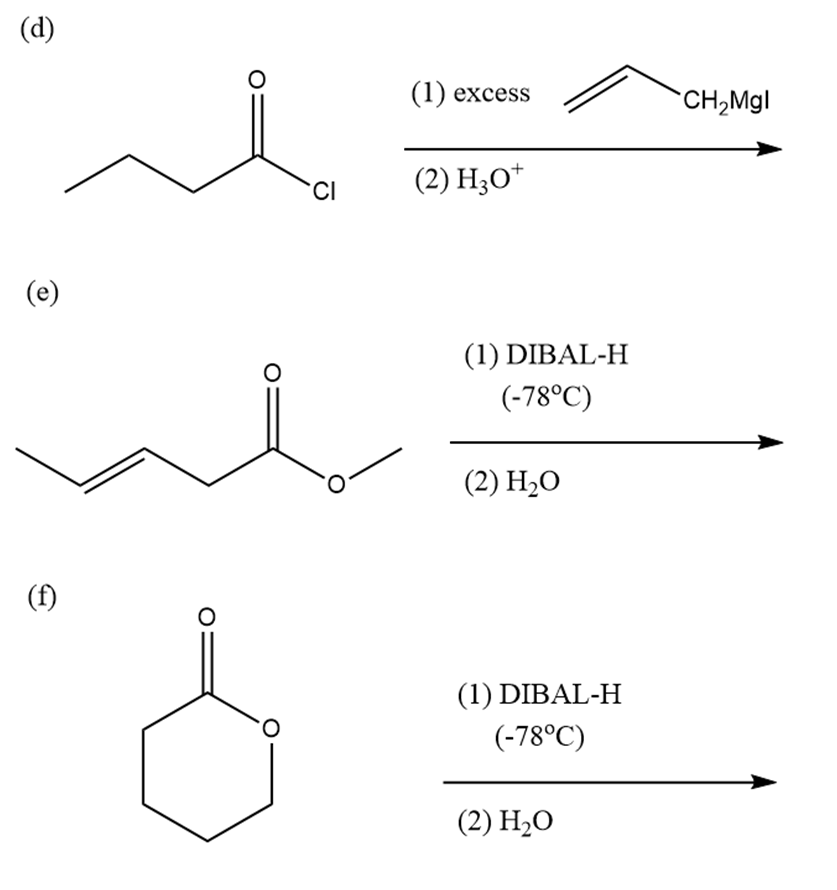
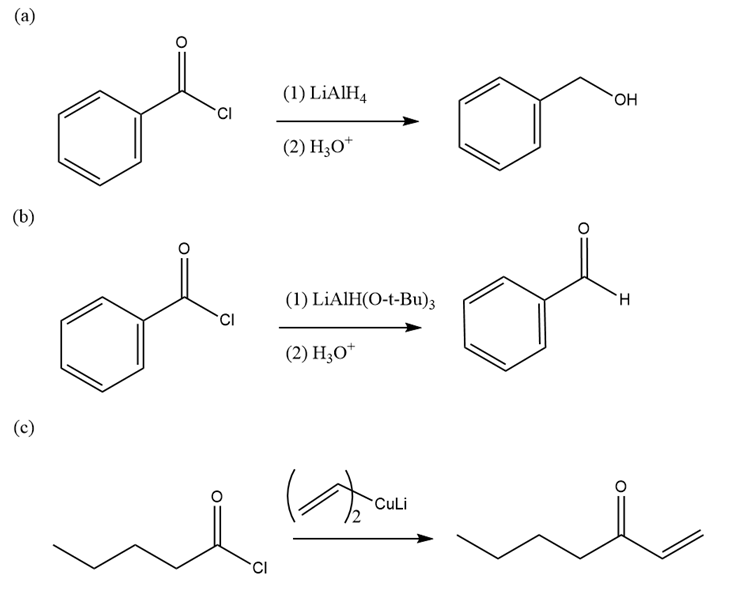
Predict the products of the following reactions:
Short Answer
Expert verified

LiAlH4 is a strong reducing agent that reduces aldehydes, ketones, acid chlorides to alcohol by donation of hydride ion (H-). LiAlH(O-t-Bu)3 is a mild reducing agent that reduces acid chloride to aldehyde instead of alcohol. DIBAL-H is also a reducing agent that reduces esters to aldehyde by donation of hydride ion (H-).

Step by step solution

01

Detailed Answer:Step 1: Theory of LiAlH4, LiAlH(O-t-Bu)3, and DIBAL-H

LiAlH4 is a strong reducing agent that reduces aldehydes, ketones, acid chlorides to alcohol by donation of hydride ion (H-). LiAlH(O-t-Bu)3 is a mild reducing agent that reduces acid chloride to aldehyde instead of alcohol. DIBAL-H is also a reducing agent that reduces esters to aldehyde by donation of hydride ion (H-).

02

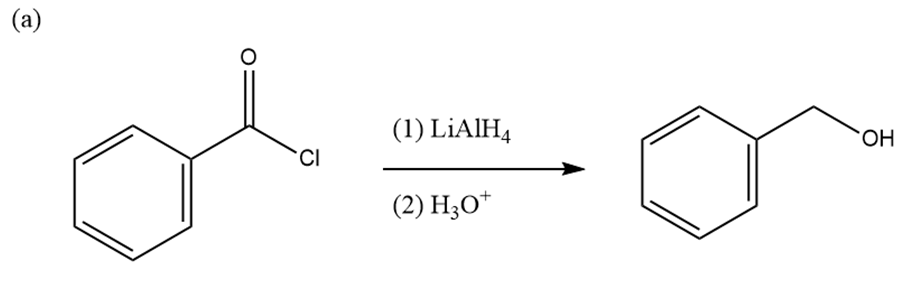
Detailed answer for part (a)

LiAlH4 is a strong reducing agent that reduces acid chloride that is benzoyl chloride to alcohol that is benzyl alcohol by donation of hydride ion (H-).
03

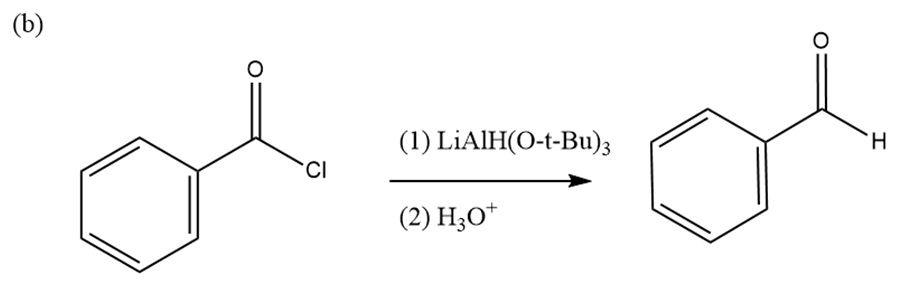
Detailed answer for part (b)

LiAlH(O-t-Bu)3 is a mild reducing agent that reduces benzoyl chlorideto benzaldehyde.
04

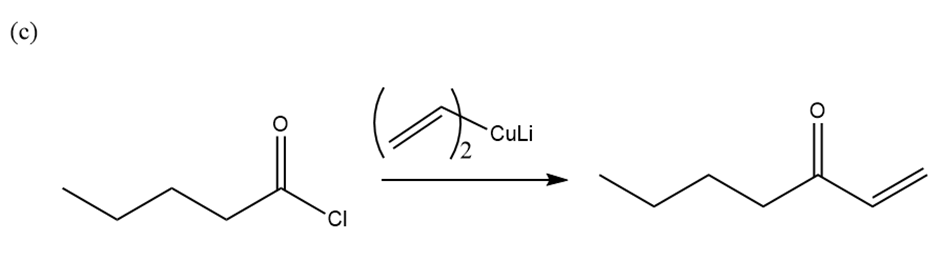
Detailed answer for part (c)

The organic part attached to copper is a vinyl anion that attacks the carbonyl carbon once to form the product as shown in the image:
05

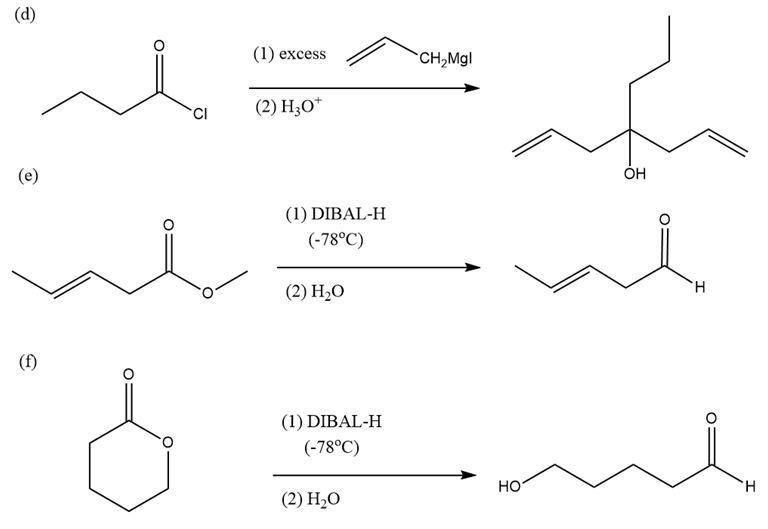
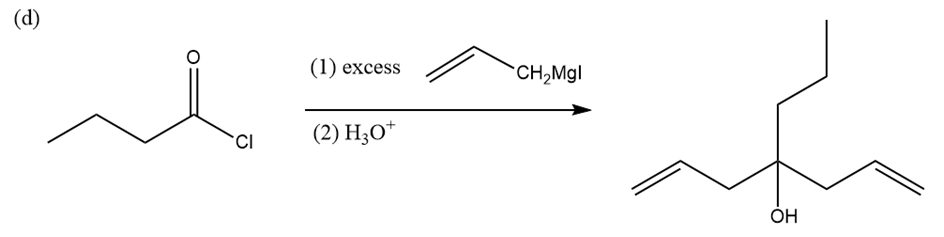
Detailed answer for part (d)

The organic part attached to magnesium is aallyl anion that attacks the carbonyl carbon twice as it is present in excess, followed by workup with water to form the alcohol as shown in the image:
06

Detailed answer for part (e)

DIBAL-H is also a reducing agent that reduces esters to aldehyde by donation of hydride ion (H-).

07

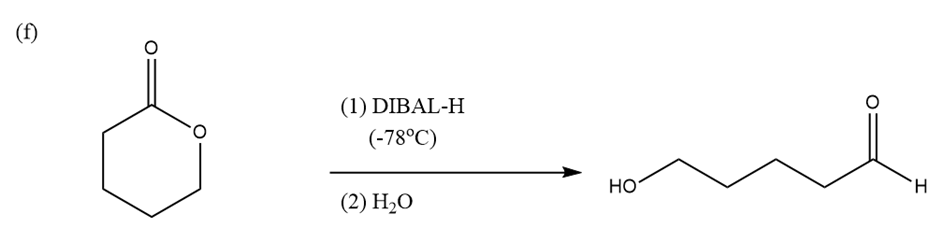
Detailed answer for part (f)

DIBAL-H is also a reducing agent that reduces esters to aldehyde by donation of hydride ion (H-). The hydride ion (H-) attacks the carbonyl carbon of the ester group and oxygen acts as a leaving group to finally form a open chain containing an aldehyde and alcoholic group as shown in the image:
Unlock Step-by-Step Solutions & Ace Your Exams!

  • Full Textbook Solutions

    Get detailed explanations and key concepts

  • Unlimited Al creation

    Al flashcards, explanations, exams and more...

  • Ads-free access

    To over 500 millions flashcards

  • Money-back guarantee

    We refund you if you fail your exam.

Over 30 million students worldwide already upgrade their learning with ÷ÈÓ°Ö±²¥!

One App. One Place for Learning.

All the tools & learning materials you need for study success - in one app.

Get started for free

Most popular questions from this chapter

Name the following ketones and aldehydes. When possible, give both a common name and an IUPAC name.

(a)CH3CO(CH2)4CH3 (b)CH3(CH2)2CO(CH2)2CH3 (c)CH3(CH2)CO(CH2)2CH3

(d)PhCOPh (e)CH3CH2CH2CHO (f)CH3COCH3

(g)CH3CH2CHBrCH2CH(CH3)CHO (h)Ph-CH=CH-CHO

(i)CH3CH=CH-CH=CH-CHO

(j) (k) (l)

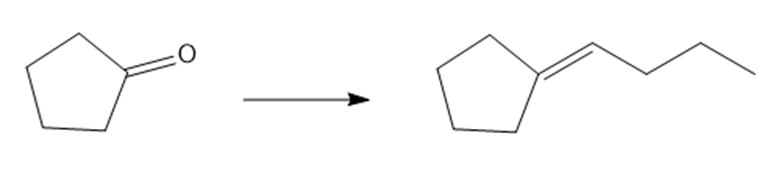
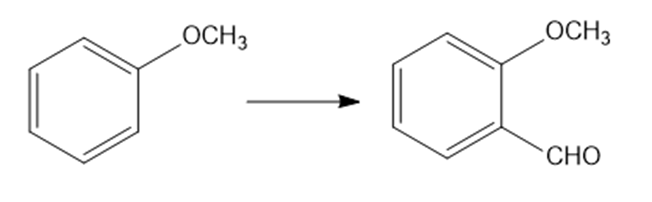
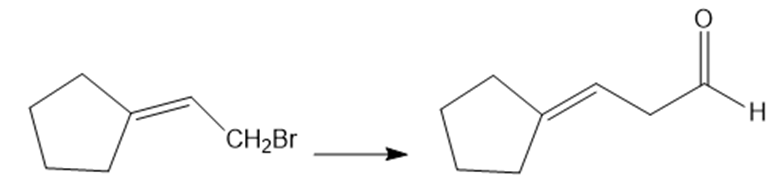
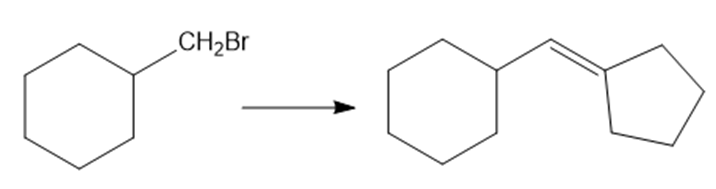
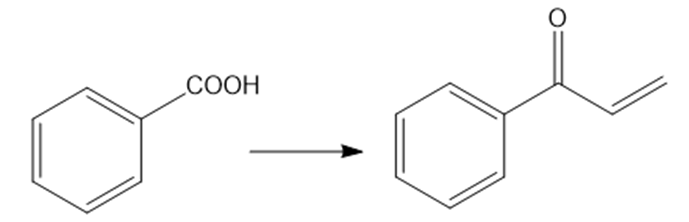
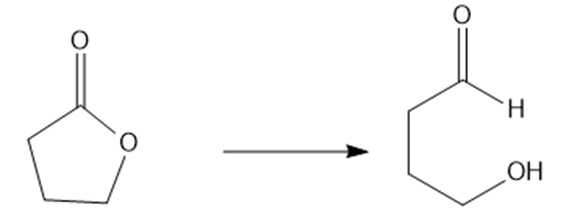
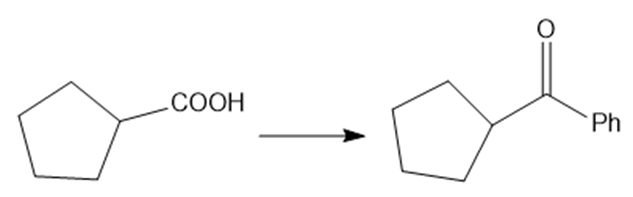
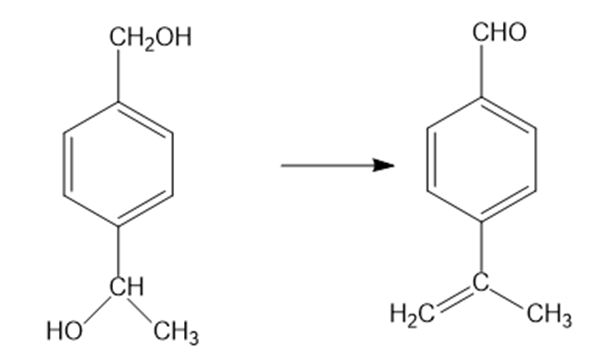
Show how you would accomplish the following synthetic conversions efficiently and in good yield. You may use any necessary additional reagents and solvents.

a.

b.

c.

d.

e.

f.

g.

h.

Both NaBH4 and NaBD4 are commercially available, and D2O is common and inexpensive. Show how you would synthesize the following labelled compounds, starting with propanone.

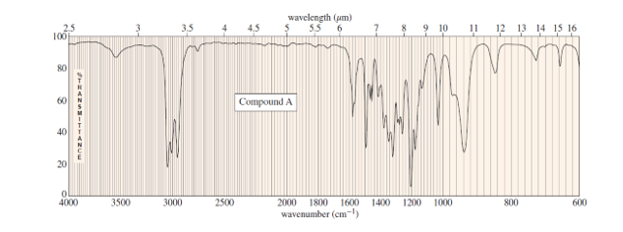
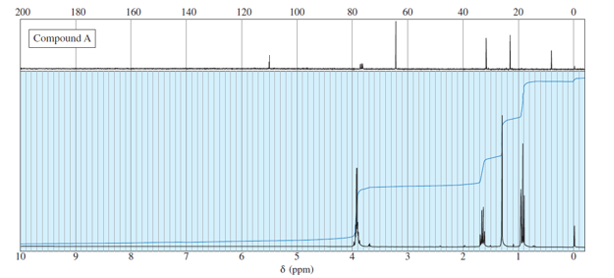
Question. The mass spectrum of unknown compound A shows a molecular ion at m/z 116 and prominent peaks at m/z 87 and m/z 101. Its UV spectrum shows no maximum above 200 nm. The IR and NMR spectra of A follow. When A is washed with dilute aqueous acid, extracted into dichloromethane , and the solvent evaporated, it gives a product B. B shows a strong carbonyl signal at 1715 cm-1in the IR spectrum and a weak maximum at 274nm(E =16) in the UV spectrum. The mass spectrum of B shows a molecular ion of m/z 72. Determine the structures of A and B, and show the fragmentation to account for the peaks at m/z 87 and 101.

(a) Propose a mechanism for the acid-catalyzed reaction of cyclohexanone with ethylene glycol to give cyclohexanone ethylene acetal.

(b) Propose a mechanism for the acid-catalyzed hydrolysis of cyclohexanone ethylene acetal.

(c) Compare the mechanisms you drew in parts (a) and (b). How similar are these mechanisms, comparing them in reverse order?

(d) Propose a mechanism for the acid-catalyzed hydrolysis of the acetal given in Problem 18-26(f).

See all solutions

Recommended explanations on Chemistry Textbooks

View all explanations

What do you think about this solution?

We value your feedback to improve our textbook solutions.

Study anywhere. Anytime. Across all devices.