Explanations
  Textbooks
  Flashcards
  魅影直播 AI
  Notes
Notes  Study Plans
  Study Sets
  Find a degree
  Magazine
 Chapter 22: Q1P (page 1151)
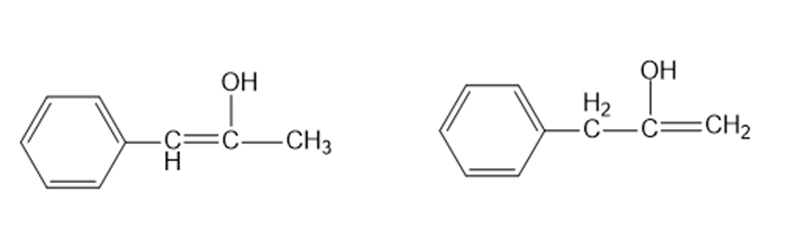
Phenylacetone can form two different enols.
- Show the structures of these enols.
- Predict which enol will be present in the larger concentration at equilibrium.
Short Answer
a.
b.
Step by step solution
Enols
Enols constitute an intermediate that is indicated as an alkene comprising hydroxyl group connected to one side of the alkene double bond. Popular kind of the tautomerism in organic chemistry is the keto-enol tautomerism. It constitutes a chemical equilibrium existing between a keto form (ketone or aldehyde) and enol form.
Different enol forms of phenylacetone
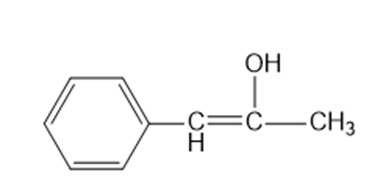
(a)The different enol forms of phenylacetone are 1-phenylprop-1-en-2-ol and 3-phenylprop-1-en-2-ol. The different enol forms result from the different position of the double bond in the molecule. The two different enol forms of phenylacetone are given as:
 Enol forms of phenylacetone
Predicting which enol will be present in the larger concentration at equilibrium
The structure which is more predominant at equilibrium is given below.
 Stable enol form
The given structure is more predominant at equilibrium as it has a double bond conjugated with the benzene ring which makes it more stable than the other structure.

Over 30 million students worldwide already upgrade their learning with 魅影直播!