/*! This file is auto-generated */ .wp-block-button__link{color:#fff;background-color:#32373c;border-radius:9999px;box-shadow:none;text-decoration:none;padding:calc(.667em + 2px) calc(1.333em + 2px);font-size:1.125em}.wp-block-file__button{background:#32373c;color:#fff;text-decoration:none} Q40P The following NMR spectra corres... [FREE SOLUTION] | ÷ÈÓ°Ö±²¥

÷ÈÓ°Ö±²¥

The following NMR spectra correspond to the compound of formula (A) C9H10O2, (B) C4H6O2, C6H10O2 . Propose structure, and show how it is consistent with the observed absorptions.

Short Answer
Expert verified

(a) The organic compound can be identified by studying magnetic behavior. This technique is nuclear magnetic resonance spectroscopy or NMR spectroscopy.

This method helps us to find the structure and molecular formula of any organic compound.

Step by step solution

01

About NMR spectra

(a) The organic compound can be identified by studying magnetic behavior. This technique is nuclear magnetic resonance spectroscopy or NMR spectroscopy.

This method helps us to find the structure and molecular formula of any organic compound.

02

About the given spectra

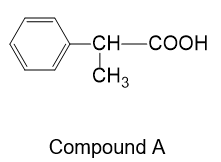
The given compound A has the chemical shift values 11.8 ppm, 7.3 ppm, 3.8 ppm, and 1.5 ppm. The given compound bears 5 elements of unsaturation. The hydrogen sets are 1H, 5H, 1H, and 3H.

03

About the structure

The chemical shift value of 11.8 ppm with 1H corresponds to the COOH group. The chemical shift value of 7.3 ppm with 5H corresponds to the mono-substituted benzene ring.

The chemical shift value 3.8 ppm with 1H with quartet corresponds to the CHCH3group. The chemical shift value 1.5 ppm with 3H with doublet corresponds to the CHCH3 group. Thus, the chemical structure of compound A is:
04

About the given spectra

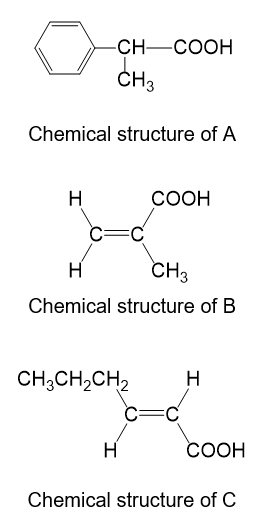
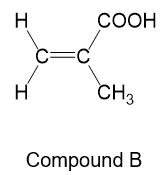
(b) The given compound B has the chemical shift values 12.1 ppm, 6.2 ppm, 5.7 ppm, and 1.9 ppm. The given compound bears 2 elements of unsaturation. The hydrogen sets are 1H, 1H, 1H, and 3H.

05

About the structure

The chemical shift value of 12.1 ppm with 1H corresponds to the COOH group. The chemical shift value 6.2 ppm with 1H corresponds to the H-C=C and it is a singlet. The chemical shift value 5.7 ppm with 1H with singlet corresponds to the H-C=C.

The chemical shift value 1.9 ppm with 3H with singlet corresponds to the vinyl CH3 group. Thus, the chemical structure of compound B is:
06

About the given spectra

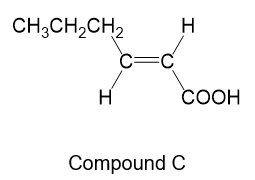
(c) The given compound C has the chemical shift values 12.15 ppm, 7.1 ppm, 5.8 ppm, and 2.2-0.9 ppm. The given compound bears 2 elements of unsaturation. The hydrogen sets are 1H, 1H, and 1H.

07

About the structure

The chemical shift value of 12.15 ppm with 1H corresponds to the COOH group. The chemical shift value 7.1 ppm with 1H corresponds to the H-C=C-COOH and it is a multiplet.

The chemical shift value 5.8 ppm with 1H with doublet corresponds to the C=C(H)COOH. The chemical shift value 2.2-0.9 ppm corresponds to the vinyl CH2CH2CH3 group. Thus, the chemical structure of compound C is:
Unlock Step-by-Step Solutions & Ace Your Exams!

  • Full Textbook Solutions

    Get detailed explanations and key concepts

  • Unlimited Al creation

    Al flashcards, explanations, exams and more...

  • Ads-free access

    To over 500 millions flashcards

  • Money-back guarantee

    We refund you if you fail your exam.

Over 30 million students worldwide already upgrade their learning with ÷ÈÓ°Ö±²¥!

One App. One Place for Learning.

All the tools & learning materials you need for study success - in one app.

Get started for free

Most popular questions from this chapter

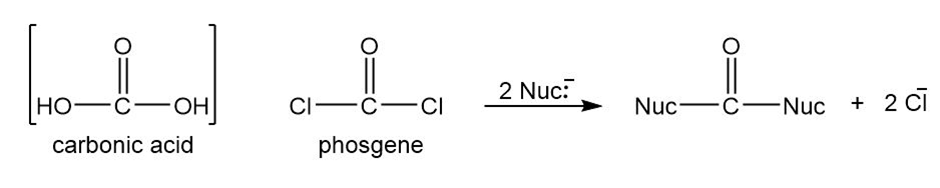
Phosgene is the acid chloride of carbonic acid. Although phosgene was used as a war gas in World War I, it is now used as a reagent for the synthesis of many useful products. Phosgene reacts like other acid chlorides, but it can react twice.

(a) Predict the products formed when phosgene reacts with excess propan-1-ol.

(b) Predict the products formed when phosgene reacts with 1 equivalent of ethanol, followed by 1 equivalent of aniline.

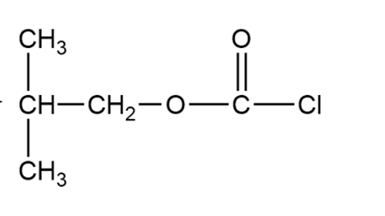
(c) Iso-butyloxycarbonyl chloride is an important reagent for the synthesis of peptides and proteins. Show how you would use phosgene to synthesize iso-butyloxycarbonyl chloride.

Isobutyloxycarbonyl chloride

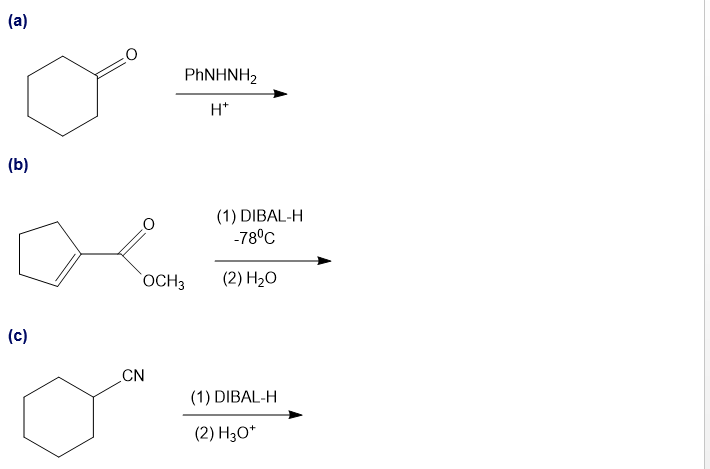
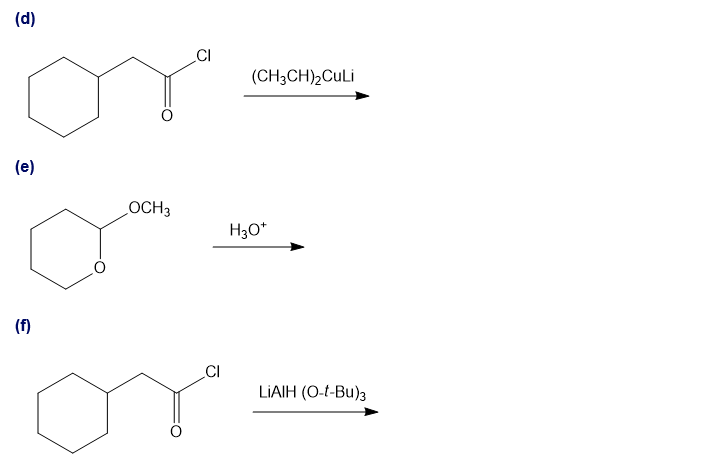
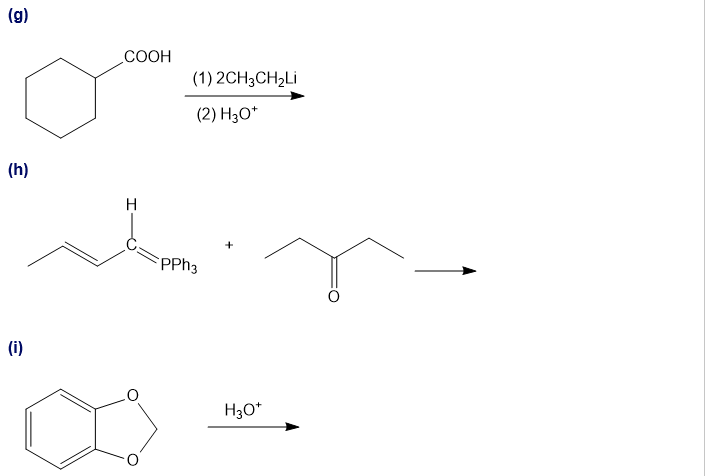
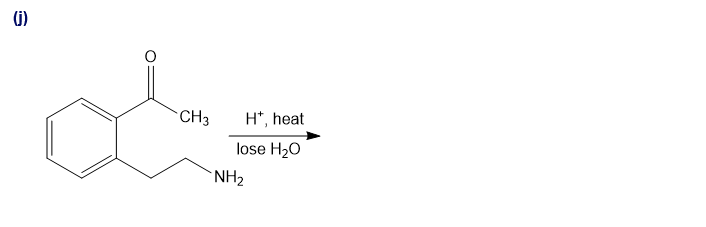
Predict the major products of the following reactions.

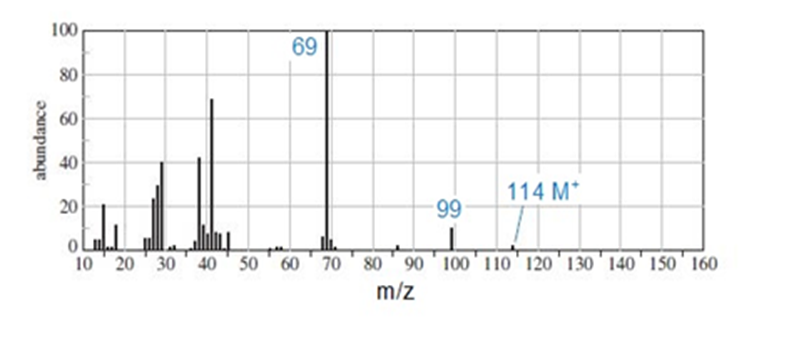
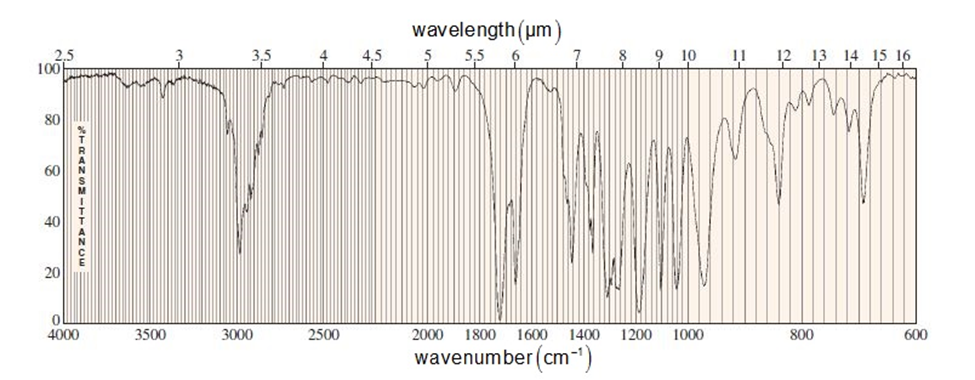
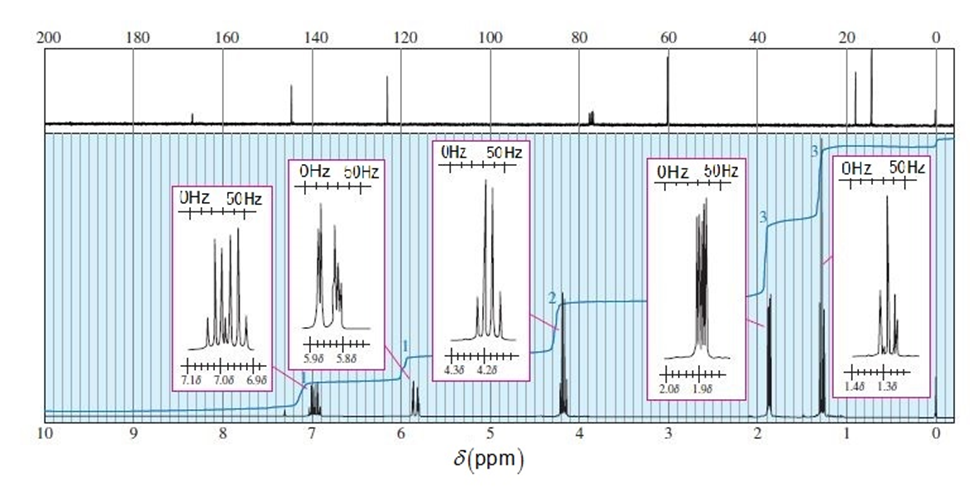
An unknown compound gives the NMR, IR, and mass spectra shown next. Propose a structure, and show how it is consistent with the observed absorptions. Show fragmentations that account for the prominent ion at m/z69 and the smaller peak at m/z99.

Classify each hydrogen atom in the following compounds as primary (10),secondary(20) , or tertiary(30).

(a) butane

(b) isobutane

(c) 2-methylbutane

(d) cyclohexane

(e) norbornane (bicyclo heptane)

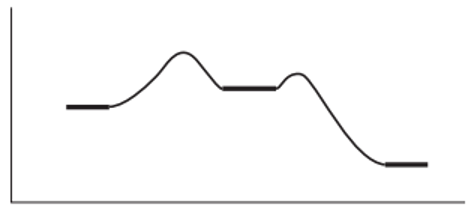
Consider the following reaction-energy diagram.

(a) Label the reactants and the products. Label the activation energy for the first step and the second step.

(b) Is the overall reaction endothermic or exothermic? What is the sign of ?

(c) Which points in the curve correspond to intermediates? Which correspond to transition states?

(d) Label the transition state of the rate-limiting step. Does its structure resemble the reactants, the products, or an intermediate?

See all solutions

Recommended explanations on Chemistry Textbooks

View all explanations

What do you think about this solution?

We value your feedback to improve our textbook solutions.

Study anywhere. Anytime. Across all devices.