/*! This file is auto-generated */ .wp-block-button__link{color:#fff;background-color:#32373c;border-radius:9999px;box-shadow:none;text-decoration:none;padding:calc(.667em + 2px) calc(1.333em + 2px);font-size:1.125em}.wp-block-file__button{background:#32373c;color:#fff;text-decoration:none} Q10 E A medical laboratory catalog des... [FREE SOLUTION] | ÷ÈÓ°Ö±²¥

÷ÈÓ°Ö±²¥

A medical laboratory catalog describes the pressure in a cylinder of gas as 14.82MPa. What is the pressure of this gas in atmospheres and torr?

Short Answer

Expert verified
  1. 14.82 × 10⁶ Pa = 111, 150 Torr
  2. 14.82 × 10⁶ Pa = 146.2620 atm

Step by step solution

01

Define pressure

Force applied perpendicular to an object's surface per unit area across which that force is spread is known as pressure.

02

Explanation

Converting M Pa into Pa,

1MPa = 106 Pa

14.82 MPa = (14.82) × (106) Pa

= 14.82 × 10⁶ Pa

  1. Converting Pa pressure into torr

1Pa = 0.0075 Torr

14.82 × 10⁶ Pa = (14.82 × 106) × (0.0075) Torr

= 111,150 Torr

Therefore, 14.82 × 10⁶ Pa is equal to 111,150 Torr

  1. Converting Pa pressure into atm

1 Pa = 9.869 × 10⁻⁶atm

14.82 × 10⁶ Pa = (14.82 × 10⁶) (9.869 × 10⁻⁶) atm

= 146.2620 atm

Therefore, 14.82 × 10⁶ Pa is equal to 146.2620 atm

Unlock Step-by-Step Solutions & Ace Your Exams!

  • Full Textbook Solutions

    Get detailed explanations and key concepts

  • Unlimited Al creation

    Al flashcards, explanations, exams and more...

  • Ads-free access

    To over 500 millions flashcards

  • Money-back guarantee

    We refund you if you fail your exam.

Over 30 million students worldwide already upgrade their learning with ÷ÈÓ°Ö±²¥!

One App. One Place for Learning.

All the tools & learning materials you need for study success - in one app.

Get started for free

Most popular questions from this chapter

As stated in the text, convincing examples that demonstrate the law of conservation of matter outside of the laboratory are few and far between. Indicate whether the mass would increase, decrease, or stay the same for the following scenarios where chemical reactions take place:

(a) Exactly one pound of bread dough is placed in a baking tin. The dough is cooked in an oven at 350 °F releasing a wonderful aroma of freshly baked bread during the cooking process. Is the mass of the baked loaf less than, greater than, or the same as the one pound of original dough? Explain.

(b) When magnesium burns in air a white flaky ash of magnesium oxide is produced. Is the mass of magnesium oxide less than, greater than, or the same as the original piece of magnesium? Explain.

(c) Antoine Lavoisier, the French scientist credited with first stating the law of conservation of matter, heated a mixture of tin and air in a sealed flask to produce tin oxide. Did the mass of the sealed flask and contents decrease, increase, or remain the same after the heating?

Identify each of the underlined items as a part of either the macroscopic domain, the microscopic domain, or the symbolic domain of chemistry. For those in the symbolic domain, indicate whether they are symbols for a macroscopic or a microscopic feature.

(a) A certain molecule contains one H atom and one Cl atom.

(b) Copper wire has a density of about 8g/cm3.

(c) The bottle contains 15 grams of Ni powder.

(d) A sulfur molecule is composed of eight sulfur atoms.

Question: Calculate these masses

a) What is the mass of 4.00 cm3 of Sodium, density = 0.97 g/cm3?

b) What is the mass of 125 mL gaseous chlorine, density = 3.16 g/L?

Question: The mercury content of a stream was believed to be above the minimum considered safe – 1 part per billion (ppb) by weight. An analysis indicated that the concentration was 0.68 parts per billion. What quantity of mercury in grams was present in 15.0 L of the water, the density of which is 0.998 g/ml? \(\left( {1ppbHg = \frac{{1ngHg}}{{1gwater}}} \right)\)

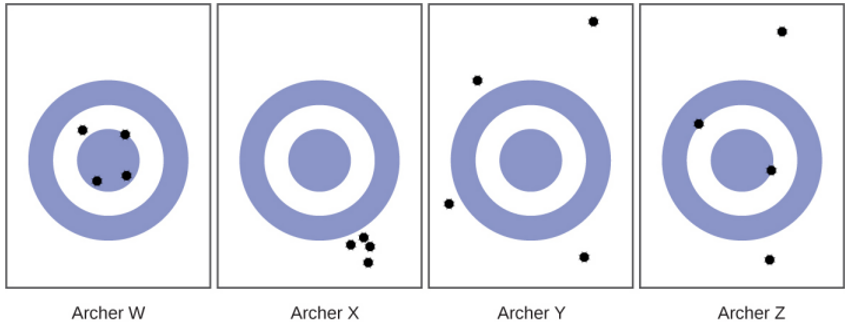
Consider the results of the archery contest shown in this figure.

(a) Which archer is most precise?

(b) Which archer is most accurate?

(c) Who is both least precise and least accurate?

See all solutions

Recommended explanations on Chemistry Textbooks

View all explanations

What do you think about this solution?

We value your feedback to improve our textbook solutions.

Study anywhere. Anytime. Across all devices.