Chapter 18: Q. 18.31 (page 635)
Write the overall equation for the conversion of pyruvate to ?
Short Answer
The overall equation for the conversion is
/*! This file is auto-generated */ .wp-block-button__link{color:#fff;background-color:#32373c;border-radius:9999px;box-shadow:none;text-decoration:none;padding:calc(.667em + 2px) calc(1.333em + 2px);font-size:1.125em}.wp-block-file__button{background:#32373c;color:#fff;text-decoration:none}
Learning Materials
Features
Discover
Chapter 18: Q. 18.31 (page 635)
Write the overall equation for the conversion of pyruvate to ?
The overall equation for the conversion is
All the tools & learning materials you need for study success - in one app.
Get started for free
Lauric acid is a fatty acid found in coconut oil.
a. How many cycles of oxidation are needed for the complete oxidation of lauric acid?
b. How many acetyl CoA are produced from the complete oxidation of lauric acid?
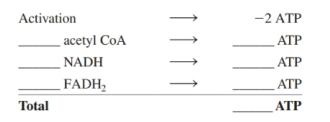
c. Calculate the total ATP yield from the complete oxidation of lauric acid by completing the following:

What is the ATP energy yield associated with each of the following?
a.
b. localid="1653514463841"
c.
d.
What are the products from one turn of the citric acid cycle?
According to the chemiosmotic theory, how does the gradient provide energy to synthesize?
Which of the following molecules will produce the most ATP per mole?
a. glucose or stearic acid
b. glucose or two pyruvate
c. two acetyl or one palmitic acid
d. lauric acid or palmitic acid
e. or fumarate in one turn of the citric acid cycle." width="9">
What do you think about this solution?
We value your feedback to improve our textbook solutions.